The fine line between protection and control, and when help becomes hinderance: Autonomy vs. Paternalism

Anomalism

Diamond Member
Joined
Dec 1, 2020
Messages
11,633
Reaction score
8,775
Points
2,138
Some left-leaning policy positions carry a kind of well-intentioned paternalism that ends up treating adults as if they can't make their own decisions. It shows up in arguments that dismiss voluntary agreements simply because one party is “desperate." As if desperation alone makes people incapable of rational thought. Whether it’s low-wage labor, sex work, or tough working conditions, the underlying assumption is “If someone wouldn’t choose this in ideal circumstances, then society must step in and ban or regulate it.” But real life is full of non-ideal circumstances. People make tradeoffs all the time, and removing their ability to make those decisions doesn’t protect them, it limits them. In effect, it says “You’re too vulnerable to know what’s best for you, so we’ll decide for you.” That’s not compassion; that’s control.

This mindset can even extend into economics. For example, opposing gig work because it’s not secure enough, or pushing to outlaw certain jobs unless they meet someone else's idea of fairness. Who defines fairness, and what about the person who loses a real opportunity because it didn’t meet an ideological purity test? The irony is that this kind of top-down protection often ends up disempowering the very people it claims to help. In trying to eliminate risk, it erases agency. When we start invalidating consent based on circumstance, we walk a fine line, because by that logic, even consensual sex, relationships, or housing arrangements could be deemed coercive if one person has fewer options than another. In trying to remove power imbalances, we risk removing autonomy altogether.
 
Last edited:
Conjecture 8
Examples 0
The post already included examples like low-wage labor, sex work, and gig economy jobs, where people often make trade offs due to economic realities rather than ideal conditions. Another example is housing. Regulations or policies that attempt to “protect” renters by limiting certain contracts or price agreements sometimes restrict people’s ability to negotiate terms that suit their immediate needs.

Similarly, in healthcare, paternalistic policies that remove choice or impose one-size-fits-all solutions can undermine patient autonomy. These examples highlight how overprotection can slide into control, removing people’s freedom to make decisions in less than perfect circumstances.
 
The post already included examples like low-wage labor, sex work, and gig economy jobs, where people often make trade offs due to economic realities rather than ideal conditions. Another example is housing. Regulations or policies that attempt to “protect” renters by limiting certain contracts or price agreements sometimes restrict people’s ability to negotiate terms that suit their immediate needs.

Similarly, in healthcare, paternalistic policies that remove choice or impose one-size-fits-all solutions can undermine patient autonomy. These examples highlight how overprotection can slide into control, removing people’s freedom to make decisions in less than perfect circumstances.
Those are not specific examples. Just generalities.
 
Some left-leaning policy positions carry a kind of well-intentioned paternalism that ends up treating adults as if they can't make their own decisions. It shows up in arguments that dismiss voluntary agreements simply because one party is “desperate." As if desperation alone makes people incapable of rational thought. Whether it’s low-wage labor, sex work, or tough working conditions, the underlying assumption is “If someone wouldn’t choose this in ideal circumstances, then society must step in and ban or regulate it.” But real life is full of non-ideal circumstances. People make tradeoffs all the time, and removing their ability to make those decisions doesn’t protect them, it limits them. In effect, it says “You’re too vulnerable to know what’s best for you, so we’ll decide for you.” That’s not compassion; that’s control.

This mindset can even extend into economics. For example, opposing gig work because it’s not secure enough, or pushing to outlaw certain jobs unless they meet someone else's idea of fairness. Who defines fairness, and what about the person who loses a real opportunity because it didn’t meet an ideological purity test? The irony is that this kind of top-down protection often ends up disempowering the very people it claims to help. In trying to eliminate risk, it erases agency. When we start invalidating consent based on circumstance, we walk a fine line, because by that logic, even consensual sex, relationships, or housing arrangements could be deemed coercive if one person has fewer options than another. In trying to remove power imbalances, we risk removing autonomy altogether.
Dial it back a bit for now. The forum is too busy for spending time readinig two long paragraphs. Put it in one, for your own sake.
{like as if you don't understand that fascism is at the crossroads in America?)
 
In effect, it says “You’re too vulnerable to know what’s best for you, so we’ll decide for you.” That’s not compassion; that’s control.
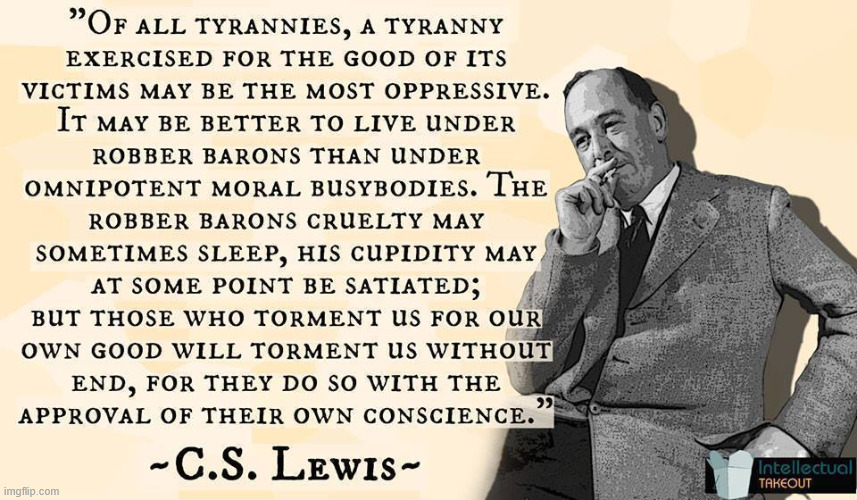
Yup. And often control that just so happens to address ulterior motives that have nothing to do with protecting the hapless.
 
a0qj32.jpg
 
Some left-leaning policy positions carry a kind of well-intentioned paternalism that ends up treating adults as if they can't make their own decisions. It shows up in arguments that dismiss voluntary agreements simply because one party is “desperate." As if desperation alone makes people incapable of rational thought. Whether it’s low-wage labor, sex work, or tough working conditions, the underlying assumption is “If someone wouldn’t choose this in ideal circumstances, then society must step in and ban or regulate it.” But real life is full of non-ideal circumstances. People make tradeoffs all the time, and removing their ability to make those decisions doesn’t protect them, it limits them. In effect, it says “You’re too vulnerable to know what’s best for you, so we’ll decide for you.” That’s not compassion; that’s control.

This mindset can even extend into economics. For example, opposing gig work because it’s not secure enough, or pushing to outlaw certain jobs unless they meet someone else's idea of fairness. Who defines fairness, and what about the person who loses a real opportunity because it didn’t meet an ideological purity test? The irony is that this kind of top-down protection often ends up disempowering the very people it claims to help. In trying to eliminate risk, it erases agency. When we start invalidating consent based on circumstance, we walk a fine line, because by that logic, even consensual sex, relationships, or housing arrangements could be deemed coercive if one person has fewer options than another. In trying to remove power imbalances, we risk removing autonomy altogether.
The Founders to a man were NOT into paternalism. They understood that liberty required allowing people to form whatever sorts of societies they want to have, live as they wanted to live short of violating another's unalienable right, They would inevitably at things wrong, make mistakes.

They also believed people with that liberty would mostly correct their mistakes, figure out how to right wrongs, become better. Most especially if those were mostly religious and moral people.

They understood that some would accomplish more and do better than others, but liberty also allows for the cream to rise to the top and doesn't force it to linger behind as everybody else catches up.
 
Dial it back a bit for now. The forum is too busy for spending time readinig two long paragraphs. Put it in one, for your own sake.
{like as if you don't understand that fascism is at the crossroads in America?)
That's really not that much text I think. Some ideas need to be fleshed out to be properly represented and understood. Not everything can be reduced to a few sentences.
 
Fine if you're happy with the replies you got? without mine you might have gotten none. That's how it works on this clusterfuk.

I'm interested in what you have to say but I don't have time right now. (the Epstein and Obama things)
 
Fine if you're happy with the replies you got? without mine you might have gotten none. That's how it works on this clusterfuk.

I'm interested in what you have to say but I don't have time right now. (the Epstein and Obama things)
Absorbing and responding to information can be exhausting, especially if you're trying to do it honestly. No hard feelings.
 
Absorbing and responding to information can be exhausting, especially if you're trying to do it honestly. No hard feelings.
I regret having to put you on the backburner. You seemed to have found a way to make what I see as fascism, quite acceptable.

I'm sure you honestly see it as conservatism.

I'll try to find you later and think up something to debate.
 
I think he might be trying to say my post sent him into narrative shock. He is possibly trying to stabilize his belief structure.

Donald H

If this is true, I suggest you sit with the discomfort rather than dismissing it.
 
15th post
Can you elaborate on what you meant before? I'm curious.
Me too. I've not seen anything you've posted that was promoting fascism. Maybe he's using a "very special" definition.
 
I regret having to put you on the backburner. You seemed to have found a way to make what I see as fascism, quite acceptable.

I'm sure you honestly see it as conservatism.

I'll try to find you later and think up something to debate.
Huh? I've said lots of things before. Be specific if you're seriious. I'm still interested in talking to you too.
The post I quoted above is the one I'm curious about. Can you elaborate? What did you mean by making fascism quite acceptable? Is there anything in my OP you'd like to critique?
 
The post I quoted above is the one I'm curious about. Can you elaborate? What did you mean by making fascism quite acceptable? Is there anything in my OP you'd like to critique?
Wasn't it us that talked about the definition of fascism and wasn't it you who seemed to agree that defined Trump?

Rather than trying to guess at the specific issue that you're trying to pursue, I can just say that Trump has demonstrated his fascist leaning hundreds of time.

I would see 1srelluc's latest post (thread) as a Trump demonstration of fascism. It's a demonstration of him overstepping his authority. IF he can do that, then is there anything that he can't do?
 
Back
Top Bottom