People are already experimenting with things like car paint that acts like a solar panel..
It’ll never fly becouse effective area will not be more than two-three square meters, and if the paint has an efficiency of 30% (which is very much), then the cars will have "the installed power of solar charging" 600 -900Wh
Sure, the math doesn't add up now, but they're working on it, not just complaining like you folks here.
I agree and I "don't mind" an electric vehicle, Tesla or renewable energy sources, I'm just trying to say that an electric car isn't a threat to the "oil reserves".
24% is the theoretical maximum efficiency for solar modules. This should increase as technology improves, but over the last 30 years it hasn't. My system (which I grant you is ancient) only produces around 11% efficiency, and that on a good day.
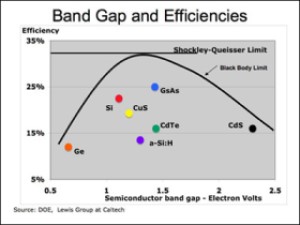
Again Mr. Westwall demonstrates his ignorance, or intent to lie. Max efficiency for a silicon single junction panel is about 30%
Solar Efficiency Limits
Junctions & Band Gaps page. The best modern production silicon cell efficiency is 24% at the cell level and 20% at the module level as reported by SunPower in March of, 2012. In a laboratory, the record solar cell efficiency is held by the University Of New South Wales in Sydney, Australia at 25%.
There are a number of assumptions associated with the SQ Limit that restrict its general applicability to all types of solar cells. Although there are numerous programs underway to find ways around the SQ Limit, it is still applicable to 99.9% of the solar cells on the market today.
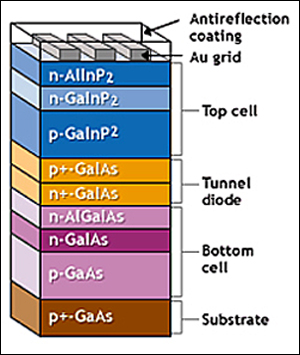
The earliest and most frequent work around to the SQ Limit has been the use of multiple p/n junctions, each one tuned to a different frequency of the solar spectrum. Since sunlight will only react strongly with band gaps roughly the same width as their wavelength, the top layers are made very thin so they are almost transparent to longer wavelengths. This allows the junctions to be stacked, with the layers capturing the shortest wavelengths on top, and the longer wavelength photons passing through them to the lower layers.
The example of a multi-junction cell on the left has a top cell of gallium indium phosphide, then a "tunnel diode junction", and a bottom cell of gallium arsenide. The tunnel junction allows the electrons to flow between the cells and keeps the electric fields of the two cells separate. Most of today's research in multi-junction cells focuses on gallium arsenide as one of the component cells as it has a very desirable band gap.
Performing a calculation using the SQ methodology; a two-layer cell can reach a maximum theoretical efficiency of 42% and three-layer cells 49%. The record for a multi-junction cell is held by the University Of New South Wales (UNSW) in Sydney, Australia at 43% using a five cell tandem approach. However, the UNSW tandem cell is very expensive. In addition to the cost issue, there are other constraints that make the tandem cells complex. For example, all the layers must be lattice compatible with one another in their crystalline structure and the currents from each individual cell must match the other cells. Multi-junction cells are commercially used in only special applications because their expense currently outweighs any efficiency improvement. At the moment they are used in space where weight is most important and in concentrated PV systems where the sunlight is focused on a very small cell area requiring only small amounts of semiconductors per cell.
Multi-junction cells too expensive and difficult to manufacture at present, but a 43% efficient cell would definitely be a game changer.