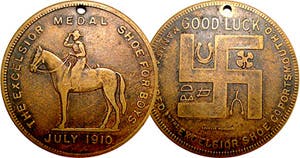
Swatstika Use Prior to WW2

presonorek

Gold Member
Joined
Jun 7, 2015
Messages
7,865
Reaction score
1,236
Points
140
Location
Lynchburg, Virginia
Today I found a church in Lynchburg Virginia with a few swastikas on the floor of a brick walkway between buildings. I knew there had to be some better explanation than this church was a group of radical German sympathizers during World War 2. So did a little digging but not a whole lot. This is one article I found that explained it a little bit.

For background this church was built in 1925 which was 16 years before the beginning of World War2. The Nazi Party was already using the symbol by 1925 but the Nazi Party was known the way it was later to become known.

 
Last edited:
Today I found a church in Lynchburg Virginia with a few swastikas on the floor of a brick walkway between buildings. I knew there had to be some better explanation than this church was a group of radical German sympathizers during World War 2. So did a little digging but not a whole lot. This is one article I found that explained it a little bit.

For background this church was built in 1925 which was 16 years before the beginning of World War2. The Nazi Party was already using the symbol by 1925 but the Nazi Party was known the way it was later to become known.

I think there used to be US Army division with the swastika as its emblem.
 
I have several books by Kipling 1900's editions which have the Swastika on their covers. Indian Sacred Symbol.

In Hinduism, the swastika (स्वस्तिक) is a sacred and auspicious symbol with deep religious and cultural significance. It is primarily known as a symbol of good luck, prosperity, and well-being. The right-facing swastika (clockwise) is the more commonly used and recognized version in Hinduism, while the left-facing one (counter-clockwise) is also used, often associated with the night, the goddess Kali, and tantric practices.

Here's a more detailed look:
  • Right-facing swastika:
    In Hinduism, the right-facing swastika is a solar symbol, representing the sun's movement and often associated with deities like Vishnu and Surya. It symbolizes prosperity, auspiciousness, and good fortune.

  • Left-facing swastika:
    While less common, the left-facing swastika is also used in Hinduism, typically linked to the goddess Kali and her tantric aspects, representing night and magical practices.

  • Multiple interpretations:
    The swastika's four arms can be interpreted in various ways, such as representing the four Vedas, the four goals of life (Dharma, Artha, Kama, Moksha), the four seasons, or the four directions.

  • Not inherently evil:
    The swastika, in its Hindu context, is a positive and benevolent symbol, predating its appropriation by the Nazi regime. The Nazi symbol, known as the Hakenkreuz, is a variation of the swastika with angled arms, and is not the same as the Hindu swastika.

  • Widely used:
    The swastika is a common sight in Hindu temples, homes, and during religious ceremonies, marking auspicious occasions and new beginnings.

  • Greg
 
clinic1113.jpg
 
Back
Top Bottom