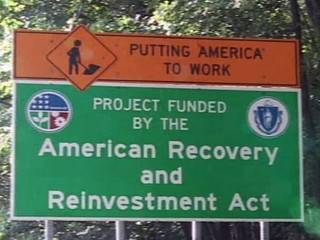
Well, I know it's working around me. Lot of roadwork going on because of it.
About time, too.
So you are OKAY with the idea of redoing your bathroom at a cost of 10,000 even though you are broke?
I am glad to see we will have pretty streets to drive on next year...as we drive to the unemployment office and continue to pay 500 million dollars a day in intertest to those that lent us the money for pretty streets.
Pathetic.
Really dumb. Roads represent investments. Just as the buildings and improvements built by the WPA and CCC in the last depression are still in use, those roads will be there and making money for all of us as the market comes back.
I traveled through Oregon, Idaho, Montana, Wyoming, North Dakota, South Dakota, and Utah this summer, and saw needed work going on in all of those states. People working at jobs that created infrastructure that will be used by all of us for many decades to come.
http://www.usnews.com/articles/news...-amount-to-major-infrastructure-overhaul.html
Describing the $787 billion stimulus package, President Obama evokes the 1950s construction of the interstate system, conjuring images of highways, bridges, and orange cones. "Throughout our history, there have been times when a generation of Americans seized the chance to remake the face of this nation," he said last month. "And that's what we're doing today: building a 21st-century infrastructure.
But as projects are chosen, it's becoming clear that the program may amount to little more than an infrastructure face-lift. Owing to the need for speed and to institutional obstacles, most stimulus transportation projects are small and localized. "Here and there, people will notice things," says Robert Poole, director of transportation policy at the libertarian Reason Foundation. He cites repaired potholes and new streetlights. "But I don't think the country as a whole will say, 'Wow, transportation is so much better,' " Poole says.
This stems from the law's main purpose: creating jobs quickly. It prioritizes projects that will be completed within three years. Major highway construction typically takes 13 years from start to finish, reports the Federal Highway Administration.
So more than three quarters of the approved highway projects' funds will go to repaving and widening roads, while less than 6 percent will pay for new construction, according to the investigative nonprofit ProPublica. Other reports show that smaller, rural projects, like bridges, often receive funding priority over those that might get more traffic, largely because they can be launched more quickly.
That doesn't necessarily make the spending ineffective. One quarter of major urban roads, for example, are in poor condition and would benefit from repairs. But it does mean that few projects will have sweeping effects.
One project that experts say could be "transformational" is limited by a lack of funding. High-speed rail, which Obama says could benefit 10 major corridors between cities around the country, was slated for $8 billion in the stimulus, and Obama has asked Congress for $5 billion more over five years. But the Government Accountability Office estimates that constructing high-speed rail between Los Angeles and San Francisco alone will cost about $33 billion. Similarly, while the American Association of State Highway and Transportation Officials estimates that the nation's highways and bridges need an annual investment of $166 billion through 2015, the stimulus package has only $27.5 billion.
Overall, the law allots $48.1 billion to the Department of Transportation, or just 6 percent of total stimulus funds.
Wow a major investment indeed, 6 percent of the total package. While a great part of the remaining 94 percent goes to expanding government and limiting the amount of capital in the private sector, where jobs are really created. Brilliant indeed...