More on classified documents.
THE SURPRISINGLY SHORT HISTORY OF AMERICAN SECRECY
Sam Lebovic | Jul 5, 2016
Amid the recent hubbub about leaks and whistleblowers and Hillary Clinton’s rogue server, it has been easy to forget what a state secret actually is. Legal commentators and political pundits tend to think about state secrecy in the abstract terms of political philosophy. Perhaps secrecy is always undemocratic, appropriate only for absolutist or totalitarian states. Perhaps it is an unavoidable necessity in a hostile world—democratic governments find themselves forced to keep secrets to protect the security of the public. Or perhaps, if we follow Max Weber, secrecy is an essential trait of modern, bureaucratic governance.
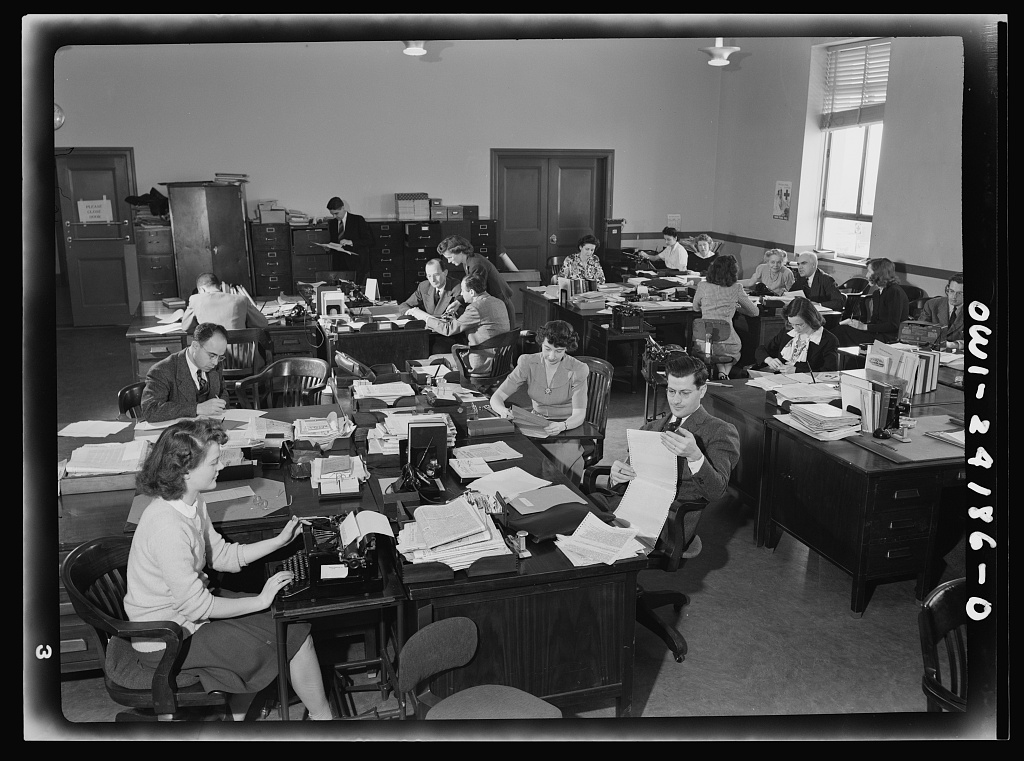
The Office of War Information (pictured above) created the Security Advisory board during World War II to coordinate government classification policies that would protect state secrets. Credit: Wikimedia Commons
Whatever the truth of these broader musings, all of them make it difficult to remember that the “secrets” at stake in modern controversies were not dreamt up as thought experiments for political philosophy. They were produced by quite specific acts: the stamping of a document, the development of bureaucratic methods and logics of classification, the enforcement of physical and legal protections against prying eyes. State secrecy, in other words, should be understood as an institution. Which means that it has an institutional history.
In the United States, that history is remarkably short. The modern classification system was created in September 1951, in an executive order issued by Harry Truman