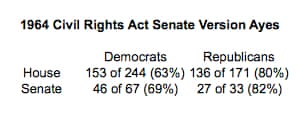
>> When we look at the party vote in both houses of Congress, it fits the historical pattern.
Republicans are more in favor of the bill:
80% of Republicans in the
House and
Senate voted for the bill. Less than 70% of Democrats did. Indeed, Minority Leader Republican
Everett Dirksen led the fight to end the filibuster. Meanwhile, Democrats such as
Richard Russell of
Georgia and
Strom Thurmond of
South Carolina tried as hard as they could to sustain a filibuster.
Of course, it was also Democrats who helped usher the bill through the House, Senate, and ultimately a Democratic president who signed it into law. The bill wouldn't have passed without the support of Majority Leader
Mike Mansfield of Montana, a Democrat. Majority Whip
Hubert Humphrey, who basically split the Democratic party in two with his 1948 Democratic National Convention speech calling for equal rights for all, kept tabs on individual members to ensure the bill had the numbers to overcome the filibuster.
Put another way, party affiliation seems to be somewhat predictive, but something seems to be missing. So, what factor did best predicting voting?
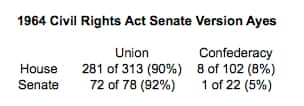
You don't need to know too much history to understand that the South from the civil war to the Civil Rights Act of 1964 tended to be opposed to minority rights. This factor was separate from party identification or ideology. We can easily control for this variable by breaking up the voting by those states that were part of the confederacy and those that were not.
You can see that geography was far more predictive of voting coalitions on the Civil Rights than party affiliation.
What linked Dirksen and Mansfield was the fact that they weren't from the south. In fact, 90% of members of Congress from states (or territories) that were part of the Union voted in favor of the act, while less than 10% of members of Congress from the old Confederate states voted for it. This 80pt difference between regions is far greater than the 15pt difference between parties.
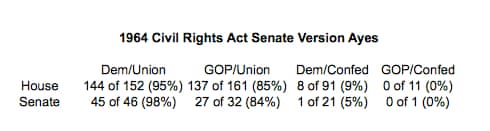
But what happens when we control for both party affiliation and region? As Sean Trende
noted earlier this year, "sometimes relationships become apparent only after you control for other factors".
In this case, it becomes clear that
Democrats in the north and the south were more likely to vote for the bill than Republicans in the north and south respectively. This difference in
both houses is statistically significant with over 95% confidence. It just so happened southerners made up a larger percentage of the Democratic than Republican caucus, which created the initial impression than Republicans were more in favor of the act.
Nearly 100% of Union state Democrats supported the 1964 Civil Rights Act compared to 85% of Republicans. None of the southern Republicans voted for the bill, while a small percentage of southern
Democrats did.
The same pattern holds true when looking at ideology instead of party affiliation. The folks over
at Voteview.com, who created
DW-nominate scores to measure the ideology of congressmen and senators, found that the more liberal a congressman or senator was the more likely he would vote for the Civil Rights Act of 1964, once one controlled for a factor closely linked to geography. <<
This ^^ is your brain on facts.