The fact of the matter is that people in 3rd world countries do not have very good healthcare and do not have clean drinking water and have all kinds of health/sanitation issues. If they are allowed to come here unchecked, then they will be reintroducing diseases which have been all but eradicated here in the US. That is just a fact.
Are third-world countries with poor healthcare, no clean drinking water, and all kinds of health and sanitation issues likely to be bringing multi-drug resistant strains of TB to the US? That seems counter-intuitive, as those nations would be unlikely to have a large amount of antibiotic use or over-use.
While your point about health issues of immigration and illegals may be true for the country as a whole, I don't see anything in the article to indicate it is related to this particular incident.
So? This is just an example of what CAN happen. While you sit here all comfy in America soaking in your luck and access to healthcare (even though most libs would claim you have no access to healthcare), other people in other countries don't have the same luxuries. They don't have vaccinations. They don't have access to clean drinking water or even food some of the time.
There are all different new strains of bacteria because they can mutate. That doesn't mean that it didn't come from someplace other than the US. Now, go ahead and argue with science.
National TB statistics United States 2016 & 2015
The preliminary TB statistics for the United States for 2016 show a total of 9,287 TB cases reported, compared with a total of 9,546 for 2,015. This is a very slight decline and a much higher rate of decline is needed if the goal of the elimination of
TB in the United States is to be reached in the foreseeable future. This was a decrease in incidence from 3.0 per 100,000 to 2.0 per 100,000.
The incidence in 2016 ranged from 0.2 cases per 100,000 in Wyoming to 8.3 in Hawaii. Alaska, Arkansas, California, Florida, Georgia, Hawaii, Maryland, Minnesota, New Jersey, New York, North Dakota, and Texas, as well as Washington DC, all reported incidences that exceeded the overall national incidence. Four states, California (2,130), Texas (1,333), New York (763) and Florida (602) accounted for 50.9% of all cases.1 Among the individuals for whom the information was available, 5.7% were HIV infected, 4.6% had been homeless at some point in the previous year, 1.8% resided in a long term care facility and 3.5% were confined to a correctional facility.
Country of birth
Among the 9,287 cases of TB reported in 2016, 2,935 (31.6%) occurred among U.S. born people, and 6,307 (66.2%) TB cases were among foreign born people. So foreign born people in the United States continue to be disproportionately affected. The top five countries of origin of foreign born people with TB were Mexico, the Philippines, India, Vietnam and China. These five countries accounted for 54.9% of all cases among foreign born people.
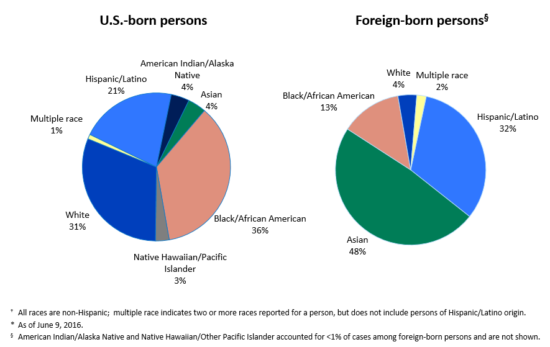
TB cases for U.S. born people and foreign born people 2015
In 2015 of those people born in the U.S. 36% were Black/African American, 31% were White, and 21% Hispanic/Latino. Of those people who were foreign born 48% were Asian, 32% Hispanic/Latino and 13% Black/African American.
Drug resistance
The most recent year for which information about drug resistance, that is
drug susceptibility data, is available is 2015. In 2015 there were 88 cases of
multidrug resistant TB. Among the 88 cases 72 occurred in people with no reported history of TB disease. This means that they were cases of transmitted or
primary drug resistant TB. One case of
extensively drug-resistant TB was reported.
National no. of TB cases by year
In 2015 the number of U.S. TB cases increased compared with the previous year. This was the first time since 1992 that this had happened.
TB statistics United States | National, state & drug resistant


 Go on, keep displaying your willful ignorance because of . . . fear of racism or something silly.