RTD's $539M Diesel Comeback: Because Electric Buses Were Just Too Shocking

excalibur

Diamond Member
Joined
Mar 19, 2015
Messages
28,372
Reaction score
57,349
Points
2,290
We could have told them that.

But the Democrat's massive slush fund at taxpayers expense was pushing this insanity out there.
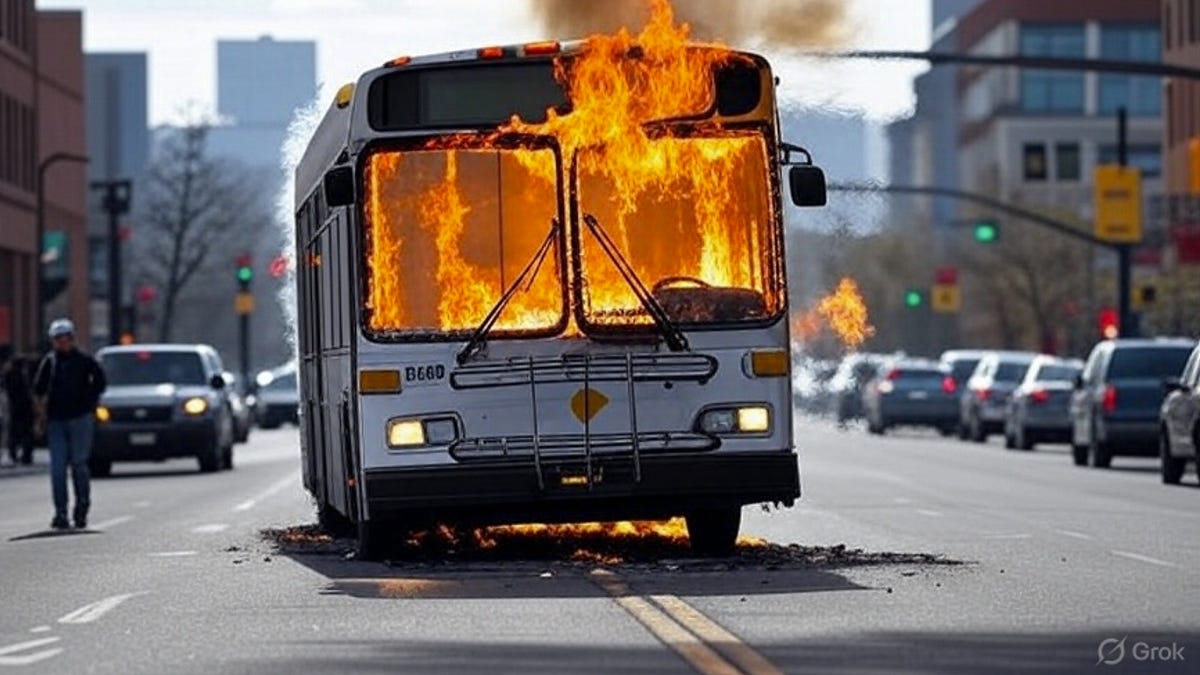


In a stark admission that the electric vehicle revolution is more mirage than reality, Colorado’s Regional Transportation District (RTD) is set to borrow a whopping $539 million to replenish its bus fleet, effectively shelving its longheld EV bus dreams.
This move, detailed in RTD’s latest financial forecast, underscores the harsh lessons learned from pushing unripe green tech onto public transit systems: it doesn’t work, it costs a fortune, and taxpayers foot the bill for the fallout. For years, RTD has chased the holy grail of battery-electric buses under the banner of Colorado’s climate mandates, only to bail on contracts and pivot back to the reliable, efficient diesel engines that powered American mobility for decades.The plan targets replacing an aging fleet of 995 diesel buses, many nearing the end of their 12-year or 500,000-mile lifespan.
Over the next five years, RTD will tap sales taxes from metro Denver’s eight counties—funding 70% of its $1.2 billion annual budget—to finance these ā€œclean dieselā€ purchases, adding to an already ballooning $2.7 billion debt load. Specifics include a $51 million chunk already approved for 47 diesel units to roll out on Denver’s East Colfax Avenue rapid transit line by 2027, initially pitched as hybrids but downgraded to straight diesel when electric options proved elusive.


More added cost because of CO2 FRAUD.


Why it is well over $20 trillion and counting...
 
We could have told them that.

But the Democrat's massive slush fund at taxpayers expense was pushing this insanity out there.


In a stark admission that the electric vehicle revolution is more mirage than reality, Colorado’s Regional Transportation District (RTD) is set to borrow a whopping $539 million to replenish its bus fleet, effectively shelving its longheld EV bus dreams.
This move, detailed in RTD’s latest financial forecast, underscores the harsh lessons learned from pushing unripe green tech onto public transit systems: it doesn’t work, it costs a fortune, and taxpayers foot the bill for the fallout. For years, RTD has chased the holy grail of battery-electric buses under the banner of Colorado’s climate mandates, only to bail on contracts and pivot back to the reliable, efficient diesel engines that powered American mobility for decades.The plan targets replacing an aging fleet of 995 diesel buses, many nearing the end of their 12-year or 500,000-mile lifespan.
Over the next five years, RTD will tap sales taxes from metro Denver’s eight counties—funding 70% of its $1.2 billion annual budget—to finance these ā€œclean dieselā€ purchases, adding to an already ballooning $2.7 billion debt load. Specifics include a $51 million chunk already approved for 47 diesel units to roll out on Denver’s East Colfax Avenue rapid transit line by 2027, initially pitched as hybrids but downgraded to straight diesel when electric options proved elusive.


.

Our district got one electric bus and simply hated it.

.
 
We could have told them that.

But the Democrat's massive slush fund at taxpayers expense was pushing this insanity out there.


In a stark admission that the electric vehicle revolution is more mirage than reality, Colorado’s Regional Transportation District (RTD) is set to borrow a whopping $539 million to replenish its bus fleet, effectively shelving its longheld EV bus dreams.
This move, detailed in RTD’s latest financial forecast, underscores the harsh lessons learned from pushing unripe green tech onto public transit systems: it doesn’t work, it costs a fortune, and taxpayers foot the bill for the fallout. For years, RTD has chased the holy grail of battery-electric buses under the banner of Colorado’s climate mandates, only to bail on contracts and pivot back to the reliable, efficient diesel engines that powered American mobility for decades.The plan targets replacing an aging fleet of 995 diesel buses, many nearing the end of their 12-year or 500,000-mile lifespan.
Over the next five years, RTD will tap sales taxes from metro Denver’s eight counties—funding 70% of its $1.2 billion annual budget—to finance these ā€œclean dieselā€ purchases, adding to an already ballooning $2.7 billion debt load. Specifics include a $51 million chunk already approved for 47 diesel units to roll out on Denver’s East Colfax Avenue rapid transit line by 2027, initially pitched as hybrids but downgraded to straight diesel when electric options proved elusive.


They can use both....the evs for short runs...
 
We could have told them that.

But the Democrat's massive slush fund at taxpayers expense was pushing this insanity out there.


In a stark admission that the electric vehicle revolution is more mirage than reality, Colorado’s Regional Transportation District (RTD) is set to borrow a whopping $539 million to replenish its bus fleet, effectively shelving its longheld EV bus dreams.
This move, detailed in RTD’s latest financial forecast, underscores the harsh lessons learned from pushing unripe green tech onto public transit systems: it doesn’t work, it costs a fortune, and taxpayers foot the bill for the fallout. For years, RTD has chased the holy grail of battery-electric buses under the banner of Colorado’s climate mandates, only to bail on contracts and pivot back to the reliable, efficient diesel engines that powered American mobility for decades.The plan targets replacing an aging fleet of 995 diesel buses, many nearing the end of their 12-year or 500,000-mile lifespan.
Over the next five years, RTD will tap sales taxes from metro Denver’s eight counties—funding 70% of its $1.2 billion annual budget—to finance these ā€œclean dieselā€ purchases, adding to an already ballooning $2.7 billion debt load. Specifics include a $51 million chunk already approved for 47 diesel units to roll out on Denver’s East Colfax Avenue rapid transit line by 2027, initially pitched as hybrids but downgraded to straight diesel when electric options proved elusive.


I’d be curious to know if they have enough riders to justify a bus line at all.
 
I’d be curious to know if they have enough riders to justify a bus line at all.
Great question. I believe ridership has gone down so significantly in the Spokane Rapid Transit area that they are basically giving rides away. I am not sure who, in the current ridership, pays for tickets to support this boondoggle, besides the abused Spokane taxpayer. SMH, they don't seem to learn that it is their idiotic voting choices that are perpetuating this garbage though. That's OK, Spokane voters, keep voting the likes of Lisa Brown into your gov't and you'll get more of this. Same in CO.
 
Many New York school districts have reported issues with electric buses, including technical and safety problems that have led to some being decommissioned. Concerns about battery life, especially in cold weather, and the overall feasibility of transitioning to electric buses have also been raised by school officials.

 
We could have told them that.

But the Democrat's massive slush fund at taxpayers expense was pushing this insanity out there.


In a stark admission that the electric vehicle revolution is more mirage than reality, Colorado’s Regional Transportation District (RTD) is set to borrow a whopping $539 million to replenish its bus fleet, effectively shelving its longheld EV bus dreams.
This move, detailed in RTD’s latest financial forecast, underscores the harsh lessons learned from pushing unripe green tech onto public transit systems: it doesn’t work, it costs a fortune, and taxpayers foot the bill for the fallout. For years, RTD has chased the holy grail of battery-electric buses under the banner of Colorado’s climate mandates, only to bail on contracts and pivot back to the reliable, efficient diesel engines that powered American mobility for decades.The plan targets replacing an aging fleet of 995 diesel buses, many nearing the end of their 12-year or 500,000-mile lifespan.
Over the next five years, RTD will tap sales taxes from metro Denver’s eight counties—funding 70% of its $1.2 billion annual budget—to finance these ā€œclean dieselā€ purchases, adding to an already ballooning $2.7 billion debt load. Specifics include a $51 million chunk already approved for 47 diesel units to roll out on Denver’s East Colfax Avenue rapid transit line by 2027, initially pitched as hybrids but downgraded to straight diesel when electric options proved elusive.


We told ā€˜em but libs didnt listen
 
We told ā€˜em but libs didnt listen
Democrat way. Don't confuse them with facts and logic, their minds are already made up and they don't care what you think. LOL--Spokane does this all the time. They wanted a new centrally located stadium downtown for a pro soccer team that they were wooing. It went to a vote to keep an existing site, out of downtown, that was used for HS games as well, or spend MORE taxpayer $$$ for the new stadium that the pro team wanted. The new stadium was overwhelmingly voted down, but the city gov't deemed they knew better and overruled the vote. Just like that, no explanation. The worst part is the voting public didn't push back AT ALL. Spokane voters deserve everything they get.
 
Back
Top Bottom
