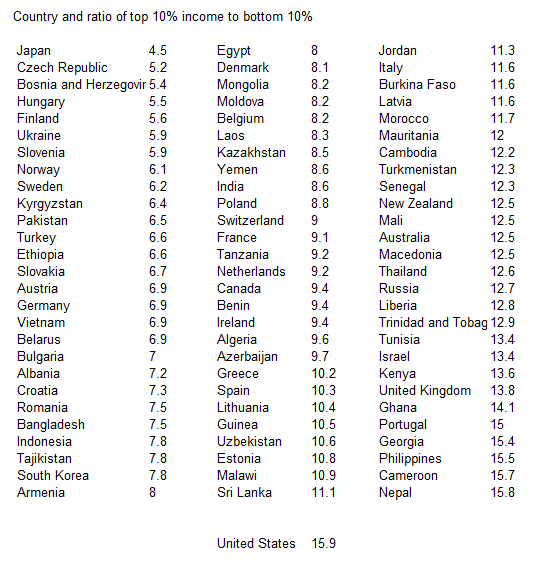
Many people argue that the pattern of world growth over the past 20 years has not been beneficial. They point out that globalisation-driven growth has gone hand in hand with a growth in inequality. This inequality is a worry in its own right (communities get broken up; the poor get left behind) and also a missed opportunity (emerging markets might have done better still if only their extra wealth had been distributed more fairly). Is this charge against globalisation true? And, if it is, does it follow that globalisation has been a failure because its benefits have been pinched by the rich?
The evidence that the rich have done best is certainly compelling. Inequality has risen in both rich and poor countries. It is thus a sharp break from the pattern established between 1950 and 1990, when there was a general decline in inequality, notably in East Asia, where the tigers managed to combine fast growth with relatively equal incomes.
But it is not so clear that globalisationin the sense of opening up to trade and foreign investmentis to blame. Ukraine and Poland both opened themselves in the 1990s. Yet inequality rose in Poland and fell in Ukraine. Globalisation, it seems, sometimes increases inequality, sometimes reduces it.
A more plausible culprit for rising inequality seems to be technological progress (see chart below). This is associated with inequality in poor countries because in emerging markets the people best able to take advantage of new technology are those who already have an education and who are usually among the richest in society. The more technological progress, therefore, the better the well-off do.
But to limit technology to reduce inequality would be a cure worse than the disease. Technology in its broadest sensethe flow of new ideasis the only way of getting growth rates up to 5-10% a year, the rate which enables poor countries to catch up with the West. Without it, growth would be dependent on labour and capital inputs, and growth would be just a few percent. To reduce technological progresseven supposing one could do itwould be to condemn poor countries to stay poor.
In fact, since the mid-1990s, the incomes of the poorest fifth have risen everywhere except, marginally, in Latin America, where they have been affected by the after-shocks of debt crises. In Asia, the real incomes of the poorest fifth rose 4% a year; in Africa, by 2% a year, faster than the rise for other income groups.
The result is that the number of very poor people in the world is falling fasteven though many critics continue to believe that the poor have not really benefited from growth. In 1990 those on $1 a day accounted for more than a quarter of the population of developing countries. By 2015, on current rates, the proportion of very poor people should have shrunk to 10%. Moreover, these monetary measures probably understate the real gains from things such as lower child mortality, safer water, literacy and other social achievements. A rich man appreciates his extra cash but this does not compare with what a poor family gains from seeing an infant survive childhood or learn to write.