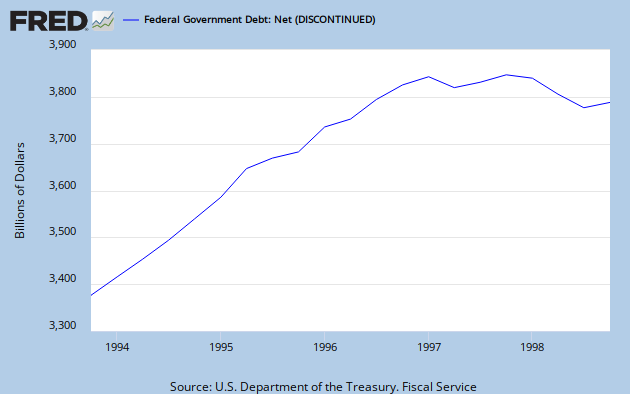
I hope you read this and don't skim over this. I will try to answer any question you may have to better help you understand how this system works, because it is confusing and the public press doesn't help much. I have spent over a decade working within a pension fund, so I hopefully can be able to clear up misconceptions.
Based upon today’s new economic and budget projections for the coming 10 years from the Office of Management and Budget (OMB):
The United States can be debt-free this decade. By dedicating the entire budget surplus to debt reduction, The United States can eliminate its
publicly held debt by FY 2009.
Source:The United States on Track to Pay Off the Debt by End of the Decade
This is in reference to the publicly held debt. I blew it up for you. Remember, SS does not hold publicly held debt.
Mr. Clinton's plan is based on the idea that by using the Social Security surplus to pay down the national debt, the Government's interest bill will decline substantially.
By the White House's estimate, the Government's interest expense will be $107 billion lower in 2011 than it would be if the Social Security surplus were not used, starting this year, to reduce the debt. Mr. Clinton's proposal would take the money saved because of the lower amount of debt, starting in 2011, and earmark it to shore up Social Security.
Source: CLINTON ABANDONS IDEA OF INVESTING RETIREMENT FUNDS - NYTimes.com
Remember when you said that
This despicable gimmick used by the White House and Congress to cover up the huge federal budget deficit was the looting of the Social Security Trust Fund, Medicaid, Civil Service and military retirements funds[1]. This money may very well not be available to many of us when we grow old.
And I said
Its not a despicable gimmick because its not a gimmick at all. It is how all cash flows into and out the SS trusts have been accounted for since the early 1980s when the government revamped the operations of the SS trusts.
From your link.
Both parties routinely agreed for decades to spend excess Social Security payroll tax revenues on general Government operations.
This is how its been done for decades, since at least when SS was revamped in the early 1980s.
Now, to get to your point, which I think you've mis-understood, and I don't blame you, because it is very unclear in the article to which you've reference.
First, on the very next line of the article
But this year the two parties have both pledged to balance the budget without using any of the Social Security money, and they have been trading bitter accusations about the inability of the other to show how to do it.
What happens every year, as has happened for many years, is that money comes into the fund then money goes out and is spent, as I explained above
How SS really operates
* ----------> Payroll taxes come into the Treasury
* The government issues nonmarketable bonds to the SS trusts in the amount of the cash coming into the Treasury
* The government spends the money from payroll taxes
* The government credits interest payments to the SS trusts
* <---------- SS payments are paid out and the SS trusts are debited that amount.
What they are talking about is the
excess money coming into SS. So, for example, as I explained
Total social security cash receipts in the fiscal year was $620 billion. Total social security cash outlays was $442 billion.
the total excess is $178 billion. This is what they were arguing about.
But as mentioned in the NY Times article you linked, the government had been doing this for decades. This isn't the Clinton administration resorting to despicable accounting gimmicks. This is business as usual in Washington.
Now, I agree that it would have been better to have not spent that money. It would have been better if they invested the $178 billion. It would have improved the balance sheet of the United States. But it isn't a raid. In FY 2000, the SS trusts would have bought a net of $178 billion in nonmarketable special-issue securities. That doesn't change. What would have changed had the money not been spent would have been the balance sheet of the US Treasury, which would have made the US government better off. But it wouldn't have affected the SS trusts, other than if the funds had been held as collateral off balance sheet of the trusts.
Here is what the incremental SS trusts balance sheet would have looked like in 2000
Debit: $620 billion in nonmarketable special-issue government bonds issued to the SS trusts
Credit: -$442 billion in disbursements and outlays
Net change in the net asset value of the SS trusts: +$178 billion.
And here is what the US Treasury's balance sheet would have looked like
Credit: -$620 billion in nonmarketable special-issue government bonds issued to the SS trusts
Net change in the net asset value of the US Treasury: -$620 billion.
Now here is what the incremental SS trusts balance sheet would have looked like in 2000 had the $178 billion not been spent
Debit: $620 billion in nonmarketable special-issue government bonds issued to the SS trusts
Credit: -$442 billion in disbursements and outlays
Net change in the net asset value of the SS trusts: +$178 billion.
And here is what the US Treasury's balance sheet would have looked like had the $178 billion not been spent
Debit: +$178 billion not spent by the government and instead invested
Credit: -$620 billion in nonmarketable special-issue government bonds issued to the SS trusts
Net change in the net asset value of the US Treasury: -$442 billion.
The US government would have been $178 billion better off had it not spent the surplus. But the SS trusts would not have been better off, at least not from an accounting stand-point.
The real-world caveat to this is that the SS trusts would have been better off because the government would have pledged the $178 billion as collateral to back up the SS trusts. And that's a good thing. Investing rather than spending almost always makes a balance sheet stronger, no matter if you're the government, a person, a company, etc.
But again, understand this - there can be no "raid" on social security because there is no cash in the fund. The only securities held in the funds are nonmarketable, special-issue government bonds that can only be credited and debited by the government. It's not like there is $1 trillion of cash sitting there. There are no marketable government bonds in the fund that can be sold. Nothing in the fund can be sold. Thus, nothing can be raided and taken out.
When the government talks about the "surplus," what they are talking about is that excess. That is what the CBO is talking about in your next link.
But to go back to your NY Times link where it says
Mr. Clinton's plan is based on the idea that by using the Social Security surplus to pay down the national debt, the Government's interest bill will decline substantially.
By the White House's estimate, the Government's interest expense will be $107 billion lower in 2011 than it would be if the Social Security surplus were not used, starting this year, to reduce the debt. Mr. Clinton's proposal would take the money saved because of the lower amount of debt, starting in 2011, and earmark it to shore up Social Security.
This again is confusing, and I can see how it gives the impression that there is this pile of money that the government can raid. But there is not.
What the article is referring to is on the first page, where it says
President Clinton dropped one of the most contentious elements of his plan for bolstering Social Security's finances today, and called on Congress to break the partisan deadlock over how to prepare the retirement system for the aging of the baby boom generation.
In his weekly radio address, Mr. Clinton said he would send Congress legislation next week based on a proposal he first floated earlier this year to shore up Social Security with projected Federal budget surpluses. But the new version will not include Mr. Clinton's longstanding call for the Government to invest some Social Security taxes in the stock market. ...
In a signal of his desire for bipartisan cooperation, White House officials said Mr. Clinton was withdrawing for now his plan to seek higher returns for the system by having the Government invest as much as 15 percent of Social Security's reserves in the stock market.
First, understand what a pension fund does. It makes investments to earn a return to pay benefits in the future. The higher the return of the plan assets, either 1.) the more money that can be paid out in the end, and/or 2.) the less amount that must be contributed to meet the same amount of benefits in the future.
So, what Clinton proposed was that the SS trusts invest in the stock market and earn a higher return (over time) in the future. A higher return means that the fund will be worth more in the future. To meet the same future benefit claims, the government could lower the taxes paid into the SS trust, but what Clinton was arguing was to use the excess, i.e. the surplus, the $178 billion, to pay down the national debt. In other words, as returns in the trust rose over time, instead of lowering contributions, i.e. payroll taxes, he was going to keep payroll taxes the same and use that money to pay off debt.
Here's an example.
Let's say you want to retire in 10 years, and you decide to put away $10,000 a year for the next 10 years. You have two options, you can invest in government bonds that earn 3% a year or stocks that earn 10% a year. In the first option earning 3%, at the end of 10 years, you will have $128,000 in the bank. At the end of 10 years using the second option of earning 10%, you will have $185,000 in the bank.
But let's say you only need $128,000 at the end of 10 years. If you decide to go with option 2 and earn 10% a year, you don't need to put $10,000 away. In fact, you only have to put $6500 away each year to earn $128,000 at 10% in 10 years. Now let's say you also have a debt of $20,000. You can pay that off in 10 years by investing $6500 at 10% and applying the $3500 to pay off the debt. Now, you could save $6500 a year and spend the extra $3500, but you'd still have a debt of $20,000 (plus interest) at the end of the decade.
That is what Clinton was proposing. What Clinton was proposing was to use taxes intended for SS to pay down the marketable debt while investing in assets that earn a higher return so the government could afford to take SS taxes and pay off the national debt. He was proposing to take that $10,000 and invest it in stocks so it could a higher return and have some left over to pay down debt. That's not underhanded. That's smart.
It's confusing, I know, but there wasn't anything untoward going on in the 1990s. But people don't understand how this works and make false conclusions.