Let’s address this

Instead of looking for reasons to demonize Israel, can we please have a real conversation about the real issues?
Fair enough. But discrimination is a valid issue and pretending it isn’t doesn’t help the conversation.
Discussing specifically, the small, isolated, Arab villages in Area C...
They are populated by people who are not citizens of Israel, but citizens of Palestine. Palestine is, by treaty, responsible for their welfare. But they live in an area controlled by Israel.
They tend to be economically and socially based in an agricultural society, mostly farmers and herders. They are being overtaken by urban growth.
They have a very different culture of land use and ownership than Israelis.
There are security concerns.
There are accessibility concerns.
There are community development plans which should be written.
There is infrastructure to be built.
If we are trying to solve problems, these are the topics we should be discussing.
Part of the problem, from what read is that the Palestinians in Area C are kind of in a no man's land situation - they aren't quite governed by Israel, but must submit to Israel's building authority, and they aren't quite governed by the PA who issue building permits only to have them torn down by Israel. In some cases cities straddle borders creating even more confusion as to jurisdiction and the ability to expand.
There have been potential partnerships between Israel and PA to try to increase housing but they get shot down by Israeli politicians not wanting to see resources spent on Palestinians or anything that gives any more land to Palestinian families. It's extremely political.
IMO (which will probably be shot down) - Israel should just annex Area C, offer the resident Palestinians citizenship, and then treat them as financially disadvantaged communities in need of resources and development and, maybe cultural protection for their agrarian lifestyle. Fund the necessary infrastructure to bring them up to par with their fellow citizens.
Part of the problem, from what read is that the Palestinians in Area C are kind of in a no man's land situation
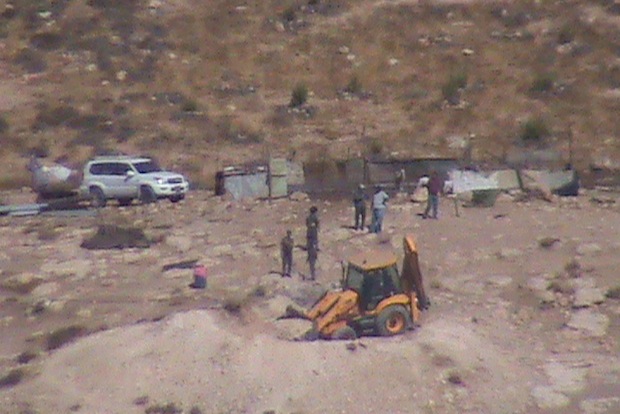
Indeed, the PA is not allowed to provide any services and Israel won't. Typically they do not have water or electricity. If they dig a well or build a cistern to collect rain water, Israel bulldozes them. If they install solar panels, Israel hauls them off. Permits are virtually impossible to get.
Israel's plan is to drive all of the Palestinians into the bantustans.
All lies of course. Existing Palestinian villages in area C have access to water, electricity, etc. and no one stops them from making small improvements within their villages if they apply for permits in a timely manner, but they rarely do and they are encouraged by EU NGO's to ignore Israeli laws and build without permits despite the fact they know that the structures will be taken down if they do.
Yes I was going to say the same, only add some context:
the PA provides services in its areas of control, Ramallah, Hebron etc. all these areas are truly thriving and constantly building modern 10-15 level apartment buildings and markets.
This is all well planned and organized, Ramallah could easily shy Tel-Aviv.
2nd level are the villages spread all over the map, there're 2 kinds of them, and this is typical to all Arab villages- roughly half of them are modernized suburban areas that cannot be differentiated other than by Mosque, and half of them are spontaneously gathered together private mansions, typical Arab style of urban development with almost impossible stoop and sharp turns on narrow streets and very crowded buildings. Look Wadi 'Ara or Majd el-Shams.
These tend to build completely spontaneously, everywhere one can see a new villa built inside a mountain at a strange distance from everyone else. The way they get electricity and water is by hacking the system and the government usually turns a blind eye where it seen as a within the natural boundaries of the town's development. Then when more families move to the new area, the govt will make them pay a symbolic fine and move in the infrastructure - these are all private homes and mansions.
3rd level is what Tinmore was talking about, entirely wild shacks, built out of metal plates, parts of roofs and some wood to hold it standing on the sides of the roads. Caravans basically only without camels. These are either Bedouins or outcasts.
Also in this category are Hiltop folks, they usually build on top, with or without a fence depending on the stock.
None have electricity or water, and the govt routinely destroy or arrests both of them. Eventually the govt itself proposes both of them an opportunity to participate in building the land in planned projects that take place in the area.
Those who want to keep it that way - their problem, but everyone knows exactly how to follow the laws and the steps to plan communities that can be recognized by the govt.
The overall plan is not to create bantustans, but to follow the Country Outline Plan that outlines regional areas of centralized governance, several towns and villages in a unit of a natural landscape, or a region of one big city. And to sift appropriate projects and connect them into the boundaries of regional governance.
Regional councils are as said are usually based on units of natural landscape, centers of economy, and cultural centers in the country. Some are entirely Arab, some entirely Jewish, some mixed are with the addition of Bedouin and Druze towns.
Bantustants were based on skin color.
Israel doesn't divide it's governance according to skin color, but according to natural cultural and geographical landscapes of the country.