A new thread is being woven into the complex tapestry of Jewish history, a thread fashioned from a double twist of DNA.
The DNA data suggest a particular version of Jewish history and origins that historians have not yet had time to appraise but that seem to be reconcilable in principle with the historical record, according to experts in Jewish studies.
The emerging genetic picture is based largely on two studies, one published two years ago and the other this month, that together show that the men and women who founded the Jewish communities had surprisingly different genetic histories.
The earlier study, led by Dr. Michael Hammer of University of Arizona, showed from an analysis of the male, or Y chromosome, that Jewish men from seven communities were related to one another and to present-day Palestinian and Syrian populations, but not to the men of their host communities.
The finding suggested that Jewish men who founded the communities traced their lineage back to the ancestral Mideastern population of 4,000 years ago from which Arabs, Jews and other people are descended. It pointed to the genetic unity of widespread Jewish populations and took issue with ideas that most Jewish communities were relatively recent converts like the Khazars, a medieval Turkish tribe that embraced Judaism.
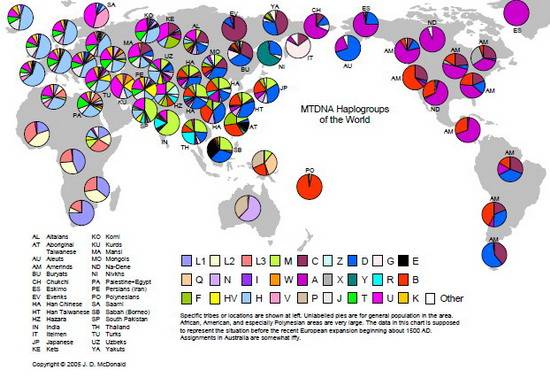
A new study now shows that the women in nine Jewish communities from Georgia, the former Soviet republic, to Morocco have vastly different genetic histories from the men. In each community, the women carry very few genetic signatures on their mitochondrial DNA, a genetic element inherited only through the female line. This indicates that the community had just a small number of founding mothers and that after the founding event there was little, if any, interchange with the host population. The women's identities, however, are a mystery, because, unlike the case with the men, their genetic signatures are not related to one another or to those of present-day Middle Eastern populations.
The new study, by Dr. David Goldstein, Dr. Mark Thomas and Dr. Neil Bradman of University College in London and other colleagues, appears in The American Journal of Human Genetics this month. Dr. Goldstein said it was up to historians to interpret the genetic evidence. His own speculation, he said, is that most Jewish communities were formed by unions between Jewish men and local women, though he notes that the women's origins cannot be genetically determined.
"The men came from the Near East, perhaps as traders," he said. "They established local populations, probably with local women. But once the community was founded, the barriers had to go up, because otherwise mitochondrial diversity would be increased."
In ancient Israel, the Jewish priesthood was handed from father to son. But at some time from 200 B.C. to A.D. 500, Jewish status came to be defined by maternal descent. Even though the founding mothers of most Jewish communities were not born Jewish, their descendants were.
In a recent book, "The Beginnings of Jewishness," Dr. Cohen argued that far-flung Jewish communities had adopted the rabbinic teaching of the matrilineal descent of Jewishness soon after the Islamic conquests in the seventh, eight and ninth centuries A.D.
One part of the Goldstein team's analysis, that matrilineal descent of Jewishness was practiced at or soon after the founding of each community, could fit in with this conclusion, Dr. Cohen said, if the communities were founded around this time.
The data being generated by Dr. Hammer, Dr. Goldstein and other population geneticists touches on the delicate issue of whether Jews can be considered a race. Dr. Cohen noted that the Nazis and their anti-Semitic predecessors had argued that Jews were a race and therefore irreconcilable with the host community and that Jews had in response argued they were not, because they admitted people by conversion.
If the founding mothers of most Jewish communities were local, that could explain why Jews in each country tend to resemble their host community physically while the origins of their Jewish founding fathers may explain the aspects the communities have in common, Dr. Cohen said.
Despite the definition of Jewishness as being born to a Jewish mother, and the likelihood of some continuity between ancient and modern populations, it has not until recently been clear that genetics had anything much to contribute to questions of Jewish identity.
Some scholars suspected that Jewish communities had through intermarriage or conversion become little different from their host populations. Many say they believe that even if Jews are a group definable in ethnic, as opposed to cultural or religious terms, it is either impossible or unwise to define an ethnic group genetically.
But since the Y chromosome and mitochondrial DNA clock up occasional changes or mutations every thousand years or so, on much the same time scale as human population splits, different ethnic groups tend to have characteristic patterns of mutations. "