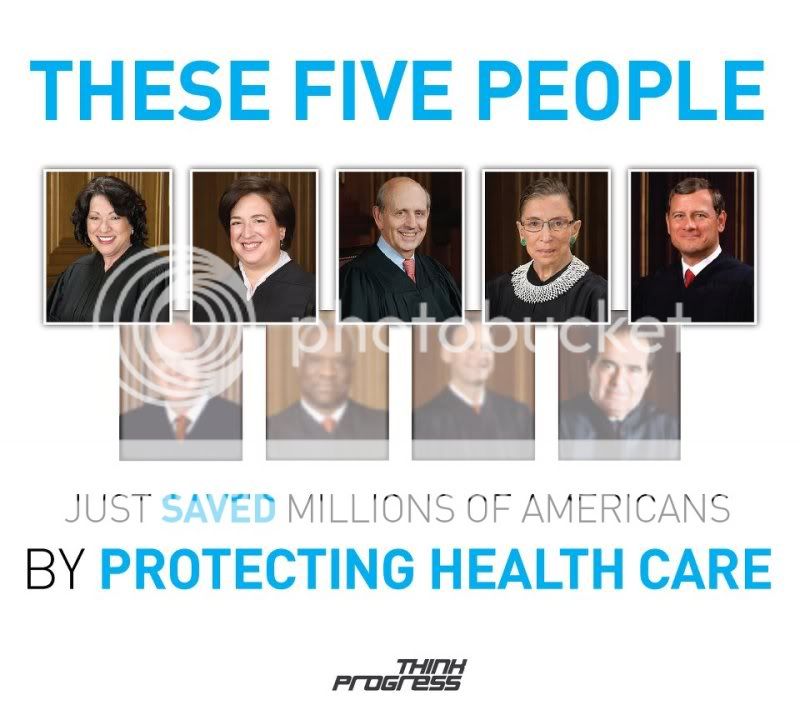
Had Chief Justice John Roberts sided with his fellow conservatives, as he often does, the definitive legislation of Barack Obama's presidency, progressives' century-long fight for universal health care, would have been thrown out. We are inured to this irony: Many of the Court's rulings that have the greatest influence on American life are increasingly decided by the narrowest possible margin.
It wasn't always this way. From 1801 to 1940, less than 2 percent of the Supreme Court's total rulings were resolved by 5-to-4 decisions. Since then, more than 16 percent of the Court's rulings have been decided by "minimum-winning coalitions." In the two most recent Courts, more than a fifth of all rulings were decided by 5-to-4 votes.
Scholars consider these narrow decisions the most political. Research indicates that 5-to-4 rulings are the most likely to be overturned by later Courts. They carry the same legal authority as more unanimous opinions -- but not the same moral authority. In this vein, the one branch of government designed to be above partisanship echoes the rise in hyperpartisanship seen throughout Washington.
The Roberts Court has decided more cases by a 5-to-4 ruling (about 21.5 percent) than any Court before it, though only by a narrow margin. The previous Court, led by William Rehnquist, decided 20.5 percent of its cases by this minimum coalition. That rate, however, represents roughly twice the share of 5-to-4 rulings in the Stone Court, during World War II. And the Stone Court had more than three times the rate of 5-to-4 decisions of any Court prior.