Oceanic acidification affects marine carbon pump and triggers extended marine oxygen holes
Oceanic acidification affects marine carbon pump and triggers extended marine oxygen holes
Matthias Hofmanna and
Hans-Joachim Schellnhubera,b,1
Author Affiliations
Contributed by Hans-Joachim Schellnhuber, January 8, 2009 (received for review November 3, 2008)
Abstract
Rising atmospheric CO2 levels will not only drive future global mean temperatures toward values unprecedented during the whole Quaternary but will also lead to massive acidification of sea water. This constitutes by itself an anthropogenic planetary-scale perturbation that could significantly modify oceanic biogeochemical fluxes and severely damage marine biota. As a step toward the quantification of such potential impacts, we present here a simulation-model-based assessment of the respective consequences of a business-as-usual fossil-fuel-burning scenario where a total of 4,075 Petagrams of carbon is released into the atmosphere during the current millennium. In our scenario, the atmospheric pCO2 level peaks at ≈1,750 μatm in the year 2200 while the sea-surface pH value drops by >0.7 units on global average, inhibiting the growth of marine calcifying organisms. The study focuses on quantifying 3 major concomitant effects. The first one is a significant (climate-stabilizing) negative feedback on rising pCO2 levels as caused by the attenuation of biogenic calcification. The second one is related to the biological carbon pump. Because mineral ballast, notably CaCO3, is found to play a dominant role in carrying organic matter through the water column, a reduction of its export fluxes weakens the strength of the biological carbon pump. There is, however, a third effect with severe consequences: Because organic matter is oxidized in shallow waters when mineral-ballast fluxes weaken, oxygen holes (hypoxic zones) start to expand considerably in the oceans in our model worldwith potentially harmful impacts on a variety of marine ecosystems.
Yeah, right... Here's what a professor has to say about your little fear mongering.
Guest Post by Professor Brice Bosnich
The Chemistry of Ocean pH
BACKGROUND
Pure Water and its pH
The water molecule is comprised of three atoms two of hydrogen (H) and one of oxygen (O). Each of the hydrogen atoms is linked to the oxygen atom by a chemical bond, and hence the water molecule is symbolized as H2O, see picture below. At 25oC, in the case of a very small number of water molecules, one of the hydrogen atoms breaks off (dissociates), thereby forming equal numbers of two charged species, a negatively charged hydroxide ion (OH-) and a corresponding positively charged hydrogen ion (H+) called a proton. The size of the respective charges is equal to that carried by an electron. Notwithstanding this dissociation, nearly all of the water continues to exist in the form of the water molecule, H2O.
H2O MoleculePure water is neutral, namely neither acidic nor basic (alkaline). Acidity occurs when there are more protons present than hydroxide ions and conversely, water is basic or alkaline when hydroxide ions are in excess. The concept of pH was first introduced by the Danish chemist, Sorensen, in 1909. He defined it as the relationship;
pH = log10 (1/[H+]) = log10 [H+] (1)
where [H+] is the (molar)1 concentration of protons. Because the molar concentration (M) of protons in pure water at 25oC is 10-7 M, the pH of water is 7. Thus a pH value less than 7 refers to an acidic solution, whereas a value higher than 7 indicates a basic solution.
Water exposed to air slowly becomes mildly acidic, because atmospheric carbon dioxide (CO2) dissolves in the water. When dissolved in water CO2 reacts with water to give carbonic acid, H2CO3, as shown by equation (2):
H2O + CO2 ⇌ H2CO3 (2)
As indicated by the two-way arrows (⇌

, this chemical reaction is reversible; water and carbon dioxide generates carbonic acid which also breaks up (rather slowly) to regenerate water and carbon dioxide. The equilibrium lies to the left so that there is much more CO2 dissolved in water than H2CO3.
The amount of CO2 that is dissolved in water depends on the temperature of the water, and on the concentration present in the water and the pressure of CO2 in the air above the water. The warmer the water, the less CO2 will dissolve in it. Because cold water will absorb more carbon dioxide, it follows that if water containing dissolved CO2 is warmed it will release CO2 into the air. (Consider the effect when a warm bottle of beer is opened!) The more CO2 that is present in the air above the water, the more CO2 that will dissolve.
Carbonic acid is an acid in water because its hydrogen atoms (H) can dissociate to release protons (H+), equation (3):
H2CO3 ⇌ HCO3- + H+ (3)
The bicarbonate ion, HCO3-, can also dissociate its hydrogen atom to give a proton and the carbonate ion, CO32-. Carbonic acid and the bicarbonate ion are said to be weak acids because, unlike hydrochloric acid in water solution, the hydrogen atom is not fully dissociated. For slightly complicated reasons carbon dioxide dissolved in water will generate; H2CO3, HCO3- and H+. Because of the presence of the proton derived from carbonic acid [equation (3)], water that has been exposed to carbon dioxide in the air will be mildly acidic, about pH = 5.7. Raindrops become acidic for the same reason.
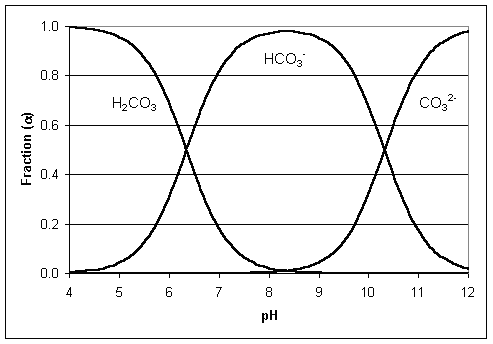
The figure below shows the fraction (alpha) of various species in solution with varying pH. At lower pH more carbonic acid is present (left), at higher pH more carbonate exists (right), at about pH 8.5 the maximum fraction of bicarbonate is present and at this pH it is essentially the only species present.
Chemical reactions of carbonates in water at different pHs
Sea water acidification
The pH of sea water can be measured2 although there are complications due the presence of dissolved salts and other factors. On average, surface sea water is mildly basic, about pH of 8.1, although the measured pH can vary by as much as 0.3 pH units at different times in the same area and from area to area. There is a mathematical relationship between pressures of CO2 (pCO2) and the resulting pH of pure water3. This relationship is the basis for the calculation of ocean pH values. Caldeira4 employed such a formula to conclude that the pH of the oceans had changed by about 0.15 of a unit since 1750. He assumed, without providing any empirical evidence, that the pre-industrial pH was 8.25. This work has been challenged because it is not consistent with observation3. The ocean is a very complicated system and does not yield to simple modeling.
The effect of pH changes on marine life
The hard exo-skeletons of many organisms consist of calcium carbonate (CaCO3). Calcium carbonate is rather insoluble in water unlike, for example, sugar, which is highly soluble in water. Even so a small amount does dissolve in water to produce calcium ions, Ca2+, and carbonate ions, CO32-, as shown by the (heterogeneous) equilibrium, equation (4):
CaCO3 (solid) ⇌ Ca2+ + CO32- (4)
Thus, addition of acid to water that is in contact with calcium carbonate will lead to production of carbon dioxide by the reaction shown, equation (5):
CO32- + 2H+ → CO3H2 → CO2⇡+ H2O (5)
This reaction leads to the destruction of calcium carbonate.
The alarmist argument asserts5,6 that were the oceans to become progressively more acidic from increasing amounts of carbon dioxide released in the air, the exo-skeletons of organisms (corals, shells, and other calciferous organisms) might be dissolved by the process shown in equation (5). Whereas in principle this may be true there is no conclusive evidence that this process is occurring to any measurable extent, despite the almost universal public posturing of marine biologists.
Marine life survived higher levels of CO2
During past periods, stretching back millions of years, atmospheric carbon dioxide levels have varied enormously7; at times reaching concentrations far exceeding those at present and those projected over the next 100 years. Yet during these times of differing carbon dioxide concentrations, calciferous sea organisms continued to thrive. Whereas it is true that there have been boom and bust periods for corals and other calciferous sea organisms, the boom and bust events do not correlate with the concentration of carbon dioxide in the atmosphere8. Incidentally, there is also no correlation with temperature.
Consistent with these historical observations are the reported experimental studies9 that show that calciferous marine organisms are much more immune to the effects of ocean acidification than is usually supposed. In fact these experiments suggest that even for some of the extreme projections of ocean acidification most of the organisms are likely to survive or adapt.
It should be noted that the shells of coral and those of other organisms with calciferous exo-skeletons are not formed spontaneously by the reverse of reaction (4). The calcium carbonate of their skeletons is laid down by a process called biomineralization10,11, where the organism actively (uses energy) lays down the calcium carbonate in a precise way about itself. (It is amusing to note that over 95% of spiral shells are right-handed, a morphological manifestation of the biomineralization process. Were the calcium carbonate laid down spontaneously, equal numbers of right- and left-handed shells would form.) It is conceivable that the biomineralization process could counteract any decomposition that might occur by a mild acid such as carbonic acid. There is still much to learn about the response of the oceans to increases in carbon dioxide and how organisms with calciferous skeletons respond to small changes in pH that ensue from the formation of carbonic acid.
The effect of warming in the oceans
The other concern for all organisms in the oceans is the consequences that may follow from an increase in temperature.
The figure below is said to show the variation in ocean heat content from 1955 to June, 201112. It will be noted that from 2003 to present there has been no change in ocean heat content. It is precisely during this time that the accurate Argo buoys13 were fully deployed!
Global Ocean Heat content
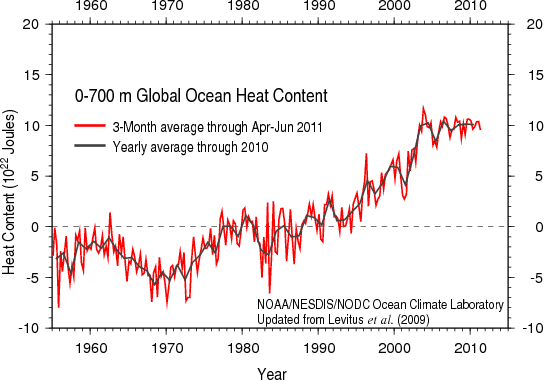
Before this (1955 to 2003) the data was obtained by less accurate methods (expendable Bathythermographs14) that only covered the world shipping lanes. The Argo buoys, by contrast, cover the whole of the oceans except under the sea ice at the poles. It is tiresome but straightforward to calculate the change in ocean temperature from 1955 to present from the above graph. The result is that over this time the temperature has increased 0.17oC! (I thank Dr William Kininmonth for confirming the result of this calculation.) One can accept this change and be forced to conclude that there has been very little change in temperature. In fact, it is more probable that the apparent change in temperature falls within experimental error, meaning that it cannot be said that there has been a change in upper ocean temperature. Marine organisms appear to be safe from ocean warming. Similarly, most of these organisms are very likely to be safe from the supposed effects of possible ocean acidification. It has been noted that the Australian coral reef would benefit from an increase in sea temperature15.
Acknowledgement. I am grateful to three people for reviewing a draft of this piece. Two are intelligent non scientists, the other although a scientist is not a chemist, but is also intelligent. They made valuable suggestions to improve and make accessible this piece. The problems that remain are my own. This may be the first time that peer review has been used for the Jo Nova blog. Could this mean that the alarmists will now accept her, I hear you cry?
References
(1) Molar Concentration definition.
(2) CDIAC: Determination of thePH of sea water using the indicator dye m-cresol purple (1996) (PDF)
(3) Marsh, G.E., (2005) -- SEAWATER pH AND ANTHROPOGENIC CARBON DIOXIDE (PDF) First chapter in Climate Change, Ed: Siddhartha P. Saikia (International Book Distributors 2010).
(4) Caldeira, K., Wickett, M.E. (2003), Anthropogenic carbon and ocean pH, NATURE, Vol 425, p 365 (PDF)
(5) Royal Society Publications, Policy Document (2005): Ocean acidification due to increasing atmospheric carbon dioxide (PDF)
(6) Kleypas, J.A., R.A. Feely, V.J. Fabry, C. Langdon, C.L. Sabine, and L.L. Robbins, 2006. Impacts of Ocean Acidification on Coral Reefs and Other Marine Calcifiers: A Guide for Future Research, report of a workshop held 1820 April 2005, St. Petersburg, FL, sponsored by NSF, NOAA, and the U.S. Geological Survey, 88 pp. (PDF)
(7) Berner, R. and Kothavala, Z. (2001) Geocarb III: A Revised Model of Atmospheric CO2 over Phanerozoic Time, American Journal of Science, Vol. 301, P.182-204; doi:10.2475/ajs.301.2.182 (PDF)
(8) Kiessling, W. (2009) Geologic and Biologic Controls on the Evolution of Reefs, Annual Review of Ecology, Evolution, and Systematics Annual Review of Ecology, Evolution, and Systematics, Vol. 40: 173-192 DOI: 10.1146/annurev.ecolsys.110308.120251
(9) Vulnerability of marine biodiversity to ocean acidification: A meta-analysis, Estuarine, Coastal and Shelf Science, Volume 86, Issue 2, 20 January 2010, pages 157-164
(10) Cooperative Institute for Ocean Exploration, Research and Technology (CIOERT) Workshop report (2010): New Instrumentation for Assessment of Ocean Acidification in Coral Ecosystems, and Modeling of Coral Calcification (PDF)
(11) Hofmann, G.E., ODonnell, M.J., and Todgham, A.E. (2008) Using functional genomics to explore the effects of ocean acidification on calcifying marine organisms, Marine Ecology Progress Series, Vol. 373: 219225.
(12) National Oceanographic Data Centre, NOAA, Global Ocean Heat Content (0-700m).
(13) About ARGO: The Argo array is part of the Global Climate Observing System/Global Ocean Observing System GCOS/ GOOS.
(14) NOAA Expendable Bathythermographs (XBT)
(15) Lough JM (2008): Coral calcification from skeletal records revisited. Mar Ecol Prog Ser 373:257-264 (PDF)