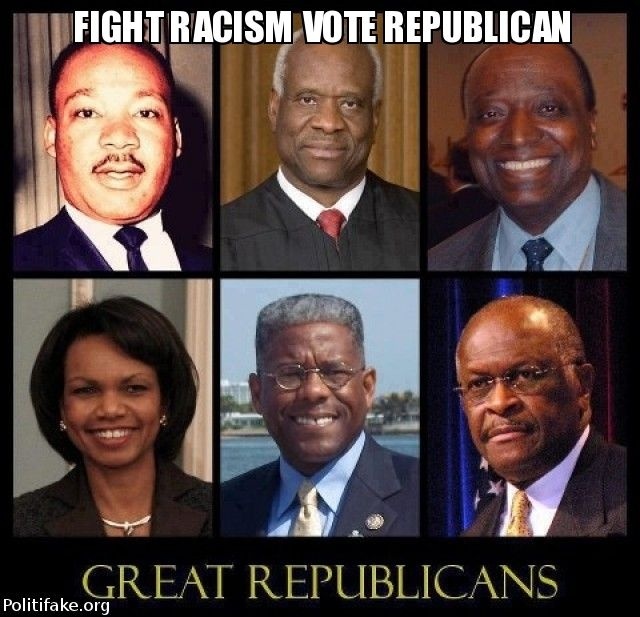
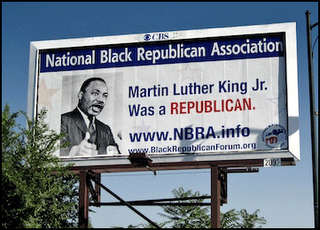
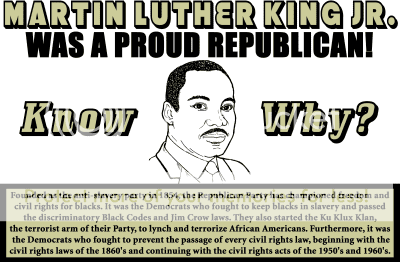
As the leader of the SCLC, King maintained a policy of not publicly endorsing a U.S. political party or candidate: "I feel someone must remain in the position of non-alignment, so that he can look objectively at both parties and be the conscience of both—not the servant or master of either."
[45] In a 1958 interview, he expressed his view that neither party was perfect, saying, "I don't think the Republican party is a party full of the almighty God nor is the Democratic party. They both have weaknesses ... And I'm not inextricably bound to either party."
[46]
King critiqued both parties' performance on promoting racial equality:
Actually, the Negro has been betrayed by both the Republican and the Democratic party. The Democrats have betrayed him by capitulating to the whims and caprices of the Southern Dixiecrats. The Republicans have betrayed him by capitulating to the blatant hypocrisy of reactionary right wing northern Republicans. And this coalition of southern Dixiecrats and right wing reactionary northern Republicans defeats every bill and every move towards liberal legislation in the area of civil rights.
[47]
Although King never publicly supported a political party or candidate for president, in a letter to a civil rights supporter in October 1956 he said that he was undecided as to whether he would vote for
Adlai Stevenson or
Dwight Eisenhower, but that "
In the past I always voted the Democratic ticket."
[48] In his autobiography, King says that in 1960
he privately voted for Democratic candidate John F. Kennedy: "I felt that Kennedy would make the best president. I never came out with an endorsement. My father did, but I never made one." King adds that he likely would have made an exception to his non-endorsement policy for a second Kennedy term, saying "Had President Kennedy lived, I would probably have endorsed him in 1964."
[49] King supported the ideals of democratic socialism, although he was reluctant to speak directly of this support due to the anti-communist sentiment being projected throughout America at the time, and the association of socialism with communism. King believed that capitalism could not adequately provide the basic necessities of many American people, particularly the African American community