Introduction:
Science fiction deals with improbable possibilities, fantasy with plausible impossibilities. Automation of rote tasks like order taking should shock no one.
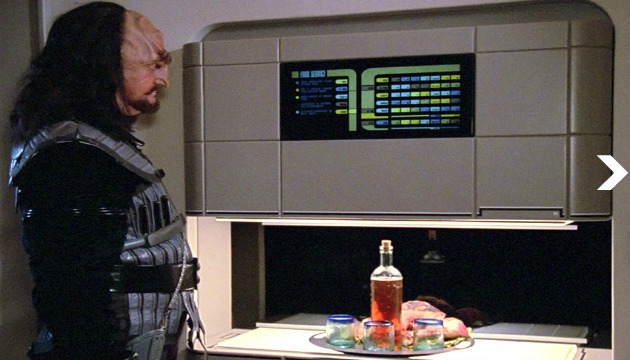
Star Trek: The Next Generation (TNG) showed us food replicators. Even though automatically and instantly synthesizing food itself was far off, it was clear even in 1987 that it was just a matter of time before the order-taking aspect of what the food synthesizer did would become automated.
In other words, when watching shows like TNG, viewers are called to notice the foretelling not of the "automobile," but of the "traffic jam." Sci-fi gives us a glimpse at future processes every bit as much as future products. Focus on the latter and ignore the former at your peril.
Reading the Writing on the Wall
Just what the hell were people thinking when they watched TNG? Did they not see what I and, apparently, what the makers of McDonald's cashier kiosks saw?
- The machine takes an order.
- The (seemingly same - I don't know, but it doesn't matter) machine produces the items ordered.
- The machine delivers the ordered items to the customer.
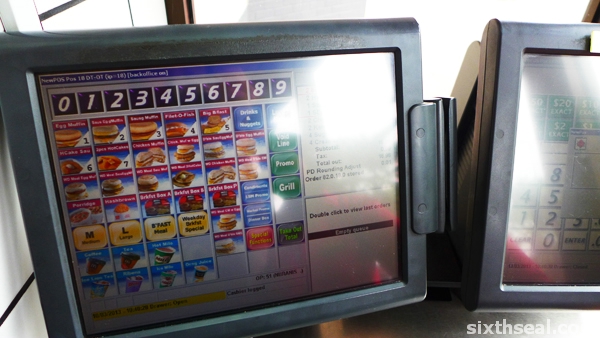
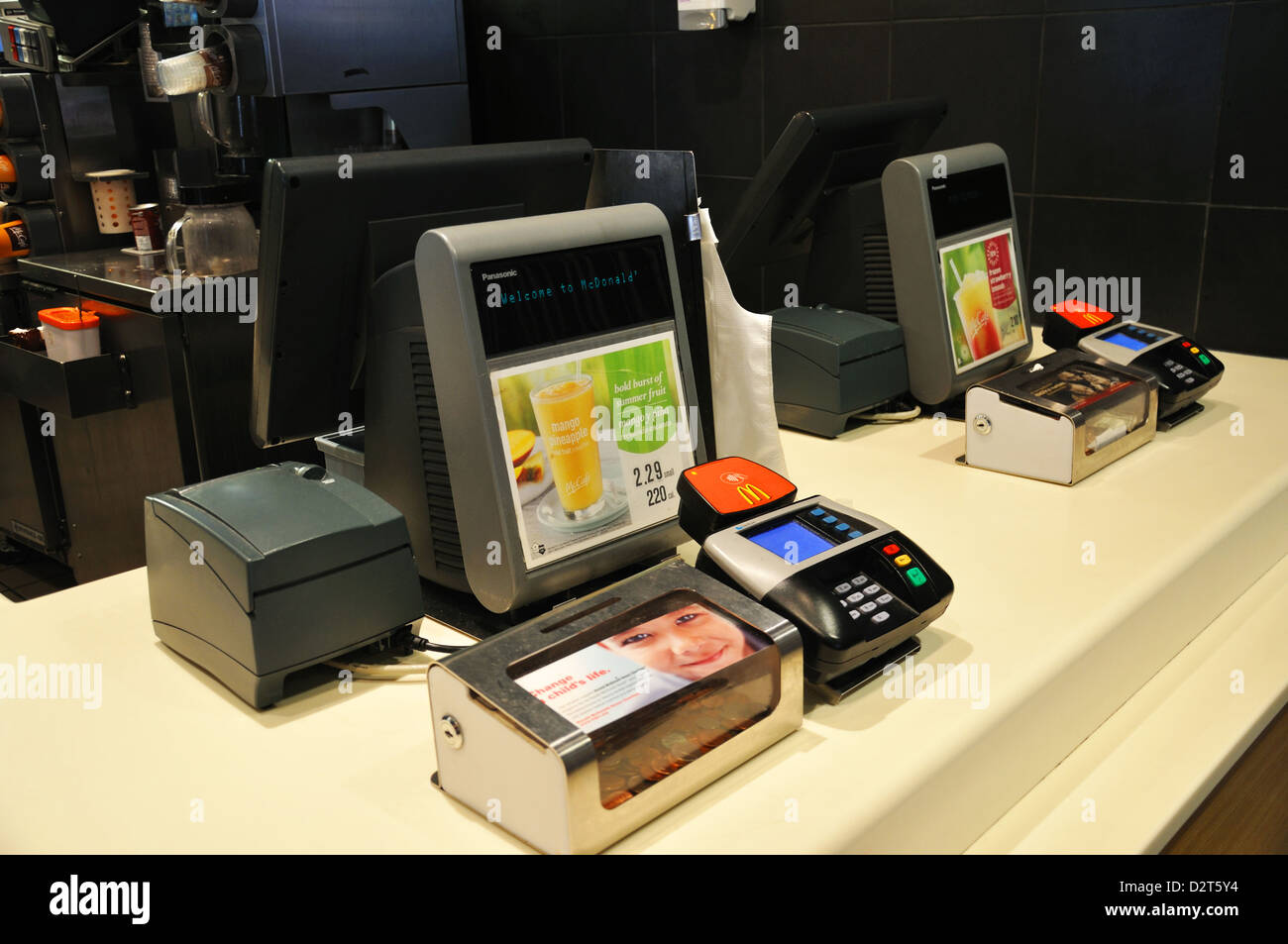
In the late 1980s and 1990s, even today, any observer will know that we are nowhere near having machines generate out of "ether" a steak, glasses, a bun and wine. On the other hand, even then, the order taking aspect was just a matter of time. And when should one have realized the time was nigh? The moment one saw pressure activated touch screens [1], or if not then certainly by the time we saw hepatic touchscreen registers.
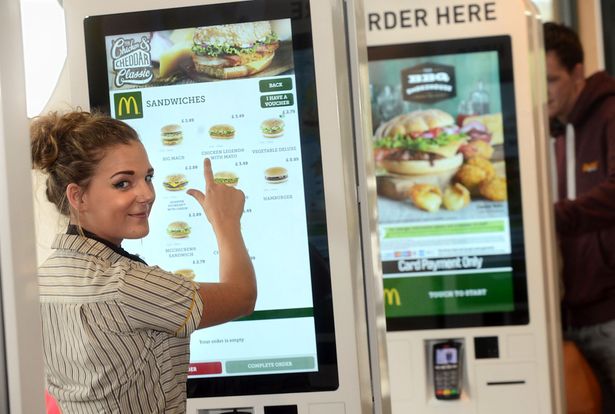
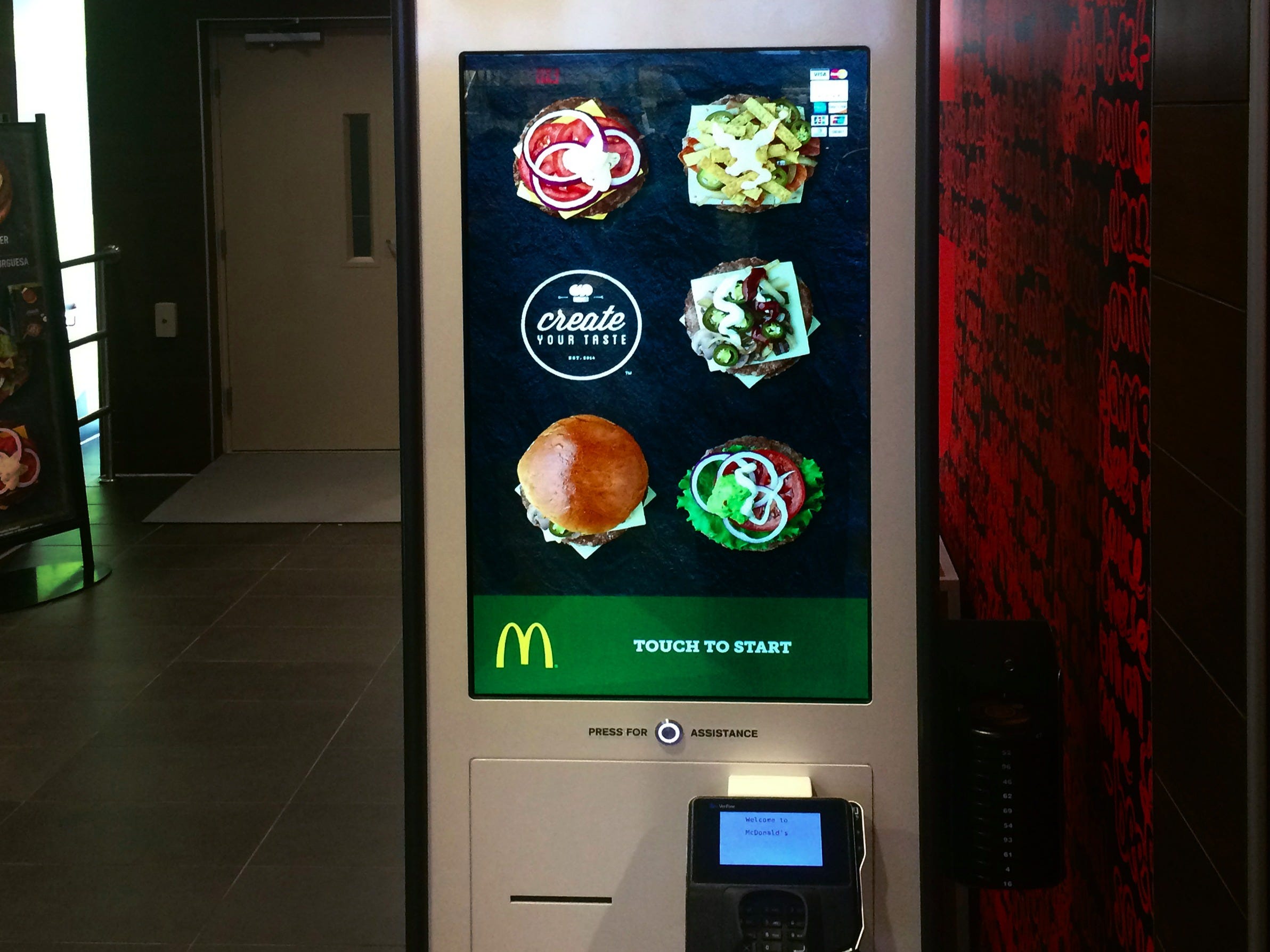
Just what is the kiosk below other than a prettier and far version of the registers above? Let's be real. When you order at a McDonald's having registers like those above, you don't hear the cashier hollering order to a line cook as might have happened in a short order diner.
And the ordering kiosks need not even be that large...there're reasons why they are, and if someone wants to know what they are, ask.
Think! Think! Just how different is the self service kiosk from a typical McDonald's cash register? Just how different is the process McDonald's is implementing from that at your local grocery store, Home Depot or Walmart?
It's not different at all. The customer selects what she wants to buy, informs the seller of what she demands and pays for it. The only difference is that at goods stores, the customer also obtains the item(s) she wants, whereas at a restaurant, the seller delivers the food to the customer.
Aside from having user prompts, the self-service kiosks do not materially differ from the one's McDonald's employees have long used. Just how hard do you think it is to take existing cash register code and insert some prompts so that customers can place their own food order? It's literally child's play so long as one is well organized and logical in one's thinking.
The economic and social realities:
People need not like the economic realities, but disliking them and complaining about them doesn't alter them. The principles of economic theory are not opinions.
The matter of wages is never really about how much people on average earn, but rather whether their earning keep pace with the rise in goods and service prices. It's about what goods and services people can afford, not the absolute sum being paid/earned.
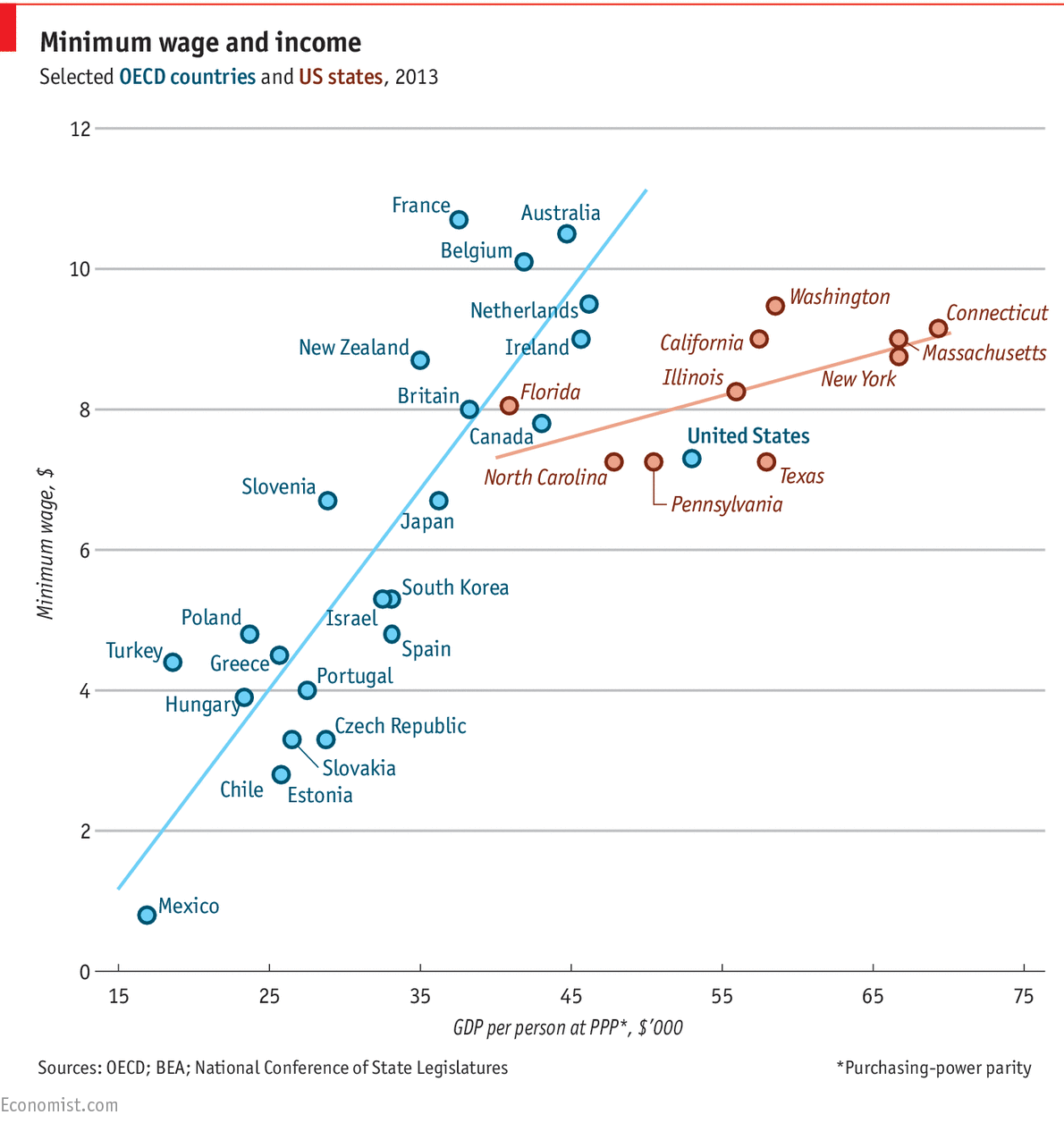
America as a whole is an outlier among advanced economies. Given the pattern across the rest of the OECD, a group of mostly rich countries, one would expect America, where GDP per person is $53,000, to pay a minimum wage around $12 an hour. That would mean a raise of about 65% for Americans earning the minimum pay rate. Be that as it may, the question is not whether $15 or $12 per hour is on par with other OECD nations, but rather whether $7.25, $12, or $15 is enough for a person to live as should a low wage earning, frugal, independent adult having no job alternative (at that moment) would in the U.S.
In the Roaring '20s, prices increased after the war, and wages kept pace with them. Life was, leaving social and socioeconomic issues out of it, good, hence the name for the era.
The war "over there" left Europe and the Middle East in need of rebuilding and the U.S. was primed and ready to produce everything the rest of the world needed. And that is exactly what the U.S. did, thus the "roar" of the 1920s. [2]
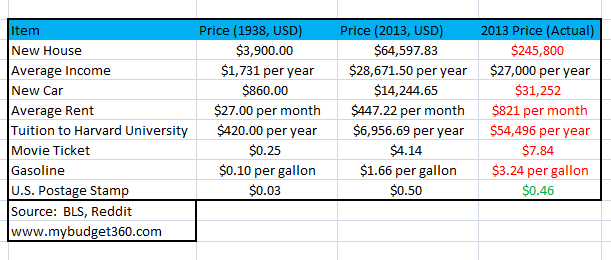
So where are wages from an affordability standpoint? Well, to be sure, one can compare non-inflation adjusted prices over time as the AEI did in a 2014 essay it published. If one does, things will look better now than 60 years ago. To wit...
Another way to "mess with" the presentation is to depict expensive items that most people buy infrequently and show them alongside inexpensive and more frequently purchased goods. The chart above depicts non-inflation adjusted figures showing how long one would have (have had) to work to afford the items shown at the wages shown.
How many Americans buy or rent housing without the cost of major appliances being part of the mortgage or rent? Few; thus while it's didactically interesting that in 2013 it takes a $19.30/hour ($40K/year) worker 23 hours to obtain the cash needed to buy a washing machine, just how many washing machines do think that worker bought between 1973 and 2013? Even looking at the goods noted, there's a problem. Of the items shown, how much advancement do you suppose has to happen for folks to replace those extant and working durable goods with a new one? Take the TV. People fairly well flocked to replace their CRT TVs with flat screens. Now there are fancier flat screens, like AMOLED ones perhaps, but is there a crush to replace "standard" plasma/LED TVs with AMOLED ones? Only among certain classes of consumers -- mainly enthusiasts and "rich-enough" folks who, respectively, feel pressed to do so or who just can so they do.
(Note: Replacing some durable goods for emotional reasons, such as their looking un-stylish, is a different matter. That's called redecorating, not replacing a refrigerator, and it is a hugely discretionary purchase in comparison with replacing one that no longer functions properly. I don't know what the figures would be for car prices, but seeing that chart above, the first thing that came to mind was why isn't a car shown?
The point is that affordability must be considered both in the abstract, as in the chart above, as well as in reality, which means the cost of certain kinds of goods is a poor barometric surrogate for/illustrator of affordability. The reality is that a person buying durable goods in 2013 probably wasn't buying any such goods in 1973. Who might have been? People who are quite old now and whose durable item has died, and are they working and thus able to experience increasing wages? No. So, yes, nice graphic and good data, but it's total sophistry to apply that data in support of an argument that affordability has increased in real terms.
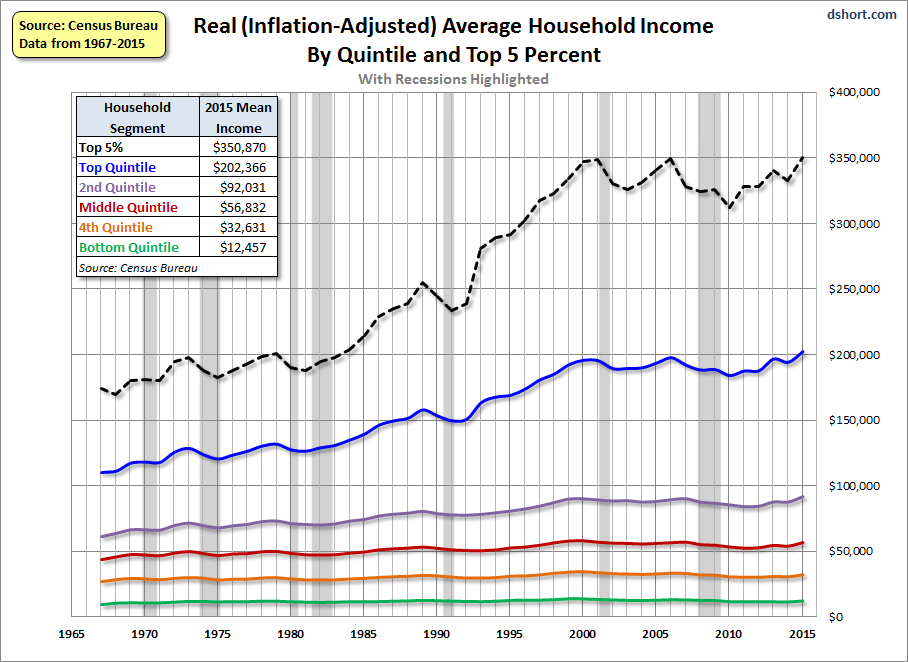
Another problem with that chart above is that it conveniently goes from 1973 to 2013. What does one find when examining wages from the 1970s to the present?
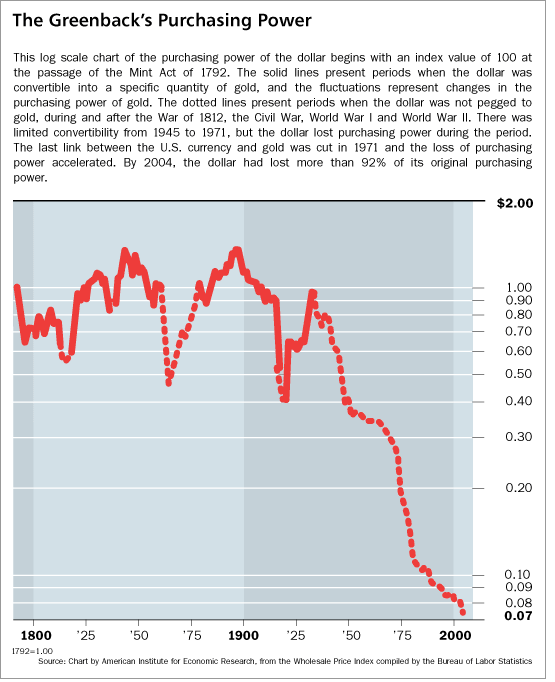
You surely notice that when adjusted for the general increase in goods and services prices, the slight incline the green, orange and red lines had is gone. Even the slope of the purple line is dramatically less. What does that imply? It implies that individuals in those income ranges have less purchasing power today than they did in 1973. That should come as no surprise given what you see in the "mybudget" chart above. If one needs a straight on depiction of that, here. (Don't make anything of the slope of the chart below; the one below places the dependent quantity on a log scale so the chart can cover 200 independent units.)
People like to say "the rich get richer and the poor get poorer." That's not actually what happens. The poor don't really get poorer; they just can't afford to buy as much stuff. The rich do get richer and they do so at a rate well ahead of inflation.
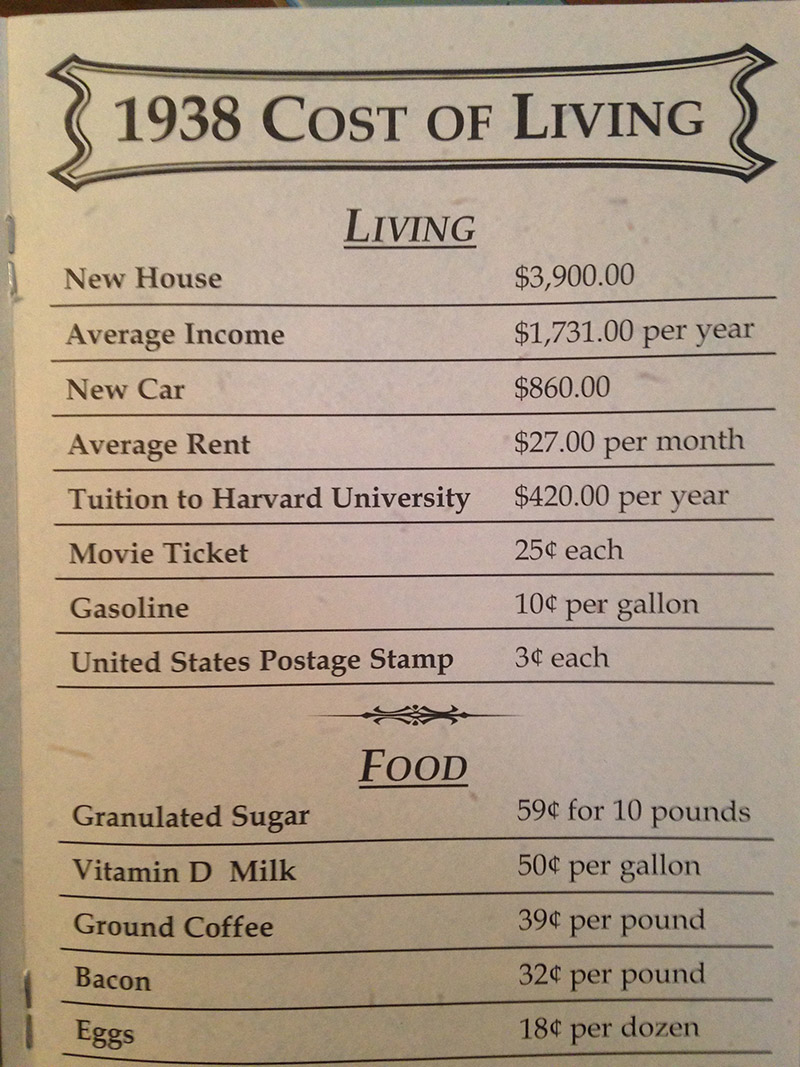
What does 10 lbs of sugar cost today? To best inflation, the price must be less than $10.
How about a gallon of vitamin D milk? If the price bests inflation, it will cost less than $8.56. We all know it costs far less than that.
There are many factors that contribute to certain goods prices being dramatically less expensive today than a long time ago. One of the major reasons is the efficiency deriving from technology implementations in the production and delivery of commodities and low price branded goods. In short, producers and sellers of those goods can, with the implementation of cost saving technology and processes, continue to make what they consider a suitable profit and do so without having to increase the price at or above the rate at which prices in general increase.
Coming finally back to our McDonald's case study example, one sees that manifest. In 1955, a cheeseburger was $0.19.
If the price of McDonald's cheeseburgers keep pace with inflation, they should cost $1.71. Well,
two cheeseburgers cost $2.00.

Dealing with the Forbes article:
You know what allows low price sellers to remain competitive as low price sellers? Replacing labor with capital, which is precisely what the McDonald's self-service kiosks are. So what you need to ask yourself is this: do you want to continue to find low prices at places like McDonald's? The fact is that whether you do or not, by lowering their food service delivery costs, McDonald's Corporation and its franchisees can realize greater profits. That's a win-win for the corporation and for the franchisee, the latter being one of the small business owners for whom Ed Rensi seems so concerned.
From/regarding the Forbes article:
McDonald’s announced the nationwide roll-out of touchscreen self-service kiosks.
Because the kiosk deployment is nationwide rather than limited to locales where the minimum wage is $15, it stands to reason that the kiosks are more cost effective than is paying a cashier, regardless of whether a cashier earns $7.25 or $15.00 per hour. While the kiosk implementation roughly coincides with the $15/hour wage hike, that it does cannot rationally be taken as evidence the price increase catalyzed cashier automation.
Not all businesses have the capital necessary to shift from full-service to self-service.
Of course some will fail to make that change and also offer nothing that motivates consumers to buy their goods. Those businesses will close. There's no reason to think that minimizing operational process costs is the only dimension where businesses must be able to remain competitive. Business owners can opt to fall somewhere on the spectrum between artisanal and mass market. If they want to play in the latter end of the marketplace, being able to generate revenues that allow them to keep pace with technology advances is a core competency at which they must excel.
Rensi makes out as though his having foreseen that happening was surprisingly prescient on his part. Well, I have news for him. Anyone who took Marketing and Microeconomics 101 would make the same prediction because that's just how textbook is his prediction. Rensi equates his predictive ability with lamentations about small businesses collapsing. Well, just what does he think a McDonald's franchise is? A multinational corporation?
Customers have a limit to what they will pay for service.
Yes, they do. In the context Rensi's essay, however, it's important to note what Rensi does not. Businesses need to make a profit.
The Fight for $15 was always more a creation of the left-wing Service Employees International Union (SEIU) rather than a legitimate grassroots effort. Reuters reported last year that, based on federal filings, the SEIU had spent anywhere from $24 million to $50 million on the its Fight for $15 campaign, and the number has surely increased since then.
Well, sure to some degree, but the union's concerns and actions are tangential to what lies at the heart of the matter. The heart of the matter is about large, profitable and innovative businesses besting their competitors as businesses. Rensi can wax romantic about "grassroots efforts and mom and pop," and so on, but the fact is that it's all about the "trophy and the race," not the "horse." If mom and pop want to play the game of business, they can, but if they don't keep that in mind, the race is what they will lose for their competitors are there to win, not merely to say they "ran."
Seen in that light, the union role is very clear. Unions have members in large organizations, not at mom and pop establishments. Thus, for as much as there would seem to be animosity between unions and big corporation management, the reality is that they have a far more symbiotic relationship that it seems by looking at the superficial haranguing that makes the news.
What annoys me about stories like the one Forbes ran:
Let me very clear here. Whether the minimum wage rises, stays the same or fall is not what bothers me. What disconcerts me is people, presumably bright people, advancing the notion that it is the wage increase that is the problem. The wage increase isn't the problem. The problem is that for decades modern Western society has given us visible indicators of what was to come and now that "tomorrow" has become "today," people are up in arms over it and making out as though legislators who stipulate a higher minimum wage are the ones to blame.
The blame lies with the people who watched TNG and who saw cashiers using touchscreen registers. For what are they culpable? For seeing those things and not saying to themselves:
"Oh, my. Look at how technology will change the way work is performed. I don't know when that's going to happen, but given given what I see before me, not just in sci-fi entertainment but also in the real world, I better take steps now to minimize or eliminate the risk that the changes adversely affect me. What can I do that will allow me to embrace the change when it comes? Maybe I could, instead of buying that "whatever," spend that money at my
local community college to learn how to do something that pays halfway decently and that won't be replaced by technology before I am ready to retire."
That's the worker side of the picture. What about the business owner side? To be sure a bit more savvy is needed and expected of capitalists, entrepreneurs. Owners have to realize that the key to being able to keep up is business growth. Thinking about McDonald's franchisees, what distinctive competency and innovation do do those franchise owners bring to the table? Little to none if you ask me. The product isn't their innovation. The process isn't their innovation. Quite simply they are merely financiers of McDonald's brand and product and what they get in return for spreading those things is the profit from operating a McDonald's restaurant.
It's absurd to think that there's anywhere to grow under that model. The growth is limited by the potential traffic flow into a given store. Great reward comes from innovation, not from exploiting an existing and very mature innovation. Business owners (potential business owners) should understand that. It's why the owner-creators of new restaurants that offer something existing ones do not stand to make handsome profits. (Whether they do depends on a variety of factors, but the point here is that the potential to do so exists whereas it does not exist as the owner of a single unit restaurant franchise.)
Notes:
[1] -- I mean the type that require two contact points -- one inside the device and one on its surface.
[2]
Sorry the very start has the crappy audio. It clears up soon after.
If you actually watch the video above, you'll (hopefully) understand why it is politically advantageous for presidential administrations in our fractiously partisan political times to, despite their claims about reducing the debt, increase the national debt as much as they think they can get away with doing. If you think that'll be any different with Trump, you need to do more than watch that one video.