How the GOP became the “White Man’s Party”
The 1964 presidential election marked the beginning of the realignment we live with today. Where in 1962 both parties were perceived as equally, if tepidly, supportive of civil rights, two years later 60 percent of the public identified Democrats as more likely to pursue fair treatment, versus only 7 percent who so identified the Republican Party. What happened?
Groundwork for the shift was laid in the run-up to the 1964 election by rightwing elements in the Republican Party, which gained momentum from the loss of the then-moderate Nixon to John F. Kennedy in 1960. This faction of the party had never stopped warring against the New Deal. Its standard bearer was Barry Goldwater, a senator from Arizona and heir to a department store fortune. His pampered upbringing and wealth notwithstanding, Goldwater affected a cowboy’s rough-and-tumble persona in his dress and speech, casting himself as a walking embodiment of the Marlboro Man’s disdain for the nanny state. Goldwater and the reactionary stalwarts who rallied to him saw the Democratic Party as a mortal threat to the nation: domestically, because of the corrupting influence of a powerful central government deeply involved in regulating the marketplace and using taxes to reallocate wealth downward, and abroad in its willingness to compromise with communist countries instead of going to war against them. Goldwater himself, though, was no racial throwback. For instance, in 1957 and again in 1960 he voted in favor of federal civil rights legislation. By 1961, however, Goldwater and his partisans had become convinced that the key to electoral success lay in gaining ground in the South, and that in turn required appealing to racist sentiments in white voters, even at the cost of black support. As Goldwater drawled, “We’re not going to get the Negro vote as a bloc in 1964 and 1968, so we ought to go hunting where the ducks are.”
This racial plan riled more moderate members of the Republican establishment, such as New York senator Jacob Javits, who in the fall of 1963 may have been the first to refer to a “Southern Strategy” in the context of repudiating it. By then, however, the right wing of the party had won out. As the conservative journalist Robert Novak reported after attending a meeting of the Republican National Committee in Denver during the summer of 1963: “A good many, perhaps a majority of the party’s leadership, envision substantial political gold to be mined in the racial crisis by becoming in fact, though not in name, the White Man’s Party. ‘Remember,’ one astute party worker said quietly . . . ‘this isn’t South Africa. The white man outnumbers the Negro 9 to 1 in this country.’ ” The rise of a racially-identified GOP is not a tale of latent bigotry in that party. It is instead a story centered on the strategic decision to use racism to become “the White Man’s Party.”
Yet, heralding the incipient emergence of the new politics of party alignment along racial lines, Barry Goldwater also voted against the civil rights bill. He was one of only five senators from outside the South to do so. Goldwater claimed he saw a looming Orwellian state moving to coerce private citizens to spy on each other for telltale signs of racism. “To give genuine effect to the prohibitions of this bill,” Goldwater contended from the Senate floor, “bids fair to result in the development of an ‘informer’ psychology in great areas of our national life—neighbor spying on neighbor, workers spying on workers, businessmen spying on businessmen.” This all seemed a little hysterical. More calculatingly, it could not have escaped Goldwater’s attention that voting against a civil rights law associated with blacks, Kennedy, and Johnson would help him “go hunting where the ducks are.”
....
Running for president in 1964, the Arizonan strode across the South, hawking small-government bromides and racially coded appeals. In terms of the latter, he sold his vote against the 1964 Civil Rights Act as a bold stand in favor of “states’ rights” and “freedom of association.” States’ rights, Goldwater insisted, preserved state autonomy against intrusive meddling from a distant power—though obviously the burning issue of the day was the federal government’s efforts to limit state involvement in racial degradation and group oppression. Freedom of association, Goldwater explained, meant the right of individuals to be free from government coercion in choosing whom to let onto their property—but in the South this meant first and foremost the right of business owners to exclude blacks from hotels, restaurants, movie theaters, and retail establishments. Like Wallace, Goldwater had learned how to talk about blacks without ever mentioning race.
Another factor also worked against Goldwater: he was a Republican, and the South reviled the Party of Lincoln. If across the nation neither party was seen as more or less friendly toward civil rights, the South had its own views on the question. There, it was the local Democratic machine that represented white interests, while the GOP was seen as the proximate cause of the Civil War and as the party of the carpetbaggers who had peremptorily ruled the South during Reconstruction. The hostility of generations of white Southerners toward Republicans only intensified with the Republican Eisenhower’s decision to send in federal troops to enforce the Republican Warren’s ruling forbidding school segregation in Brown. Most white Southerners had never voted Republican in their lives, and had vowed—like their parents and grandparents before them— that they never would.
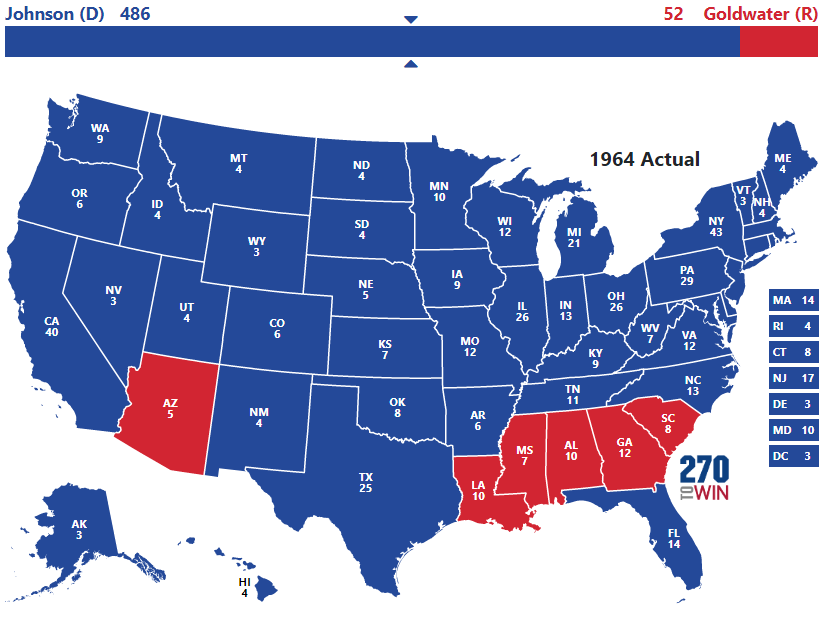
Ultimately, however, these handicaps barely impeded Goldwater’s performance in the South. He convinced many Southern voters to vote Republican for the first time ever, and in the Deep South, comprised of those five states with the highest black populations, Goldwater won outright. The anti-New Deal Republican carried Louisiana, Georgia, Alabama, Mississippi, and South Carolina, states in which whites had never voted for a Republican president in more than miniscule numbers. This was a shocking transformation, one that can only be explained by Goldwater’s ability to transmit a set of codes that white voters readily understood as a promise to protect racial segregation.


 You keep saying Democrat like it means something. They were Southern, white Christian conservatives that started the KKK and they are still, predominantly, southern, white Christians conservatives.


