https://www.jewishvirtuallibrary.org/jsource/myths3/MFrefugees.html#2
MYTH
Palestinians were the only people who became refugees as a result of the Arab-Israeli conflict.
FACT
Although much is heard about the plight of the Palestinian refugees, little is said about the Jews who fled from Arab states. Their situation had long been precarious. During the 1947 UN debates, Arab leaders threatened them. For example, Egypts delegate told the General Assembly: The lives of one million Jews in Muslim countries would be jeopardized by partition. 3
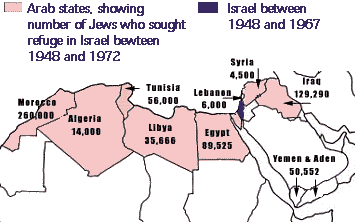
Corresponding refugees, 1948-1972
The number of Jews fleeing Arab countries for Israel in the years following Israels independence was nearly double the number of Arabs leaving Palestine. Many Jews were allowed to take little more than the shirts on their backs. These refugees had no desire to be repatriated. Little is heard about them because they did not remain refugees for long. Of the 820,000 Jewish refugees between 1948 and 1972, 586,000 were resettled in Israel at great expense, and without any offer of compensation from the Arab governments who confiscated their possessions. 4 Israel has consequently maintained that any agreement to compensate the Palestinian refugees must also include Arab reparations for Jewish refugees. To this day, the Arab states have refused to pay anything to the hundreds of thousands of Jews who were forced to abandon their property before fleeing those countries. Through 2010, at least 153 of the 914 UN General Assembly resolutions on the Middle East conflict (17 percent) referred directly to Palestinian refugees.5 Even in 2014, the Jewish refugees from Arab countries have not been mentioned in any significant UN resolution.
The contrast between the reception of Jewish and Palestinian refugees is even starker when one considers the difference in cultural and geographic dislocation experienced by the two groups. Most Jewish refugees traveled hundreds -- some traveled thousands -- of miles to a tiny country whose inhabitants spoke a different language. Most Arab refugees never left Palestine at all; they traveled a few miles to the other side of the truce line, remaining inside the vast Arab nation that they were part of linguistically, culturally and ethnically.
While Palestinians consider the refugee issue to be among the most important issues for them, the Jewish refugees from Arab countries should not be forgotten. Moreover, the basis for Israeli-Palestinian negotiations, UN Security Council Resolution 242, does not mention Palestinians at all and can apply equally to Jewish refugees.
In fact, to that effect, Congress passed a resolution in 2008 about Middle East refugee populations that encourages the U.S. to use its influence and voice to ensure "that any resolutions relating to Middle East refugees, which include reference to the required resolution of the Palestinian refugee issue, must also include a similarily explicit reference to the resolution of the issue of Jewish refugees from Arab countries." The bill also addresses the need to address the rights of all refugees, including but not limited to Jews and Christians displaced from Middle East countries.