Numbers are real if it's Trump, not if it's Obama's.
We are still under Obama's economy. It's still his budget for the fiscal year. Jobs have been added under Obama's policies, and Trump is taking credit for it.
Trickle down does not create jobs. Period.
That is so, and people who pay attention to details and rightly consider them when forming their opinions take that into consideration when remarking on the performance of the Trump Administration's actions and policies. Perfunctory and/or purely partisan "pundits," observers and "arm chair" analysts merely go by what they observe in relation to the calendar, unless of course, the results are unfavorable, in which case they attribute the observed performance to "the other guy."
Case in point. When did the "Great Recession" begin to ebb? Summer of 2009, with some peeks in its effects, most notably for this discussion,
unemployment, reversing in 2010.
As an addendum to my comments above...
It's worth noting that the labor force participation rate, as it has for mearly the last decade, will decrease over lustrum to decade so no matter who's POTUS.
It will do so until Millennials, who actually outnumber Baby Boomers, fully ensconced in the workplace/-force, thereby replacing retiring/dying Baby Boomers. (That is to say having a job that corresponds to whatever is their career, not merely being employed at "some job." It won't be until 2028 that enough Baby Boomers will have retired and/or died so that Gen X-ers outnumber them.)
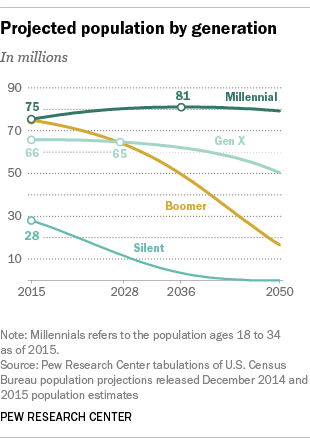

The number of Boomers has peaked in 2015?.......10 million more will "die off" during the next 10 years. Interesting. 1 million per year or 2739/day? Looks like a boon for dead body handlers.
With Trumps' Job Boom will there become a shortage of workers? Will the younger Boomers find a way back into the Labor Force? note: Many boomers would continue to work but employers discriminate due to health care costs IMVHO.
If Trump runs off 10million working age Illegals........whatever will he do? Bring in Euros? Euros do not want to landscape or clean Motel 6 rooms..........ahhhh I am getting ahead of myself. tsk tsk.
The number of Boomers has peaked in 2015?
Do you mean peaked as in "the largest quantity of Boomers to be alive at a given point in time?" Or do you mean "the the time when Boomers represented the largest quantity of people in the workforce/-place?"
The answer to the first question is that Boomers' numbers peaked in 1964, the last year of the Baby Boom and the time when the Baby Boomer generation had suffered the least impact from deaths and infirmity that it possibly could and ever will.
The answer to the second question, I think with regard to the context I've given -- people working at their "career job" rather just at "a job" - is that Boomers still are the largest group in the workforce/-place, but with our aging and dying, we won't, as a generation group, for much longer hold that status. I'm soon to be 60 and I'll retire at some point between 60 and 62, assuming I don't first die.
With Trumps' Job Boom will there become a shortage of workers?
Strictly/macroeconomically speaking a worker "shortage" is what happens when an economy is at or below what's called "
structural unemployment," (see also:
Unemployment types and
Making Sense of Unemployment Data - Page One Economics - St. Louis Fed) which, at the national level, economists put variously between 4% and 6%. Structural unemployment that exists due to a host of short-term factors, but the short of it, simply put, is that it's the rate of unemployment that is unavoidable. Accordingly, the U.S. economy has, in essence, had a worker shortage,
i.e., been at structural unemployment levels, for quite some time.
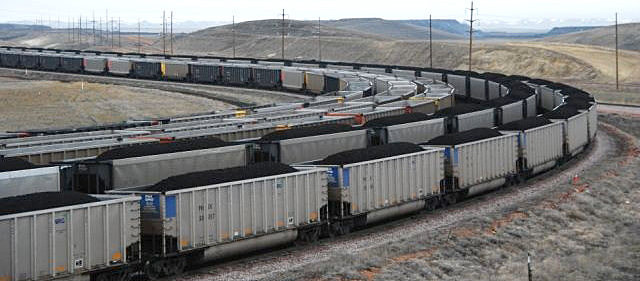
What the structural unemployment rate should be at any given period of time can vary depending on where certain numerically significant industries are in their life cycle with regard to the economy in question. (The industry life cycle is not the same thing as the business cycle. Coal, for example, is reaching the end of its industry life cycle, whereas bioengineering is likely still in its nascence.) It's normal and perfectly fine that industries appear, grow, exist in a mature phase, decline and eventually disappear so long as something -- one or several other industries -- come about to replace the ones that cease to exist. As workers and creators of future workers, it's our "job" to notice what be the emergent industries and guide our children to develop the skills needed by employers in those industries, or, with regard to ourselves, ensure we possess or obtain while we still have "good jobs/careers" the requisite skills that will, at worst, remain in demand by industries that are currently in a mature state. Having the skills needed to work in a declining industry is only useful if one already has a job in that industry and one can be sure their job won't disappear before they no longer want/need to work in that industry.