temperature
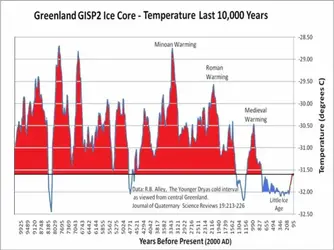
As we get closer to the present the data gets more accurate and we can spot small fluctuations on top of larger trends - this is one reason it feels that things are happening faster. Though things have basically been warming up in the last 16 thousand years, there was a severe cold spell between 12.9 and 11.5 thousand years ago: the Younger Dryas event.
(I love that name! It comes from the tough little Arctic flower Dryas octopetala, whose plentiful pollen in certain ice samples gave evidence that this time period was chilly. Before the Younger Dryas there was a warm spell called the Allerød, and before that a cold period called the Older Dryas.)
Anyway, the Younger Dryas lasted about 1400 years. Temperatures dropped dramatically in Europe: about 7°C in only 20 years! In Greenland, it was 15° C colder during the Younger Dryas than today. In England, the average annual temperature was -5° C, so glaciers started forming. We can see evidence of this event from oxygen isotope records and many other things.
Why the sudden chill? One theory is that the melting of the ice sheet on North America lowered the salinity of North Atlantic waters. This in turn blocked a current called the "Atlantic thermohaline circulation", or the Conveyor Belt for short, which normally brings warm water up the coast of Europe. Proponents of this theory argue that this current is what makes London much warmer than, say, Winnipeg in Canada or Irkutsk in Russia. Turn it off and - wham! - you'll get glaciers forming in England.
So, ironically, global warming may have brought on a sudden deep freeze in Europe. Some scientists are worried that we could be in for a repeat of the Younger Dryas if we keep melting the Arctic ice sheets at the rate we're doing now. For more, try:

 can't be...can it?