get ready, photonics is right around the corner

scruffy

Diamond Member
Joined
Mar 9, 2022
Messages
30,086
Reaction score
26,745
Points
2,788
Look at the names here - all Chinese.


This is one area where we absolutely can not allow the Chinese to gain a competitive advantage.

Photonics is going to make today's AI completely obsolete. And it'll happen overnight. You'll know it when nVidia stock plummets.

Photonics is the first and only technology that can integrate neural networks with quantum computers.
 
Piece of cake.....
:aargh::aargh: :aargh:

Abstract​


A Fabry–Pérot enhanced resistive random-access memory (FP-RRAM) comprising an Ag/BFO/ITO stack integrated with a distributed Bragg reflector (DBR) is demonstrated, enabling dual electrical and optical memory readout. Well-separated cavity resonances allow reliable optical discrimination between high- and low-resistance states. Cross-sectional transmission electron microscopy (TEM) coupled with energy-dispersive X-ray spectroscopy (EDS) mapping reveals spatially localized Ag migration and oxygen-vacancy filament formation, collectively modulating the effective permittivity of the BFO layer. Momentum-resolved reflectance measurements and finite-difference time-domain (FDTD) simulations further validate that resistive switching tunes the cavity eigenmode through changes in the effective refractive index. Combined electrical and optical characterization exhibits pronounced hysteresis and bistability, with robust retention and synchronized modulation observed up to a 50-ms timescale. By employing the Maxwell–Garnett effective medium approximation, ionic reconfiguration with optical response, revealing sharp increases in both Ag and oxygen-vacancy volume fractions at the set threshold, with Ag migration dominating the switching kinetics is quantitatively correlated. This integrated structural, optical, and theoretical analysis directly links nanoscale filament dynamics with macroscopic photonic modulations. Additionally, the FP-RRAM demonstrates linear optical weight updates with enhanced state resolution for precise synaptic modulation, leading to higher recognition accuracy than purely electrical programming. These results establish FP-RRAM as a reliable, electrically programmable, and optically addressable memory platform, offering a promising avenue for neuromorphic and photonic computing applications.
 
Piece of cake.....
:aargh::aargh: :aargh:

Abstract​


A Fabry–Pérot enhanced resistive random-access memory (FP-RRAM) comprising an Ag/BFO/ITO stack integrated with a distributed Bragg reflector (DBR) is demonstrated, enabling dual electrical and optical memory readout. Well-separated cavity resonances allow reliable optical discrimination between high- and low-resistance states. Cross-sectional transmission electron microscopy (TEM) coupled with energy-dispersive X-ray spectroscopy (EDS) mapping reveals spatially localized Ag migration and oxygen-vacancy filament formation, collectively modulating the effective permittivity of the BFO layer. Momentum-resolved reflectance measurements and finite-difference time-domain (FDTD) simulations further validate that resistive switching tunes the cavity eigenmode through changes in the effective refractive index. Combined electrical and optical characterization exhibits pronounced hysteresis and bistability, with robust retention and synchronized modulation observed up to a 50-ms timescale. By employing the Maxwell–Garnett effective medium approximation, ionic reconfiguration with optical response, revealing sharp increases in both Ag and oxygen-vacancy volume fractions at the set threshold, with Ag migration dominating the switching kinetics is quantitatively correlated. This integrated structural, optical, and theoretical analysis directly links nanoscale filament dynamics with macroscopic photonic modulations. Additionally, the FP-RRAM demonstrates linear optical weight updates with enhanced state resolution for precise synaptic modulation, leading to higher recognition accuracy than purely electrical programming. These results establish FP-RRAM as a reliable, electrically programmable, and optically addressable memory platform, offering a promising avenue for neuromorphic and photonic computing applications.

Okay, sorry. Here's how it rolls:

A "memristor" is a resistor with memory. It's like non volatile RAM, kind of, except instead of a digital word it stores an analog value.

It also happens, that a memristor is an "almost" perfect model neuron. It has a bistable state where it will "fire" and then return to baseline, just like a real neuron. You can put it in a simple circuit with a couple of capacitors and get a "chaotic oscillator" which is a real oscillator that never displays the same period twice.

So this paper, is suggesting a way to attach a quantum qubit directly to a memristor. Best of all, photonics takes a tiny fraction of the energy of an nVidia GPU, you could run all of ChatGPT on a 9 volt battery with photonics. It uses light, rather than wires.
 
Okay, sorry. Here's how it rolls:

A "memristor" is a resistor with memory. It's like non volatile RAM, kind of, except instead of a digital word it stores an analog value.

It also happens, that a memristor is an "almost" perfect model neuron. It has a bistable state where it will "fire" and then return to baseline, just like a real neuron. You can put it in a simple circuit with a couple of capacitors and get a "chaotic oscillator" which is a real oscillator that never displays the same period twice.

So this paper, is suggesting a way to attach a quantum qubit directly to a memristor. Best of all, photonics takes a tiny fraction of the energy of an nVidia GPU, you could run all of ChatGPT on a 9 volt battery with photonics. It uses light, rather than wires.
So like, we're going to see really lifelike robots.
 
Piece of cake.....
:aargh::aargh: :aargh:

Abstract​


A Fabry–Pérot enhanced resistive random-access memory (FP-RRAM) comprising an Ag/BFO/ITO stack integrated with a distributed Bragg reflector (DBR) is demonstrated, enabling dual electrical and optical memory readout. Well-separated cavity resonances allow reliable optical discrimination between high- and low-resistance states. Cross-sectional transmission electron microscopy (TEM) coupled with energy-dispersive X-ray spectroscopy (EDS) mapping reveals spatially localized Ag migration and oxygen-vacancy filament formation, collectively modulating the effective permittivity of the BFO layer. Momentum-resolved reflectance measurements and finite-difference time-domain (FDTD) simulations further validate that resistive switching tunes the cavity eigenmode through changes in the effective refractive index. Combined electrical and optical characterization exhibits pronounced hysteresis and bistability, with robust retention and synchronized modulation observed up to a 50-ms timescale. By employing the Maxwell–Garnett effective medium approximation, ionic reconfiguration with optical response, revealing sharp increases in both Ag and oxygen-vacancy volume fractions at the set threshold, with Ag migration dominating the switching kinetics is quantitatively correlated. This integrated structural, optical, and theoretical analysis directly links nanoscale filament dynamics with macroscopic photonic modulations. Additionally, the FP-RRAM demonstrates linear optical weight updates with enhanced state resolution for precise synaptic modulation, leading to higher recognition accuracy than purely electrical programming. These results establish FP-RRAM as a reliable, electrically programmable, and optically addressable memory platform, offering a promising avenue for neuromorphic and photonic computing applications.
/----/ Say what? I asked Gimini to simplify the technical jargon.

Here is the simplified breakdown of that study:

The Big Idea

Researchers created a new type of computer memory chip (FP-RRAM) that can be read using both electricity and light. By combining standard memory materials with a special light-reflecting structure, they turned a simple electronic switch into a color-shifting optical sensor.

How It Works

  • The Switch: Inside the device, tiny bridges made of silver and oxygen atoms form and break. This changes the device's electrical resistance.
  • The Light Trick: These physical changes also change how light moves through the material (its refractive index).
  • The Result: Because the device acts like a tiny echo chamber for light, changing the internal "bridge" changes the color or intensity of light it reflects. This allows you to "read" the memory state without even touching it with wires.

Why It Matters

  • Dual-Mode: It’s a "two-in-one" device that works for both traditional electronics and futuristic light-based (photonic) computing.
  • Smarter AI: When used like a brain cell (synapse), the light-based readout is more precise than electricity alone. This led to higher accuracy in image recognition tasks.
  • Proven Tech: Using advanced microscopes and simulations, the team proved exactly how the silver movement drives the optical change, ensuring the process is reliable and stable.

Comparison Table

FeatureStandard MemoryThis New FP-RRAM
Readout MethodElectricity onlyElectricity and Light
PrecisionStandardHigh (better for AI)
ApplicationBasic data storageNeuromorphic (brain-like) computing
 
Look at the names here - all Chinese.
Unfortunately, the library doesn't like my out of date web browser so I can't read it, I might be a chinese spy after all, shame as photons and optics is a special interest of myself.

This is one area where we absolutely can not allow the Chinese to gain a competitive advantage.
That reminds me of a program I watched many years ago speaking to this very issue mentioning how Hitachi had many chinese offices all around them on every US campus taking in the very latest technology. I used to have a buddy who did R&D at a university as a professor using some really cool stuff for mostly governmental work, defensive armor and the like; he is a real nice guy and never thought anything of any chinese students or whatever working there or passing through. Meanwhile, J. Biden let in something like 300,000 undocumented chinese and no one seems to even know where they are.

Photonics is going to make today's AI completely obsolete. Photonics is the first and only technology that can integrate neural networks with quantum computers.
Oh goody, let's put photonic brains into our best robot bodies and create an army of terminators.
 
Okay, sorry. Here's how it rolls:

A "memristor" is a resistor with memory. It's like non volatile RAM, kind of, except instead of a digital word it stores an analog value.

It also happens, that a memristor is an "almost" perfect model neuron. It has a bistable state where it will "fire" and then return to baseline, just like a real neuron. You can put it in a simple circuit with a couple of capacitors and get a "chaotic oscillator" which is a real oscillator that never displays the same period twice.

So this paper, is suggesting a way to attach a quantum qubit directly to a memristor. Best of all, photonics takes a tiny fraction of the energy of an nVidia GPU, you could run all of ChatGPT on a 9 volt battery with photonics. It uses light, rather than wires.
/-----/ "You could run all of ChatGPT on a 9 volt battery with photonics. It uses light, rather than wires."
OK, now I get it. Why didn't they say that in the first place?
 
So like, we're going to see really lifelike robots.

Maybe, yes. With photonics we no longer need a power plant the size of a city.

There are some truly wonderful applications in therapeutics. For example have you seen an actual Neuralink? They're large devices, they're going to implant this in your brain:

1769594300510.webp


With photonics this whole thing reduces to literally a wafer, about 1/10 mm on a side and about 5 microns thick. My friend who suffered paralysis after spinal surgery could have benefited greatly from this.
 
There's two main applications of these memristor devices.

If you have a "simple memristor" like in the OP you get an associative memory.

If you have a "spiking memristor" you get computational power too.

This is everything you ever wanted to know about memristors, it's long and boring and you have to get past the accent, but at the end of the day it's a pretty good summary.


And here is Leon Chua, one of the pioneers of the memristor (also long, interesting though).

 
An "optical memristor" is simply a device that can store an analog value in a recoverable way. That value could be anything, it could be amplitude, it could be phase relative to some other signal, it could be frequency related.

There's all kinds of examples of this technology in action. Here's a retina:


Here is an excellent general review:


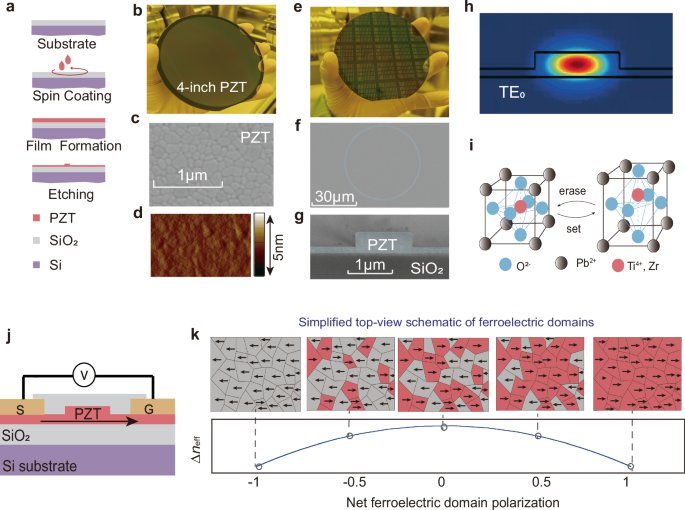
There's different kinds of these things, here's a PZT, and indium-gallium-zinc oxide is also promising.


These devices overcome the Von Neumann bottleneck in computing, which is the time it takes to get from memory to the CPU. In a memristor (and in a neuron) the memory and the CPU are the same thing.
 

New Topics

Back
Top Bottom