Nothing is according to me. It is a matter of historical record when the 16th Amendment was proposed in 1871 and the Blaine Amendment of 1875. The 1871 amendment attempted to apply the First Amendment to the states. The amendment was proposd by a member of the 39th Congress. The slaughterhouse cases had nothing to do with the Blaine Amendment and there was no mention of the slaughterhouse cases and no mention by Blaine, who was a member of the 39th Congress. The Blaine Amendment was started by a speech by Grant in 1875, and there was also no mention of the slaughterhouse cases or the incorporation of the Bill of Rights.
Then it will be remarkably easy for you to quote this 'proposed 16th amendment in 1871' and establish through evidence that it was proposed in 1871.
Please do so now.
As the Blaine amendment wasn't proposed in 1871. Nor was it proposed by the 39th congress. You've moved your goal posts.
I never said the Blaine Amendment was proposed in 1871; I stated 1875. I never stated it was proposed by the 39th Congress either. I stated that it was proposd by a member of the 39th Congress, and that member was Blaine.
It is remarkedly easy to produce the 1871 amendment. If you are asking, you shouldn't be engaging me on the subject.
If it was remarkably easy to produce the 1871 amendment,
you would have done so. You didn't. You gave me excuses instead, insinuating an argument you clearly can't back factually.
Lets try this again:
Quote this 'proposed 16th amendment in 1871' and establish through evidence that it was proposed in 1871.
And as always, you citing yourself isn't evidence. Proceed.
This is the easiest evidence.
Nothing is according to me. It is a matter of historical record when the 16th Amendment was proposed in 1871 and the Blaine Amendment of 1875. The 1871 amendment attempted to apply the First Amendment to the states. The amendment was proposd by a member of the 39th Congress. The slaughterhouse cases had nothing to do with the Blaine Amendment and there was no mention of the slaughterhouse cases and no mention by Blaine, who was a member of the 39th Congress. The Blaine Amendment was started by a speech by Grant in 1875, and there was also no mention of the slaughterhouse cases or the incorporation of the Bill of Rights.
Then it will be remarkably easy for you to quote this 'proposed 16th amendment in 1871' and establish through evidence that it was proposed in 1871.
Please do so now.
As the Blaine amendment wasn't proposed in 1871. Nor was it proposed by the 39th congress. You've moved your goal posts.
I never said the Blaine Amendment was proposed in 1871; I stated 1875. I never stated it was proposed by the 39th Congress either. I stated that it was proposd by a member of the 39th Congress, and that member was Blaine.
It is remarkedly easy to produce the 1871 amendment. If you are asking, you shouldn't be engaging me on the subject.
If it was remarkably easy to produce the 1871 amendment,
you would have done so. You didn't. You gave me excuses instead, insinuating an argument you clearly can't back factually.
Lets try this again:
Quote this 'proposed 16th amendment in 1871' and establish through evidence that it was proposed in 1871.
And as always, you citing yourself isn't evidence. Proceed.
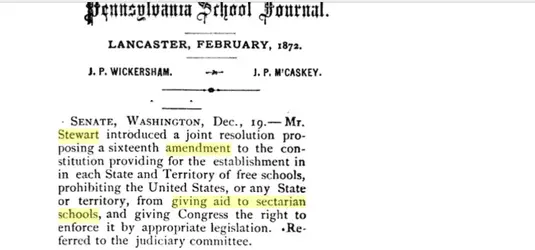
Do you want the December 19, 1871 proposed amendment by Stewart or the April 19, 1871 proposed amendment proposed by Burdett?
Here are the two amendments attempting to apply the First Amendment to the states. Both are before the Slaughterhouse cases and both are identical to the Blaine Amendment in content, which was after the Slaughterhouse cases.
Burdett's April 19, 1870 proposed amendment:
SECTION 1. No State or municipal corporation within any State of the United States shall levy or collect any tax for the support or aid of any sectarian, denominational, or religious school or educational establishment; nor shall the legislature of any State, or the corporate authorities of any municipality within any State, appropriate any money or make any donation from the public fund or property of such State or municipality for the support or aid of any sectarian, religious, or denominational schools or educational establishments.
SEC. 2. Congress shall have power to enforce this article by appropriate legislation.
Stewart's December 19, 1871 proposed amendment:
SECTION. 1. There shall be maintained in each State and Territory a system of free common schools, but neither the United States nor any State, Territory, county, or municipal corporation, shall aid in the support of any schools wherein the peculiar tenets of any denomination are taught.
SEC. 2. Congress shall have power to enforce this article by appropriate legislation.
Burdett wasn't a representative until 1869,
after the 14th amendment was proposed, written, introduced and ratified. Your claim was that the proposed amendment was made by 'members of the 39th congress'. Which Burdett was not. Making him and his proposals irrelevant to your argument.
Worse, I've reviewed the Congressional record for April 19th, 1870. There's no amendment proposed by Mr. Burdett. Nor any record of Rep. Burdett having said anything on that day. Nor the slightest mention of Burdett's 'intention' to apply the 1st Amendment to the States.
Worse still, there's no mention of 'incorporating the 1st amendment' in any of his proposals. Or those by Stewart in 1871. It wasn't until the Blaine Amendment in 1875.....2 years AFTER the Slaughter House cases, that there was any mention of incorporating the 1st amendment.
Nor did Stewart argue that his proposed amendment incorporated the 1st Amendment upon the States. That would be you.....
citing yourself.
Sigh....again.
How many questions have you dodged so far? I will have to list all of them in the next post.
Burdett wasn't a representative until 1869, after the 14th amendment was proposed, written, introduced and ratified. Your claim was that the proposed amendment was made by 'members of the 39th congress'. Which Burdett was not. Making him and his proposals irrelevant to your argument.
I never stated that Burdett was a member of the 39th Congress. Your comment is irrelevant and a dodge.
Worse, I've reviewed the Congressional record for April 19th, 1870. There's no amendment proposed by Mr. Burdett. Nor any record of Rep. Burdett having said anything on that day. Nor the slightest mention of Burdett's 'intention' to apply the 1st Amendment to the States.
That is not my problem. The amendment applied the First Amendment to the states. It is not my problem that you do not know what the First Amendment is, what it means, its concept, or its limitation to the federal government.
Worse still, there's no mention of 'incorporating the 1st amendment' in any of his proposals. Or those by Stewart in 1871. It wasn't until the Blaine Amendment in 1875.....2 years AFTER the Slaughter House cases, that there was any mention of incorporating the 1st amendment.
There is no mention of incorporation in the Blaine Amendment. And the Blaine Amendment was not even the final joint resolution.
The Burdett amendment, the Stewart amendment, the Blaine amendment, and the other Blaine amendment all had the same language, concept, and intent of applying the First Amendment to the states. It is not my problem that you do not know what the First Amendment is, what it means, its concept, or its limitation to the federal government.
The amendment applied the First Amendment to the states. It is not my problem that you do not know what the First Amendment is, what it means, its concept, or its limitation to the federal government.
Nor did Stewart argue that his proposed amendment incorporated the 1st Amendment upon the States. That would be you.....citing yourself.
There is no mention of incorporation in the Blaine Amendment. And the Blaine Amendment was not even the final joint resolution.
The Burdett amendment, the Stewart amendment, the Blaine amendment, and the other Blaine amendment all had the same language, concept, and intent of applying the First Amendment to the states. It is not my problem that you do not know what the First Amendment is, what it means, its concept, or its limitation to the federal government.