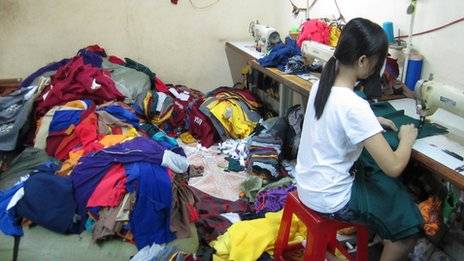
Cheap labor is and will always be sought so long as there is a monetary system firmly in place. Since we all agree that is not going anywhere soon, we should identify where these "slave like" conditions exist today.
China, Vietnam etc etc is good place to start. There are hellish work conditions in these countries. Oh, ignorance is bliss. I wonder if Tiger Woods would reject his 8 figure contract with Nike for their horrible conditions they have for workers in Vietnam. I wonder if any of the "African American" athletes that make millions in endorsements from these companies that take advantage of human labor.
Equating "cheap" labor to slavery is an offensively false equivalency. Have you ever witnessed firsthand work conditions in China? Do you know the cost of living in various parts of Vietnam relative to average wages in various industries?
Start a new thread if you feel the need to go so far off topic.
Yeah, is this your way of denying there are slave like condition in those countries?
Slave like conditions do exist. You can remain in your comfortable state of ignorance, and the issue of slavery is very much part of the topic in this thread.
[ame=http://www.youtube.com/watch?v=Z35uzed1yIU]Vietnamese worker in Malaysia complains of being kept in slave-like conditions - YouTube[/ame]
BBC News - Vietnam's lost children in labyrinth of slave labour
Last year, three teenage boys jumped out of a third-floor window in Ho Chi Minh City and ran as fast as they could until they found help. It was one in the morning and they did not know where they were going.
"I was really scared someone would catch us," recalled Hieu, 18.
Hieu, who did not want to give his real name, is from the Khmu ethnic minority. He grew up in a small village in Dien Bien, a mountainous area in north-western Vietnam, one of the country's poorest provinces and bordering China.
When he was 16 he had a job making coal bricks in his home village when a woman approached him offering vocational training.
"My parents were happy I could go and earn some money," he said.
He and 11 other children from his village were taken by bus on a 2,100km (1,300 miles) journey and put to work in Ho Chi Minh City (formerly Saigon), south Vietnam.
They spent the next two years locked in a cramped room making clothes for a small garment factory with no wages.
"We started at 6am and finished work at midnight," he said. "If we made a mistake making the clothes they would beat us with a stick."
Prostitution, begging and garment factories
Hieu is one of more than 230 child-trafficking victims that the Vietnam-based charity Blue Dragon Children's Foundation has rescued since 2005.
Continue reading the main story
Start Quote
When they realise the kids are now slaves in sweatshops, [their parents] want them back
Michael Brosowski
Blue Dragon Children's Foundation
The charity helps children forced into a variety of jobs from prostitution to begging, but in the past year just over a quarter of that number have been rescued from garment factories in Ho Chi Minh City, the country's largest metropolis and industrial centre.
Conditions are often harsh.
"Last year we raided one factory. I think 14 people work, sleep, eat in a small room with the machines," says Blue Dragon's lawyer. "The factory owner only let them go to the bathroom for eight minutes a day, including brushing your teeth, washing, going to the toilet. "
The youngest was 11 and most were from ethnic minorities.
"They are taking kids from central and northern Vietnam because they are assuming those kids can't escape," said Blue Dragon co-founder Michael Brosowski.
"If they get kids from nearby, those kids can just walk out or walk home."
Mr Brosowski believes traffickers are targeting more remote areas such as Dien Bien province because communities there do not know about the risks of human trafficking.
Gangs approach local officials pretending to offer jobs or vocational training to children of the poorest families. Many are happy to send the children away.
Some villages Blue Dragon visit are missing dozens of children.
Parents and officials only realise there is a problem when the charity shows them pictures of garment factories they have raided in the past.
"When they realise the kids are now slaves in sweatshops, they want them back," he said.
Mr Brosowski believes the problem is getting worse, partly because it is so lucrative and other people in the trafficking business want "a piece of the pie", he said.
It also fits a nationwide trend as the rural poor seek jobs in the city. He does not believe the clothes are produced for export, but cannot say for sure.
Thousands of children have been treated like property in Vietnam due to the lack of sufficient pay, being sold as sex slaves, and the horrific working conditions of the sweatshops. This travesty has gone on for years without public knowledge for anyone to stop it. Kids as young as 9 years old are working for 10 hours a day. Laws in our country are clear cut as to the amount of hours a minor may work, but in other countries, such as Vietnam, laws are not followed through to that extent. Many businessmen view the situation as out of sight out of mind and never stop this crime. Happy Meals at McDonalds always include a fluffy animal toy.
It may be of surprise, but these are made by children themselves. Kids work longer hours than many men and women, but receive much less pay. They work in old buildings with no fresh air and many deathly chemicals. They are robbed of their childhood of fun and games. Some are abused sexually and are scarred from the traumatic experiences so young.
Working for 10 hours, a person, especially a young growing child, needs at least three meals a day with a healthy snack in between. These children are being paid six cents an hour. Three basic meals cost two dollars and ten cents total. Teenage women, working for McDonalds take home a salary of $4.20 after working 70 hours per week.
---------------------------------------------------------------------
Nike workers kicked, slapped and verbally abused at factories making Converse line in Indonesia | Mail Online
Nike workers 'kicked, slapped and verbally abused' at factories making Converse
They're one of the world's top sports clothing brands, but for years Nike have been dogged by allegations of sweatshops and child labour.
Now workers making Nike's Converse shoes at a factory in Indonesia say they are being physically and mentally abused.
Workers at the Sukabumi plant, about 60 miles from Jakarta, say supervisors frequently throw shoes at them, slap them in the face, kick them and call them dogs and pigs.
Nike admits that such abuse has occurred among the contractors that make its hip high-tops but says there was little it could do to stop it.
Dozens of interviews by The Associated Press, and a document released by Nike, show the company has a long way to go to meet the standards it set for itself a decade ago to end its reliance on sweatshop labour.
One worker at the Taiwanese-operated Pou Chen plant in Sukabumi said she was kicked by a supervisor last year after making a mistake while cutting rubber for soles.
'We're powerless,' said the woman, who like several others interviewed spoke on condition of anonymity out of fear of reprisals.
'Our only choice is to stay and suffer, or speak out and be fired.'
The 10,000 mostly female workers at the Taiwanese-operated Pou Chen plant make around 50 cents an hour.
----------------------------------------------------------------------------
Go ahead, read that whole story about Nike and working conditions.
or....
Do not read it. BTW, these are things we know of. How much do we not know about?