Young Muslims who abandon their faith face violent retaliation and abuse from their families, a support group said yesterday.
The Council of Ex-Muslims of Britain said those born into the religion are often frightened of speaking out – and those that do are in danger of attack.
Read more:
Young Muslims who quit the faith 'live in fear of violent revenge' | Daily Mail Online
Follow us:
@MailOnline on Twitter |
DailyMail on Facebook
The most highly religious U.S. Muslims – the 23% of Muslims who attend mosque at least weekly, pray all five salah a day, and say religion is very important to them personally – overwhelmingly oppose homosexuality, with 73% saying it should be discouraged by society. Muslim Americans with a medium level of religious commitment, who constitute about half of all Muslims, also generally believe homosexuality should be discouraged (66% vs. 21%). By comparison, Muslim Americans with relatively low religious commitment (about a quarter of the total) are divided: 43% say homosexuality should be discouraged while 47% say it should be accepted.
Both native-born Muslims and foreign-born Muslims express similar levels of disapproval of homosexuality. But native-born African American Muslims stand out for their particularly high levels of opposition to homosexuality (75% say homosexuality should be discouraged).
Overall, 8% of Muslim Americans say suicide bombings against civilian targets tactics are often (1%) or sometimes (7%) justified in the defense of Islam. Muslims in France, Spain and Great Britain were twice as likely as Muslims in the U.S. to say suicide bombing can be often or sometimes justified, and acceptance of the tactic is far more widespread among Muslims in Nigeria, Jordan and Egypt.
There are few differences on this question
in the United States across Muslim ethnic groups,
but age is an important factor. Younger Muslims
in the U.S. are more willing to accept suicide
bombing in the defense of Islam than are their
older counterparts. Among Muslims younger than
30, for example, 15% say that suicide bombing can often or sometimes be justified (2% often, 13% sometimes), while about two-thirds (69%) say that such tactics are never justified.
In general, Muslim Americans reject the idea that their fellow Muslims in the U.S. are becoming less religious. Roughly four-in-10 (43%) say that Muslims in the United States are not changing very much in terms of their religiosity. If anything, a greater percentage says that U.S. Muslims are becoming more religious (31%) rather than less religious (17%).
http://www.pewresearch.org/files/old-assets/pdf/muslim-americans.pdf
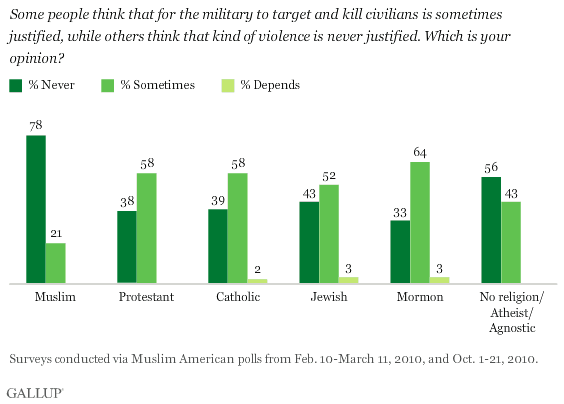
Polls on American muslims show their views are in line with most other American religious groups in terms of homosexuals, women's rights and violence. In fact in one poll evangelicals had a rate of support for saying that targeting civilians could sometimes be justified.
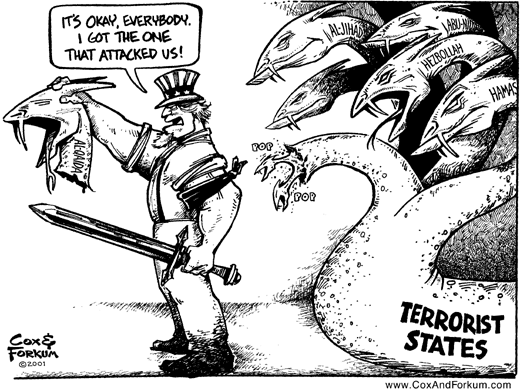
People are scared and that fear is driving them to call for things that are outright unamerican.