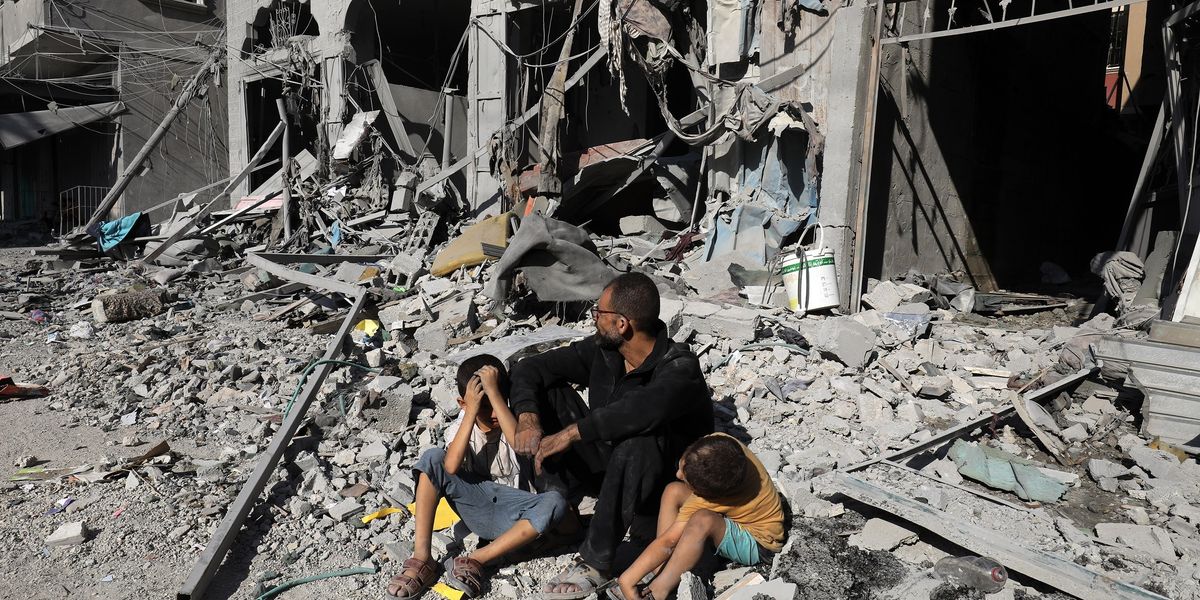
From the State Department Briefing on March 25th:
And we had talked about different versions. As you may recall, there was a different draft that was put forward first that called for a permanent ceasefire, which is not something that we supported. We, as you know, want to see an immediate ceasefire, but linked to hostages, and then we want to build that into something more enduring. So we had been in close contact with them about this resolution. And as I said, we believe this resolution is consistent with our policy on this matter, and consistent with what we believe to be the Government of Israel’s policy, so we have had conversations with them over the last 24 hours, and I’m sure those will continue.
What he said at Morehouse:
That’s why I’ve called for an immediate ceasefire — an immediate ceasefire to stop the fighting — (applause) — bring the hostages home. And I’ve been working on a deal as we speak, working around the clock to lead an international effort to get more aid into Gaza, rebuild Gaza.
You are lying or your BDS is getting in the way. There is no change in policy. An immediate ceasefire, to get the hostages out and possibly work toward a long term solution is not a permanent ceasefire and not a change in policy which, by the way, is not made in commencement speeches to college graduates.
Some general ideas were mentioned publically, and there have been some high level discussions among US and Israeli military and security leaders. Do you seriously they would release detailed information and plans to the general public?
Again. Immediate ceasefire is not the same as a permanent ceasefire per State Department briefing which is a more accurate source of information than a college commencement address. As for a two state solution? It is the only path to a lasting peace.
That is not exactly true or maybe it is just your spin. In May, the State Department stated in its report, that it was “reasonable to assess” that Israel had violated International Humanitarian Law during it’s conduct of the Gaza war. The report looked at two key areas: whether Israel had violated international law while using US weapons and whether Israel was restricting Humanitarian aid.
The State Department findings cited multiple examples where large numbers of Palestinian civilians were killed in Israeli airstrikes. The reports said these instances raised serious concerns, but the U.S. did not have enough evidence to reach definitive conclusions.
In other words, it did NOT say there was “no evidence”, as you claim, just not enough for a definitive conclusion. Big difference.
On humanitarian aid:
On the question of humanitarian aid for Gaza, the report stated that Israel initially did not cooperate with the U.S. and international aid groups to let in humanitarian aid and thus "contributed significantly" to the lack of aid to the Palestinian people.
But that has changed over time, the report added.
"We do not currently assess that the Israeli government is prohibiting or otherwise restricting the transport or delivery of U.S. humanitarian assistance," it said.
In other words, Israel was originally restricting or blocking aid but is no longer doing so. Considering the timing, that is likely due to sustained pressure from allies and the international community. Deliberate starvation as a tool of war IS a war crime.
In a
May 13th State Department briefing, it was further reiterated:
So there’s no policy change to announce, Shaun. What the report makes clear is that – first, to take a little bit of a step back, the report makes clear that this is a very complex and complicated battlefield. It is a very dense and urban setting. We are also dealing with a belligerent – in this case, Hamas – that has a clear track record and history of co-locating itself with civilians and civilian infrastructure, using civilians as human shields. We’ve also made clear in the report that the IDF has taken – undertaken steps to implement international humanitarian law obligations for the protections of civilians in the current conflict, including requirements that are related to distinction, proportionality, and others.
But we also are clear in our report that it’s reasonable to assess that defense articles covered under the National Security Memorandum have been used by Israeli security forces in instances that are inconsistent with its IHL obligations. But we also have no direct indication of Israel intentionally targeting civilians.
But to take us back – a step back, Shaun – and I guess this addresses kind of your broader question – a country’s overall commitment to international humanitarian law is not necessarily disproven by what may be individual IHL violations. And the most important thing here is that Israel does not – Israel does have a number of ongoing, active criminal investigations pending, and there are hundreds of other cases under administrative review. Israel has taken steps to – and is taking steps to – hold itself and its actions accountable.
Simultaneously, we also continue to have tools are our disposal that existed before the National Security Memorandum and existed afterwards, things like the CHIRG process, the Leahy process, the Conventional Arms Transfer Policy, end-use monitoring, and other things, to continue to assess and continue to look into instances that are reported to us that may be concerning. The same is – can be said about humanitarian aid. We continue to monitor that situation very closely, and we’ll continue to assess the Government of Israel by its actions as it relates to humanitarian aid.
The press briefings are
very nuanced, indicate areas of concern, areas where IHL may have been violated, and areas where Israel has improved its operations. There is nothing in the report itself that actually states “
no evidence found” that Israel broke international law, in fact it refers to “
credible” allegations several times. The only thing they stated close to what you claim is that there wasn’t enough to draw firm conclusions. Either way.

 www.breitbart.com