To prove Democrats don't give a damn about Americans in the midst of a pandemic, Joe re-instates Beey's 'Catch-And-Release' Illegal Immigration policy, dumping diseased, bedbug, and virus-infested illegals into US communities all over the US while hoping the $1400 hand-out the CBO says isn't needed will pacify Americans to be ok with it.
He would like to go after illegal employers. You know, the ones luring illegal workers here. Are you in support of doing this? Then stop playing wack a mole with illegal workers. Wasting our time.
Trump didnt go after illegal employers so why did illegal immigration plummet?
Did it? I didn’t notice . What are the numbers?
By the end of the 2019 fiscal year, agents had processed more than 474,000 migrants traveling as a family along the U.S.-Mexico border.
Their arrival in such large numbers, coupled with a system designed largely to hold single adult men, overwhelmed border agents and immigration officers. That resulted in serious overcrowding, prolonged detention, and deteriorating conditions at border processing and holding facilities, especially in Yuma, Arizona; and El Paso and the Rio Grande Valley in Texas; the three main routes used by migrants.
To cope with the drastic surge in arrivals, Customs and Border Protection and Immigration and Customs Enforcement began releasing thousands of families apprehended at the border.
In 2017, there were 10.5 million unauthorized immigrants in the U.S., including 4.9 million Mexicans.
The decrease in the Mexican born was the major factor driving down the overall population of unauthorized immigrants in the U.S., which in 2017 was 1.7 million below its peak of 12.2 million in 2007.
The number of Mexican unauthorized immigrants declined because more left the U.S. than arrived. Mexicans remain a much larger percentage of all unauthorized immigrants than those from any other birth country. But their 47% share of U.S. unauthorized immigrants in 2017 amounted to less than a majority for the first time since the beginning of a long era of growth in illegal immigration a half century ago. That rise began after passage of a
major overhaul of immigration policy in 1965, which imposed the
first limits on immigration from Western Hemisphere countries, including Mexico, and coincided with the end of the
Bracero program that had allowed temporary farm workers from Mexico to work legally in the U.S.
The number of Mexican unauthorized immigrants has fallen by 2 million since its peak of 6.9 million in 2007 and was lower in 2017 than in any year since 2001. Similarly, the number of apprehensions of Mexicans at the U.S. border also has fallen over the decade, a trend that began even earlier. In fact,
apprehensions of non-Mexicans outnumbered those of Mexicans for the past three fiscal years, according to federal statistics.
As the number of Mexicans decreased, unauthorized immigrants from other parts of the world increased. There were 5.5 million non-Mexican unauthorized immigrants in 2017, compared with 5.3 million in 2007. The non-Mexican number also ticked up from 2016 to 2017, offsetting the decline of Mexicans. As a result, the overall population of unauthorized immigrants statistically did not change in 2017 from the year before; the total in both years was the lowest since 2004.
The decline in unauthorized immigrants from Mexico and rise from other parts of the world is one sign of a change in how recent arrivals to this population enter the country. A growing share of U.S. unauthorized immigrants do not cross the border illegally, but probably
arrive with legal visas and overstay their required departure date. These “likely overstays” have made up a large majority of unauthorized immigrant arrivals since 2010, according to Pew Research Center analysis.
The Center’s estimate of unauthorized immigrants includes 1.5 million or more people who have temporary permission to stay in the U.S. but could be subject to deportation by
changes in government policy. In 2017, they included about 320,000 people from 10 nations with
Temporary Protected Status, about 700,000 beneficiaries of
Deferred Action for Childhood Arrivals and a rising number of people who have
applied for asylum and are awaiting a ruling.
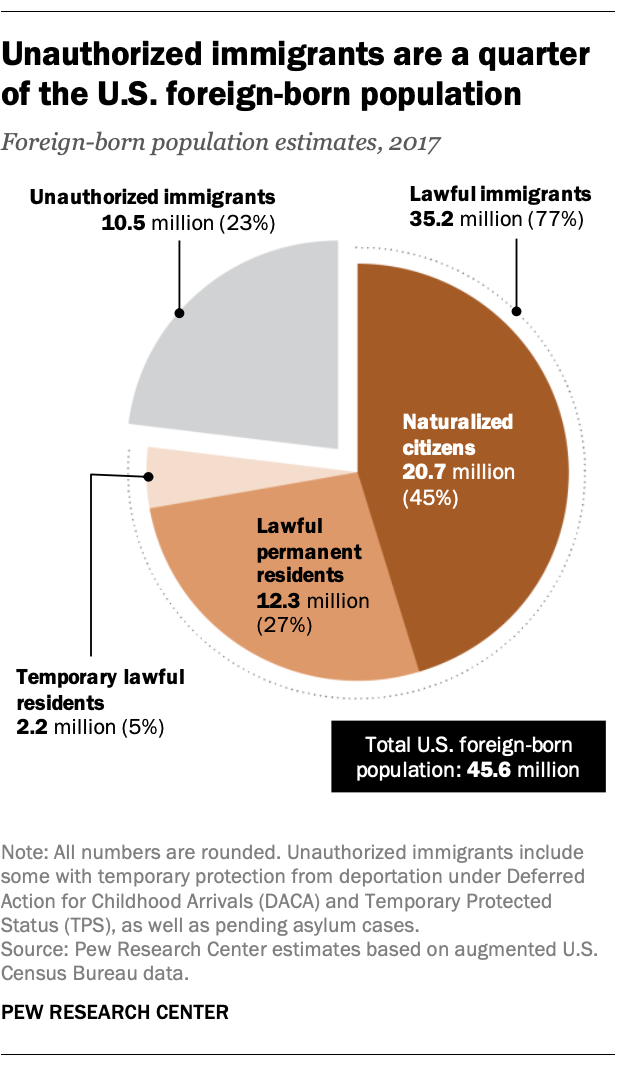
As the number of unauthorized immigrants shrank by 14% from 2007 to 2017, the U.S. lawful immigrant population continued to grow. During this period, the population of lawful U.S. immigrants – citizens and noncitizens, on permanent and temporary visas – rose by almost a quarter, to 35.2 million.
Unauthorized immigrants were 23% of the 45.6 million foreign-born residents in the U.S. in 2017.
Despite the decline over the decade, the number of unauthorized immigrants in 2017 was triple the 3.5 million in 1990.
Rising numbers from Asia and Central America
The number of Mexican unauthorized immigrants has fallen since its peak of 6.9 million in 2007 and was lower in 2017 than in any year since 2001.

www.pewresearch.org


