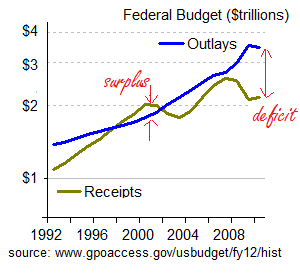
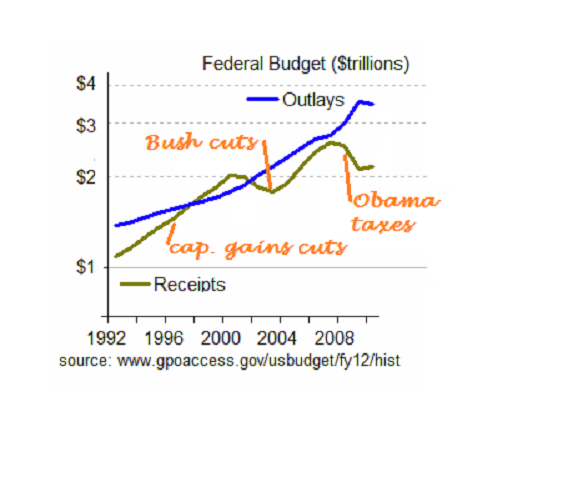
Your chart does show how much better revenue grew after a tax increase than it did after a cut, something cons are always lying about.
J: Bush's 2003 supply side tax cuts produced biggest revenue gains for government in American History. When Charlie Gibson asked BO why he wanted to raise the Cap. gains tax when it always resulted in less revenue, BO said it had to with appearance, not revenue. A liberal lacks the intelligence to think clearly.
Stephen Moore: "from 2004 to 2007 federal tax cuts revenue increased by an enormous 785 billion., the largest increase in American History
individual and corporate tax were up 40% capital gains and dividend 71% in capital gains and 41% in dividends
NYTIMES: "An unexpectedly steep rise in tax revenues from corporations and the wealthy ids driving down the deficit this year"
" the latest IRS data through 2006 show a more than 120 billion increase in tax payments by the wealthy after the 2003 Bush tax cuts through 2006
Forbes: "The Macroeconomic Effects of Tax Changes: Estimates Based on a New Measure of Fiscal Shocks," co-authored with her husband, fellow University of California, Berkeley, economist David Romer.
In their article, they find that "tax increases are highly contractionary" and that tax cuts are highly expansionary. Otherwise-careful economists Greg Mankiw of Harvard and Lawrence Lindsey of the American Enterprise Institute have run with this result, as they should,
NYSUN: It came when Mr. Gibson questioned Senator Obama about the capital gains tax. Mr. Gibson quoted Mr. Obama as talking about raising the tax to 28% from 15%. "But actually, Bill Clinton, in 1997, signed legislation that dropped the capital gains tax to 20 percent," Mr. Gibson said. "And George Bush has taken it down to 15 percent. And in each instance, when the rate dropped, revenues from the tax increased; the government took in more money. And in the 1980s, when the tax was increased to 28 percent, the revenues went down. So why raise it at all, especially given the fact that 100 million people in this country own stock and would be affected?"
Why, Robert Bartley couldn't have put it better himself. Mr. Obama was totally flummoxed, betraying a fundamental lack of understanding of the Laffer Curve. The Democrat of Illinois spoke of the need to "finance health care for Americans who currently don't have it," and of the need to "invest in our infrastructure" and in "our schools."
Mr. Gibson, to his credit, wouldn't let the point go. "But history shows that when you drop the capital gains tax, the revenues go up," he replied to Mr. Obama. Mr. Obama replied by changing the subject, to "a housing crisis that this president has not been attentive to."
Mr. Gibson tried the same question, more or less, on Senator Clinton. She, at least, disavowed raising the capital gains rate above 20%, ruling out a return to the 28% rate contemplated by Mr. Obama. But when Mr. Gibson pressed her on why she would raise it at all, she went into lunk-headed, static analysis mode, displaying a lack of understanding as severe as that afflicting her rival. "You know, Charlie, I'm going to have to look and see what the revenue situation is," she said.
Dwyer,Washington Times: By 2003, Mr. Bush grasped this lesson. In that year, he cut the dividend and capital gains rates to 15 percent each, and the economy responded. In two years, stocks rose 20 percent. In three years, $15 trillion of new wealth was created. The U.S. economy added 8 million new jobs from mid-2003 to early 2007, and the median household increased its wealth by $20,000 in real terms.
But the real jolt for tax-cutting opponents was that the 03 Bush tax cuts also generated a massive increase in federal tax receipts. From 2004 to 2007, federal tax revenues increased by $785 billion, the largest four-year increase in American history. According to the Treasury Department, individual and corporate income tax receipts were up 40 percent in the three years following the Bush tax cuts. And (bonus) the rich paid an even higher percentage of the total tax burden than they had at any time in at least the previous 40 years
http://elsa.berkeley.edu/~cromer/draft1108.pdf
Or the National bureau of Economic Research? They non-partisan enough?
http://www.nber.org/digest/mar08/w13264.html