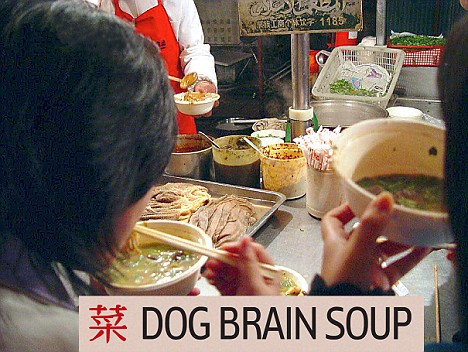
Why couldn't the Chinks tell you were American? .
Gee, I don't know, maybe because my wife and I are Asian?
And what exactly does an American look like?
Do you and your wife speak Chinese? Are you an illegal immigrant here? Did you eat any dogs, cats or puppies while in sunny China?
There is no language called Chinese. I know a little Mandarin and I did eat a scorpion on a stick while I was there.
啊,我討厭打破你,但上面是用中文寫的,你剛才說的不存在。嘖
啊,我討厭打破你,但上面是用中文寫的,你剛才說的不存在。嘖
More
A, wǒ tǎoyàn dǎpò nǐ, dàn shàngmiàn shì yòng zhōngwén xiě de, nǐ gāngcái shuō de bù cúnzài. Zé
Ah, I hate to break it to you, but the above is written in the Chinese language, that you just said does not exist. Sheesh
I hate to break it to you, tard, but that's Mandarin. There is no language called "Chinese." Most of the country speaks Mandarin. The southeast speaks Cantonese and then there are some smaller regional dialects.
Mandarin Chinese, Chinese is the language Mandarin is an ethnic dialect.
Try again
The
languages of China are the languages that are spoken by China's
56 recognized ethnic groups. The
predominant language in China, which is divided into
seven major dialect groups (often classified as distinct languages by foreign linguists), is known as
Hanyu (
simplified Chinese: 汉语;
traditional Chinese: 漢語;
pinyin:
Hànyǔ). and its study is considered a distinct academic discipline in China.
[4] Hanyu, or Han language, spans eight primary
dialect groups, that differ from each other
morphologically and
phonetically to such a degree that dialects from different regions can often be
mutually unintelligible. The languages most studied and supported by the state include
Chinese,
Mongolian,
Tibetan,
Uyghur and
Zhuang. China has 297
living languages according to
Ethnologue.
[5] According to the 2010 edition of the
Nationalencyklopedin, 955 million out of China's then-population of 1.34 billion spoke some variety of
Mandarin Chinese as their first language, accounting for 71% of the country's population.
[6]
Standard Chinese (known in China as
Putonghua), a form of
Mandarin Chinese, is the official national spoken language for the mainland and serves as a
lingua franca within the Mandarin-speaking regions (and, to a lesser extent, across the other regions of
mainland China). Several other
autonomous regions have additional official languages. For example,
Tibetan has official status within the
Tibet Autonomous Region, and
Mongolian has official status within
Inner Mongolia. Language laws of China do not apply to either
Hong Kong or
Macau, which have different official languages (
Cantonese,
English and
Portuguese) than the mainland.