Old Rocks....
Stop dodging.
I've given you a well-defined statistics problem that is solvable by even the simplest of the scientifically inclined. Those links have nothing to do with the equation I've presented you.
And therein lies the problem.
You manipulate even the query itself to fit your belief.
Which is the antithesis of Science.
The Science is what it is, there is no "clarification" or "qualification" needed, or appropriate.
The equation has an answer.
You just do not want to provide it, or you are incapable of analyzing it objectively.
Which makes you a Philosopher on this subject, and not a Scientist.
A Scientist doesn't care what the answer is, only that the equation or theory is reliable in providing an answer.
People who manipulate Science in the name of Philosophy or in an attempt to "not be wrong" do the most egregious of all disservices to Science.
Science grows more from people who were "wrong" than from those who were "right."
You're a philosopher, a politician, a commentator.
But you, sir, are no Scientist.
Perhaps Matthew can provide us an answer?
So you went to understand the variable of z. co2 makes up 390 ppm , but the other main gases remain constant as co2 moves upwards. Water vapor can go from a trace to 4+ percent of the Atmosphere within the tropics. It is not around for a long enough time to act as strong of a forcing compared to co2. But water vapor makes up such a large percentage compared to co2 that it makes up 36-72 percent of the green house effect compared to co2 that makes up 9-26 percent.
RealClimate: Water vapour: feedback or forcing?
While water vapour is indeed the most important greenhouse gas, the issue that makes it a feedback (rather than a forcing) is the relatively short residence time for water in the atmosphere (around 10 days). To demonstrate how quickly water reacts, I did a GCM experiment where I removed all the water in the atmosphere and waited to see how quickly it would fill up again (through evaporation from the ocean) . The result is shown in the figure. It’s not a very exciting graph because the atmosphere fills up very quickly. At Day 0 there is zero water, but after only 14 days, the water is back to 90% of its normal value, and after 50 days it’s back to within 1%. That’s less than 3 months. Compared to the residence time for perturbations to CO2 (decades to centuries) or CH4 (a decade), this is a really short time.
Water vapor can be a feed back to co2 or any temperature change or phase change...
When surface temperatures change (whether from CO2 or solar forcing or volcanos etc.), you can therefore expect water vapour to adjust quickly to reflect that. To first approximation, the water vapour adjusts to maintain constant relative humidity. It’s important to point out that this is a result of the models, not a built-in assumption. Since approximately constant relative humidity implies an increase in specific humidity for an increase in air temperatures, the total amount of water vapour will increase adding to the greenhouse trapping of long-wave radiation. This is the famed ‘water vapour feedback’. A closer look reveals that for a warming (in the GISS model at least) relative humidity increases slightly in the tropics, and decreases at mid latitudes.
Anyways co2 is a green house gas...
The greenhouse effect is a process by which thermal radiation from a planetary surface is absorbed by atmospheric greenhouse gases, and is re-radiated in all directions. Since part of this re-radiation is back towards the surface, energy is transferred to the surface and the lower atmosphere. As a result, the temperature there is higher than it would be if direct heating by solar radiation were the only warming mechanism.[1][2]
http://www.ipcc.ch/pdf/assessment-report/ar4/wg1/ar4-wg1-chapter1.pdf
What this means is more energy is entering the climate system then going out because the
green house effect is trapping more energy then it is removing to space. So you get a imbalance.
The Greenhouse Effect is the process by which an atmosphere holds heat around a planet. The story of how this works begins with a discussion of light.
The light that we can see with our eyes is just a small part of the full spectrum of light that occurs in nature. We call this the electromagnetic spectrum because light is a composite of interacting electric and magnetic force fields. The spectrum extends from low energy microwaves and infrared light to the visible part of the spectrum (red, orange, yellow, green, blue, and violet), and then to more energetic forms of light such as ultraviolet and x-rays. Climate 411 The Greenhouse Effect Explained - Blogs & Podcasts - Environmental Defense Fund
http://blogs.edf.org/climate411/wp-content/files/2007/07/ElectromagneticSpectrum.png
The temperature of an object is determined by a balance between incoming and outgoing energy. For the Earth, the incoming energy is the absorbed light from the Sun, and the outgoing energy is the infrared light the Earth radiates out to space. In the absence of an atmosphere with its Greenhouse Effect, that balance would lead to very cold temperatures – well below the freezing point of water.
Fortunately the Earth does have an atmosphere, and that atmosphere contains some molecules with three or more atoms – for example, water (H2O), carbon dioxide (CO2), methane (CH4), and nitrous oxide (N2O). These molecules are called "greenhouse gases" because they have a very special property. They do not absorb the visible light from the sun, but they do absorb the infrared light radiated by the Earth's surface.
If greenhouse gases were not in the atmosphere, all the infrared light radiated by the Earth would go back out to space, leaving the Earth too cold for life. But the greenhouse gas molecules absorb the infrared light, and then re-radiate some of it back to the Earth's surface. This makes the surface hotter so it radiates more light, thus establishing an equilibrium at a higher temperature. This process is known as the Greenhouse Effect.
Does co2 have a effect on temperature?
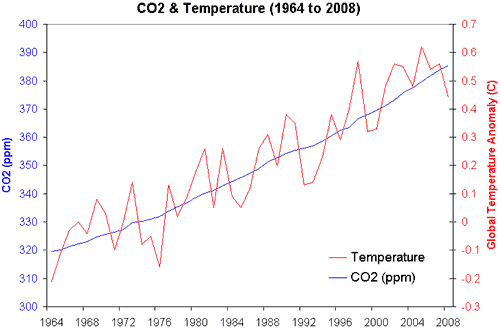
Figure 2: Annual atmospheric carbon dioxide (NOAA) and annual global temperature anomaly (GISS) from 1964 to 2008.
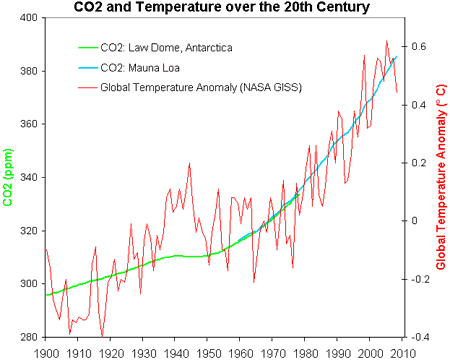
Figure 4: Green line is carbon dioxide levels from ice cores obtained at Law Dome, East Antarctica (CDIAC). Blue line is carbon dioxide levels measured at Mauna Loa, Hawaii (NOAA). Red line is annual global temperature anomaly (GISS)
Figure 4 compares CO2 to global temperatures over the past century. While CO2 is rising from 1940 to 1970, global temperatures show a cooling trend. This is a 30 year period, longer than can be explained by internal variability from ENSO and solar cycles. If CO2 causes warming, why isn't global temperature rising over this period? To answer this, one needs to recognise that CO2 is not the only driver of climate. There are a number of factors which affect the net energy flow into our climate. Stratospheric aerosols (eg - from volcanic eruptions) reflect sunlight back into space, causing cooling. When solar activity increases, the amount of energy flowing into our climate increases. Figure 5 shows a composite of the various radiative forcings that affect climate.

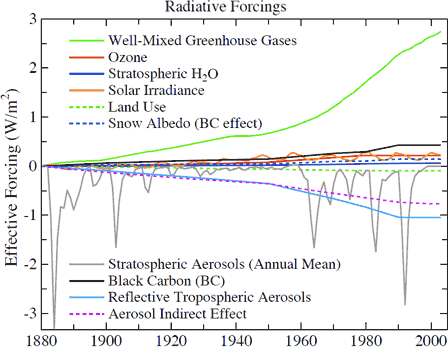
Figure 5: Separate global climate forcings relative to their 1880 values (GISS).
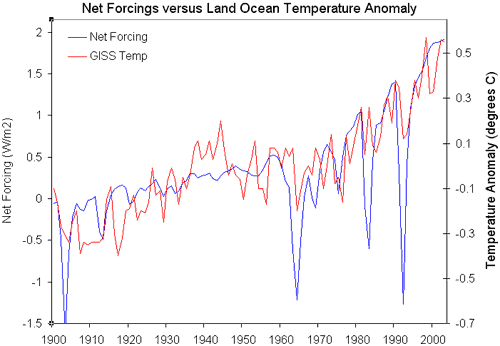
When all the forcings are combined in Figure 6, the net forcing shows good correlation to global temperature. There is still internal variability superimposed on the temperature record due to short term cycles like ENSO. The main discrepancy is a decade centered around 1940. This is thought to be due to a warming bias introduced by US ships measuring engine intake temperature. A new twist on mid-century cooling
Access : A large discontinuity in the mid-twentieth century in observed global-mean surface temperature : Nature
Correspondence to: David W. J. Thompson1 Correspondence and requests for materials should be addressed to D.W.J.T. (Email: davet@atmos.colostate.edu).
Top of page
Abstract
Data sets used to monitor the Earth’s climate indicate that the surface of the Earth warmed from ~1910 to 1940, cooled slightly from ~1940 to 1970, and then warmed markedly from ~1970 onward1. The weak cooling apparent in the middle part of the century has been interpreted in the context of a variety of physical factors, such as atmosphere–ocean interactions and anthropogenic emissions of sulphate aerosols2. Here we call attention to a previously overlooked discontinuity in the record at 1945, which is a prominent feature of the cooling trend in the mid-twentieth century. The discontinuity is evident in published versions of the global-mean temperature time series1, but stands out more clearly after the data are filtered for the effects of internal climate variability. We argue that the abrupt temperature drop of ~0.3 °C in 1945 is the apparent result of uncorrected instrumental biases in the sea surface temperature record. Corrections for the discontinuity are expected to alter the character of mid-twentieth century temperature variability but not estimates of the century-long trend in global-mean temperatures.
Finally, Thompson 2008 ends with an intriguing statement:
"compensation for a different potential source of bias in SST data in the past decade— the transition from ship- to buoy-derived SSTs—might increase the century-long trends by raising recent SSTs as much as 0.1 C, as buoy-derived SSTs are biased cool relative to ship measurements"
Figure 6: Blue line is net radiative forcing (GISS). Red line is global temperature anomaly (GISS).
http://data.giss.nasa.gov/gistemp/tabledata/GLB.Ts+dSST.txt
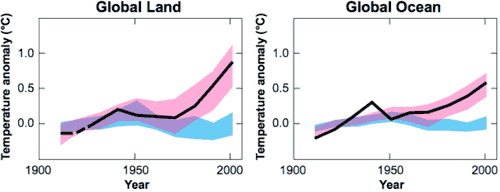
Figure 3: Comparison of observed land and ocean temperatures (solid black line) with climate results using only natural forcings (blue bar) and natural + anthropogenic forcings (red bar). Graph comes from Figure SPM-4 of the IPCC 4AR Summary for Policy Makers. Finally, Thompson 2008 ends with an intriguing statement:
So pretty much if the sun forcing, which has been going down since 1950-1960 time frame was the main forcing that is the norm then the temperature would be going down right now.
What comes first the temperature or co2?
To claim that the CO2 lag disproves the warming effect of CO2 displays a lack of understanding of the processes that drive Milankovitch cycles. A review of the peer reviewed research into past periods of deglaciation tells us several things:
*
Deglaciation is not initiated by CO2 but by orbital cycles
*
CO2 amplifies the warming which cannot be explained by orbital cycles alone
*
CO2 spreads warming throughout the planet
CO2 lags temperature - what does it mean?
As the Southern Ocean warms, the solubility of CO2 in water falls (Martin 2005). This causes the oceans to give up more CO2, emitting it into the atmosphere. The exact mechanism of how the deep ocean gives up its CO2 is not fully understood but believed to be related to vertical ocean mixing (Toggweiler 1999). The process takes around 800 to 1000 years, so CO2 levels are observed to rise around 1000 years after the initial warming (Monnin 2001, Mudelsee 2001).
http://www.sciencemag.org/content/291/5501/112.full
The outgassing of CO2 from the ocean has several effects. The increased CO2 in the atmosphere amplifies the original warming. The relatively weak forcing from Milankovitch cycles is insufficient to cause the dramatic temperature change taking our climate out of an ice age (this period is called a deglaciation). However, the amplifying effect of CO2 is consistent with the observed warming. http://icebubbles.ucsd.edu/Publications/CaillonTermIII.pdf
That CO2 lags and amplifies temperature was actually predicted in 1990 in a paper The ice-core record: climate sensitivity and future greenhouse warming by Claude Lorius (co-authored by James Hansen):
"Changes in the CO2 and CH4 content have played a significant part in the glacial-interglacial climate changes by amplifying, together with the growth and decay of the Northern Hemisphere ice sheets, the relatively weak orbital forcing"
The paper also notes that orbital changes are one initial cause for ice ages. This was published over a decade before ice c
Climate 411 The Greenhouse Effect Explained - Blogs & Podcasts - Environmental Defense Fund
[B
]Satellite measurements of outgoing longwave radiation
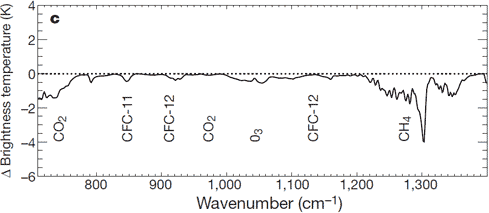
In 1970, NASA launched the IRIS satellite that measured infrared spectra between 400 cm-1 to 1600 cm-1. In 1996, the Japanese Space Agency launched the IMG satellite which recorded similar observations. Both sets of data were compared to discern any changes in outgoing radiation over the 26 year period (Harries 2001). The resultant change in outgoing radiation was as follows:
Figure 1: Change in spectrum from 1970 to 1996 due to trace gases. 'Brightness temperature' indicates equivalent blackbody temperature (Harries 2001).
What they found was a drop in outgoing radiation at the wavelength bands that greenhouse gases such as carbon dioxide (CO2) and methane (CH4) absorb energy. The change in outgoing radiation is consistent with theoretical expectations. Thus the paper found "direct experimental evidence for a significant increase in the Earth's greenhouse effect".
This result has been confirmed by subsequent papers using more recent satellite data. The 1970 and 1997 spectra were compared with additional satellite data from the NASA AIRS satellite launched in 2003 (Griggs 2004). This analysis was extended to 2006 using data from the AURA satellite launched in 2004 (Chen 2007). Both papers found the observed differences in CO2 bands matching the expected changes from rising carbon dioxide levels. Thus we have empirical evidence that increased CO2 is causing an enhanced greenhouse effect.
Surface measurements of downward longwave radiation
A compilation of surface measurements of downward longwave radiation from 1973 to 2008 find an increasing trend of more longwave radiation returning to earth, attributed to increases in air temperature, humidity and atmospheric carbon dioxide (Wang 2009). More regional studies such as an examination of downward longwave radiation over the central Alps find that downward longwave radiation is increasing due to an enhanced greenhouse effect (Philipona 2004).
Taking this a step further, an analysis of high resolution spectral data allows scientists to quantitatively attribute the increase in downward radiation to each of several greenhouse gases (Evans 2006). The results lead the authors to conclude that "this experimental data should effectively end the argument by skeptics that no experimental evidence exists for the connection between greenhouse gas increases in the atmosphere and global warming."
Figure 2: Spectrum of the greenhouse radiation measured at the surface. Greenhouse effect from water vapor is filtered out, showing the contributions of other greenhouse gases (Evans 2006).
There are multiple lines of empirical evidence that increasing carbon dioxide causes an enhanced greenhouse effect. Laboratory tests show carbon dioxide absorbs longwave radiation. Satellite measurements confirm less longwave radiation is escaping to space at carbon dioxide absorptive wavelengths. Surface measurements find more longwave radiation returning back to Earth at these same wavelengths. The result of this energy imbalance is the accumulation of heat over the last 40 [/B]
Harries 2001 does look at the full infrared spectrum except for wavelengths less than 700nm (which happens to be where a large portion of the CO2 absorption occurs). The observed changes in the spectrum from 1970 to 2006 are consistent with theoretical expectations. As the atmosphere warms, more infrared radiation is radiated to space. However, less infrared radiation escapes at CO2 wavelengths. The net effect is that less total radiation escapes out to space.
This is independently confirmed by surface measurements which find the net result is more longwave radiation returning back to the Earth's surface (Philipona 2004, Evans 2006). It's also confirmed by ocean heat measurements which find the oceans have been accumulating heat since 1950 (Murphy 2009).
http://www.nature.com/nature/journal/v410/n6826/abs/410355a0.html
http://www.skepticalscience.com/empirical-evidence-for-co2-enhanced-greenhouse-effect-advanced.htm
So this is how it works...Hope you enjoyed.



 hanerozoic Carbon Dioxide.png - Global Warming Art


