toastman,
et al,
Yes, crazy.
(LAUGHING)
The psychiatrist asked the Palestinian a few questions, took some notes then sat thinking in silence for a few minutes with a puzzled look on his face.
Suddenly, the psychiatrist looked up with an expression of delight and said, "Um, I think your problem is low self-esteem. It is very common among losers."
No insult intended. But when I read some of these exchanges, I just start chuckling. It's been that kind of day.
v/r
R
Hey, Rocco. I read the comment (really great stuff) that Kondor3 made and I agree completely.
I dont want to start a debate over Christian or Judaic legal / social doctrines but wish to show that for better or for worse, those legal / social thoughts have tended to adapt with the times. In the case of Islam, however, Moslems are essentially legally obliged to make do with doctrines that are unchanged since the time of islams inventor. Hence, there are serious debates among (proceeding alphabetically and including but not limited to, Ayatollahs, Emirs, Imams, prayer leader, Sheiks,
) and particularly among Sunni
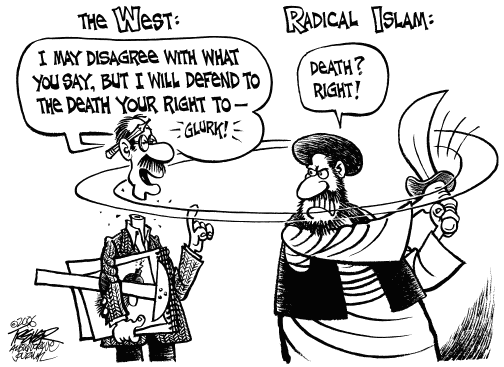
Death Cultists, about subjects we would find ridiculous, such as whether sharia allows or forbids singing.
Music and Singing: A Detailed Fatwa
This legal stagnation has led to a situation in which Islamic law has become progressively more separated from the underlying social realities of the times. This is the unavoidable outcome of such strict conservatism. The growing distance and tension between Islamist legal thought and the ever-changing circumstances of the times is reflected in the self-destructive and regressive social climate that haunts the Islamist Middle East that is now obvious to even the most casual observers. That pathology has produced an extremist reaction. The 20th and 21st centuries provide the most lurid examples of these, but the roots of this extremism are actually in the 19th century, when modernity was more or less forced upon the Islamic world by Europe.
Not at all coincidentally, Wahabbism, the principle sect of Islam in todays Saudi Arabia, which was formally put forth in the 18th century, came into its own within the Arab world in the 19th. Assassinations of British officials in India by Wahabbi fanatics are attested to during this period, and the Wahabbi ibn Saud began his initial conquests of Arabia and founded his dynasty at the dawn of the 19th century, right as the Ottoman Empire began to formulate its modernizing Tanzimat reforms. Still throughout the 19th and 20th centuries, it would be fair to say that Wahabbism was mostly an obscure, though radical, sect practiced mostly by Arabs in the Arabian Peninsula.
In terms of the Arab world, that fact is still mostly true Wahabbism itself is little more favored today in the Middle East than it was 50 or 100 years ago, even with the surge in popularity of Al Qaeda prior to the 2nd Iraq war. On the other hand, many of the goals and methods of Wahabbism, including the establishment of a worldwide caliphate and the justification of violence against infidels, are more accepted among Middle Easterners than they used to be. Though these ideas have always been a part of Islamic doctrine, they had mostly been abandoned as impracticable in the dominions of the Ottoman Empire and Persian monarchy in the 19th century. That such a radical return to the past is possible only highlights the extreme conservatism of Islamic law. In fact, the most prominent symbol of modern-day Islamism, the burqa, is only a product of the 1970s. In many ways, as Mark Steyn and others have pointed out, the reform of Islam has already taken place, and Wahabbism is it.