Excerpts from
West Antarctic Ice Sheet - Wikipedia the free encyclopedia
In January 2006, in a UK government-commissioned report, the head of the
British Antarctic Survey,
Chris Rapley, warned that this huge west Antarctic ice sheet may be starting to disintegrate. It has been hypothesised that this disintegration could raise sea levels by approximately 3.3 metres (10 ft).
[9] (If the entire West Antarctic Ice Sheet were to melt, this would contribute 4.8 m to global sea level.)
[10]Rapley said a previous (2001)
Intergovernmental Panel on Climate Change (IPCC) report that played down the worries of the ice sheet's stability should be revised. "I would say it is now an awakened giant. There is real concern."
[5]
Polar ice experts from the U.S. and U.K. met at the
University of Texas at Austin in March, 2007 for the
West Antarctic Links to Sea-Level Estimation (WALSE) Workshop. The experts discussed a new hypothesis that explains the observed increased melting of the West Antarctic Ice Sheet. They proposed that changes in air circulation patterns have led to increased upwelling of warm, deep ocean water along the coast of Antarctica and that this warm water has increased melting of floating
ice shelves at the edge of the ice sheet.
[13] An ocean model has shown how changes in winds can help channel the water along deep troughs on the sea floor, toward the ice shelves of outlet glaciers.
[14] The exact cause of the changes in circulation patterns is not known and they may be due to natural variability. However, this connection between the atmosphere and upwelling of deep ocean water provides a mechanism by which human induced climate changes could cause an accelerated loss of ice from WAIS.
[14] Recently published data collected from satellites support this hypothesis, suggesting that the west Antarctic ice sheet is beginning to show signs of instability.
[4][15]
On 12 May 2014, It was announced that two teams of scientists said the long-feared collapse of the Ice Sheet had begun, kicking off what they say will be a centuries-long, "unstoppable" process that could raise sea levels by 1.2 to 3.6 metres.
[16] They estimate that rapid drawdown of
Thwaites Glacier will begin in 200 – 1000 years.
[17] (Scientific source articles: Rignot et al 2014
[18] and Joughin et al 2014.
[19])
Warming
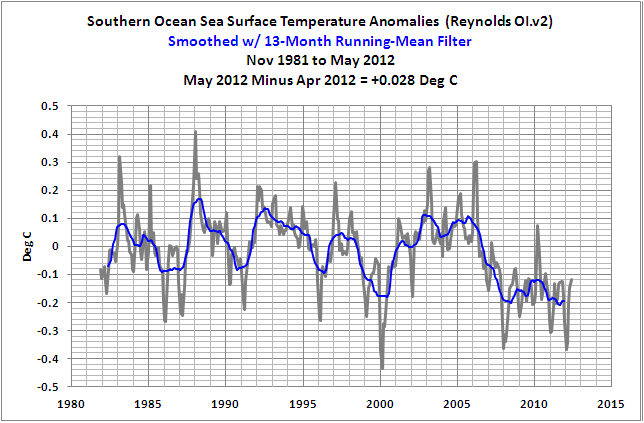
The West Antarctic ice sheet has warmed by more than 0.1 °C/decade in the last 50 years, and the warming is the strongest in winter and spring. Although this is partly offset by fall cooling in
East Antarctica, this effect was restricted to the 1980s and 1990s. The continent-wide average surface temperature trend of Antarctica is positive and
significant at >0.05 °C/decade since 1957.
[20] This warming of WAIS is strongest in the
Antarctic Peninsula. In 2012, the temperature records for the ice sheet were reanalyzed with a conclusion that since 1958, the West Antarctic ice sheet had warmed by 2.4 °C, almost double the previous estimate. Some scientists now fear that the WAIS could now collapse like the
Larsen B Ice Shelf did in 2002.
[21]
References
Notes
- In this case the ice is effectively moving upslope towards the sea.
Citations
- Lythe, Matthew B.; Vaughan, David G. (June 2001). "BEDMAP: A new ice thickness and subglacial topographic model of Antarctica". Journal of Geophysical Research 106 (B6): 11335–11352. Bibcode:2001JGR...10611335L. doi:10.1029/2000JB900449.
- Anderson, John B. (1999). Antarctic marine geology. Cambridge University Press. p. 59. ISBN 0-521-59317-4.
- Ice Shelves, Antarctic and Southern Ocean Coalition[dead link]
- Rignot, E. (2008). "Changes in West Antarctic ice stream dynamics observed with ALOS PALSAR data". Geophysical Research Letters 35 (12): L12505.Bibcode:2008GeoRL..3512505R. doi:10.1029/2008GL033365. edit
- Jenny Hogan, "Antarctic ice sheet is an 'awakened giant'", New Scientist, February 2, 2005
- Rignot, E.; Bamber, J. L.; Van Den Broeke, M. R.; Davis, C.; Li, Y.; Van De Berg, W. J.; Van Meijgaard, E. (2008). "Recent Antarctic ice mass loss from radar interferometry and regional climate modelling". Nature Geoscience 1 (2): 106.Bibcode:2008NatGe...1..106R. doi:10.1038/ngeo102. edit
- King, M. A.; Bingham, R. J.; Moore, P.; Whitehouse, P. L.; Bentley, M. J.; Milne, G. A. (2012). "Lower satellite-gravimetry estimates of Antarctic sea-level contribution". Nature491 (7425): 586–589. doi:10.1038/nature11621. PMID 23086145. edit
- Hughes, Terence J. (1981). "The weak underbelly of the West Antarctic ice-sheet.".
- Bamber J.L., Riva R.E.M., Vermeersen B.L.A., LeBroq A.M. (2009). "Reassessment of the potential sea-level rise from a collapse of the West Antarctic Ice Sheet". Science 324(5929): 901–3. Bibcode:2009Sci...324..901B. doi:10.1126/science.1169335.PMID 19443778.
- Bamber J.L., Riva R.E.M., Vermeersen B.L.A., LeBroq A.M. (2009). "Reassessment of the potential sea-level rise from a collapse of the West Antarctic Ice Sheet (Supporting Online Material)". Science 324 (5929): 901–3. Bibcode:2009Sci...324..901B.doi:10.1126/science.1169335. PMID 19443778.
- "West Antarctic ice sheet: Waking the sleeping giant?", Symposium, February 19, 2006
- Jonathan Leake and Jonathan Milne, "Focus: The climate of fear", The Sunday Times — Britain, February 19, 2006
- Statement: Thinning of West Antarctic Ice Sheet Demands Improved Monitoring to Reduce Uncertainty over Potential Sea-Level Rise (March 28, 2007)
- Thoma, M.; Jenkins, A.; Holland, D.; Jacobs, S. (2008). "Modelling Circumpolar Deep Water intrusions on the Amundsen Sea continental shelf, Antarctica". Geophysical Research Letters 35 (18): L18602. Bibcode:2008GeoRL..3518602T.doi:10.1029/2008GL034939. edit
- Kaufman, Mark (2008) "Escalating Ice Loss Found in Antarctica: Sheets Melting in an Area Once Thought to Be Unaffected by Global Warming" Washington Post (January 14) p. A01 online
- Parts of West Antarctic ice sheet beginning slow alarming collapse studies show CTV News
- Boyle, Alan (12 May 2014). "West Antarctic Ice Sheet's Collapse Triggers Sea Level Warning". Retrieved 12 May 2014.
- Rignot, E., J. Mouginot, M. Morlighem, H. Seroussi and B. Scheuch (May 12, 2014)."Widespread, rapid grounding line retreat of Pine Island, Thwaites, Smith and Kohler glaciers, West Antarctica from 1992 to 2011". Geophysical Research Letters.doi:10.1002/2014GL060140.
- Joughin, Ian, Benjamin E. Smith, Brooke Medley (May 12, 2014). "Marine Ice Sheet Collapse Potentially Underway for the Thwaites Glacier Basin, West Antarctica".Science. doi:10.1126/science.1249055.
- Jump up^ Steig, E. J.; Schneider, D. P.; Rutherford, S. D.; Mann, M. E.; Comiso, J. C.; Shindell, D. T. (2009). "Warming of the Antarctic ice-sheet surface since the 1957 International Geophysical Year". Nature 457 (7228): 459–462. doi:10.1038/nature07669.PMID 19158794. edit
- Matt McGrath (23 December 2012). "West Antarctic Ice Sheet warming twice earlier estimate". BBC News. Retrieved 16 February 2013
Twelve of these references are peer-reviewed studies. Swallow your popcorn and tell us about your references.