Fox host Martha MacCallum noted that Geller has taken criticism from the staff of Charlie Hebdo and American conservatives such as Bill Donahue of the Catholic League. Donald Trump also called Geller's actions "DUMB!" and said her cartoon contest was just "taunting" people.
Geller brushed off Trump's critique, and then rolled out an analogy that left MacCallum reeling.
"What would he have said about Rosa Parks?" Geller said. "'Rosa Parks should never have gone to the front of the bus. She's taunting people.'"
What a loon.
It's refreshing to at least see some conservatives denounce her ignorance, hate, and stupidity.
First of all, Rosa Parks did not go to the front of the bus. But I like watching Geller. She amuses me.
I'd say Geller is even braver than Rosa Parks. Parks wasn't worried about her life when she stood her ground in the bus. Geller has to live the rest of her life under constant threat by Islamic savages. And she's a woman.
That was the dumbest post I've seen in a while. Of course Rosa had reason to fear for her life. Who knows what could have happened to her when accosted by feral simians angry she wouldnt give up her seat? Rosa didnt have the money to hire police to protect her from the numerous death threats she got for years afterwards as well. Geller did nothing brave at all. She just has enough money to protect herself.
Wrong. Rosa Parks was not worried about her life, she was violating the law. Pam Geller knows that she will have a contract for her head by Islamic savages her entire life. That woman has balls.
Wrong. Rosa Parks was worried about her life. Geller may have balls but thats only because she is a hermaphrodite.
You may have balls but they're in your mouth.
Rosa parks although also a hero and great woman who fought racism, was only in fear of getting arrested for refusing to stand up and give her seat up to a white man. Pam Geller is a modern Rosa Parks.
Her refusal to move
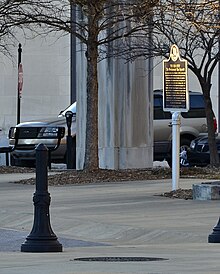
A plaque entitled "The Bus Stop" at Dexter Ave. and Montgomery St.—the place Rosa Parks boarded the bus—pays tribute to her and the success of the Montgomery bus boycott.
After working all day, Parks boarded the Cleveland Avenue bus around 6 p.m., Thursday, December 1, 1955, in downtown Montgomery. She paid her fare and sat in an empty seat in the first row of back seats reserved for blacks in the "colored" section. Near the middle of the bus, her row was directly behind the ten seats reserved for white passengers. Initially, she did not notice that the bus driver was the same man, James F. Blake, who had left her in the rain in 1943. As the bus traveled along its regular route, all of the white-only seats in the bus filled up. The bus reached the third stop in front of the Empire Theater, and several white passengers boarded.
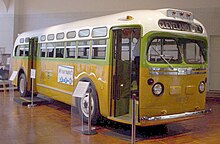
The No. 2857 bus on which Parks was riding before her arrest (a
GM "old-look" transit bus, serial number 1132), is now a museum exhibit at the
Henry Ford Museum.
Blake noted that two or three white passengers were standing, as the front of the bus had filled to capacity. He moved the "colored" section sign behind Parks and demanded that four black people give up their seats in the middle section so that the white passengers could sit. Years later, in recalling the events of the day, Parks said, "When that white driver stepped back toward us, when he waved his hand and ordered us up and out of our seats, I felt a determination to cover my body like a quilt on a winter night."
[20]
By Parks' account, Blake said, "Y'all better make it light on yourselves and let me have those seats."
[21] Three of them complied. Parks said, "The driver wanted us to stand up, the four of us. We didn't move at the beginning, but he says, 'Let me have these seats.' And the other three people moved, but I didn't."
[22] The black man sitting next to her gave up his seat.
[23]
Parks moved, but toward the window seat; she did not get up to move to the redesignated colored section.
[23] Blake said, "Why don't you stand up?" Parks responded, "I don't think I should have to stand up." Blake called the police to arrest Parks. When recalling the incident for
Eyes on the Prize, a 1987 public television series on the Civil Rights Movement, Parks said, "When he saw me still sitting, he asked if I was going to stand up, and I said, 'No, I'm not.' And he said, 'Well, if you don't stand up, I'm going to have to call the police and have you arrested.' I said, 'You may do that.'"
[24]
Rosa Parks' arrest

Booking photo of Parks
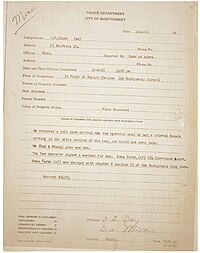
Police report on Parks, December 1, 1955, page 1
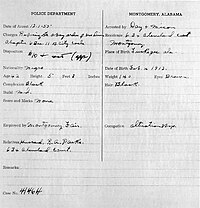
Police report on Parks, December 1, 1955, page 2
 Fingerprint
 card of Parks
During a 1956 radio interview with
Sydney Rogers in
West Oakland several months after her arrest, Parks said she had decided, "I would have to know for once and for all what rights I had as a human being and a citizen."
[25]


