Report: Russian Government Initiative Gave Millions of Dollars to Clinton Foundation
Do you want to speculate why the Russians gave millions to her foundation while Clinton she was Secretary of State? Usually as you say, they want something back.
No I don't think anything happened there and we have no proof it has happened with Trump.
It still boils down to there not being a law to release his taxes. And all the speculation without evidence is nothing more than liberals throwing a tantrum.
So it is OK for Trump but not Clinton. Or people want Trump to be like Clinton.
I stated I don't think it happened with Clinton, I also see no evidence it happened with Trump. It is all speculation, both Trump and Clinton. Benghazi, emails, birther bs, it is liberals revenge for all that. Just more silliness by the extreme sides.
Well, that's your opinion, yes, but they will eventually be released.
what exactly do you expect to find in his returns? He gets audited every year. If he was not complying with the tax code the IRS would be all over him. Are they? NO.
You on the left don't like the tax code. Neither do I. Do you know who wrote it? Congress. Which party has controlled congress for most of the last century? Dems.
So you need to look at your own party when you ***** about loopholes for the rich. They created them.
Here redfish
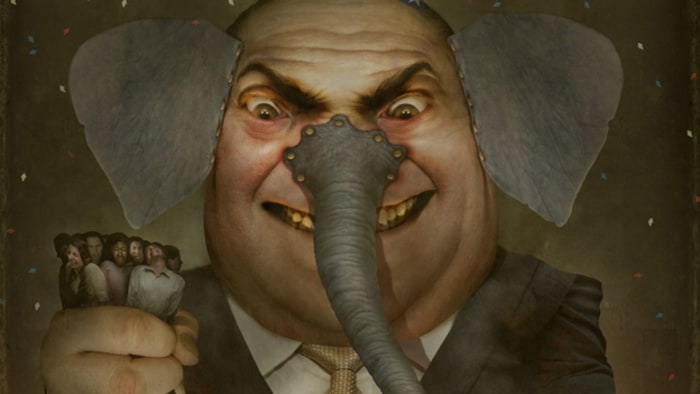
How the GOP Became the Party of the Rich
The inside story of how the Republicans abandoned the poor and the middle class to pursue their relentless agenda of tax cuts for the wealthiest one percent
Party of the Rich Matt Mahurin
Tim Dickinson
November 9, 2011
The nation is still recovering from a crushing recession that sent unemployment hovering above nine percent for two straight years. The president, mindful of soaring deficits, is pushing bold action to shore up the nation's balance sheet. Cloaking himself in the language of class warfare, he calls on a hostile Congress to end wasteful tax breaks for the rich. "We're going to close the unproductive tax loopholes that allow some of the truly wealthy to avoid paying their fair share," he thunders to a crowd in Georgia. Such tax loopholes, he adds, "sometimes made it possible for millionaires to pay nothing, while a bus driver was paying 10 percent of his salary – and that's crazy."
Preacherlike, the president draws the crowd into a call-and-response. "Do you think the millionaire ought to pay more in taxes than the bus driver," he demands, "or less?"
The crowd, sounding every bit like the protesters from Occupy Wall Street, roars back: "MORE!"
The year was 1985. The president was Ronald Wilson Reagan.
Today's Republican Party may revere Reagan as the patron saint of low taxation. But the party of Reagan – which understood that higher taxes on the rich are sometimes required to cure ruinous deficits – is dead and gone. Instead, the modern GOP has undergone a radical transformation, reorganizing itself around a grotesque proposition: that the wealthy should grow wealthier still, whatever the consequences for the rest of us.
Modern-day Republicans have become, quite simply, the Party of the One Percent – the Party of the Rich.
"The Republican Party has totally abdicated its job in our democracy, which is to act as the guardian of fiscal discipline and responsibility," says David Stockman, who served as budget director under Reagan. "They're on an anti-tax jihad – one that benefits the prosperous classes."
The staggering economic inequality that has led Americans across the country to take to the streets in protest is no accident. It has been fueled to a large extent by the GOP's all-out war on behalf of the rich. Since Republicans rededicated themselves to slashing taxes for the wealthy in 1997, the average annual income of the 400 richest Americans has more than tripled, to $345 million – while their share of the tax burden has plunged by 40 percent. Today, a billionaire in the top 400 pays less than 17 percent of his income in taxes – five percentage points less than a bus driver earning $26,000 a year. "Most Americans got none of the growth of the preceding dozen years," says Joseph Stiglitz, the Nobel Prize-winning economist. "All the gains went to the top percentage points."