Tax revenues? lol, Oh right when Dubya gutted revenues?
BUT it was this:
Total income was $2.74 trillion less during the eight Bush years than if incomes had stayed at 2000 levels.
Tax revenues? lol, Oh right when Dubya gutted revenues?
Right. Income tax receipts dropped from $1.004 trillion in 2000
to $994 billion in 2001 and $858 billion in 2002, because Bush cut each bracket by 0.5% each year.
Corporate tax receipts dropped from $207 billion in 2000 to $151 billion in 2001, $148 billion in 2002, $132 billion in 2003, because he cut the corporate tax rate from 35% all the way down to 35%.
Idiot.
Total income was $2.74 trillion less during the eight Bush years than if incomes had stayed at 2000 levels.
Yes, if only the bubble had continued for 8 more years. LOL!
Oh you want to use static dollars. Of course Bubba
2000 THERE WAS 20.0% OF GDP
2001 IT WENT DOWN TO 18.8%
2002 DUBYA.GOP PUSHED IT DOWN TO 17.0
2003 THEY PUSHED IT TO 15.7%
2004 THEY PUSHED IT TO 15.6%
Historical Federal Receipt and Outlay Summary
CBO: Bush Tax Cuts Responsible For Almost A Third Of Deficit In Last 10 Years (2001-2010)
2000 THERE WAS 20.0% OF GDP
2001 IT WENT DOWN TO 18.8%
2002 DUBYA.GOP PUSHED IT DOWN TO 17.0
In 2001, he cut each tax bracket by 0.5%.
In 2002, he cut each tax bracket by 0.5%.
Was that enough to cut tax receipts by 3% of GDP? Prove it.
Show all your work.
Better ask CBO Bubba
CBO: Bush Tax Cuts Responsible For Almost A Third Of Deficit In Last 10 Years (2001-2010)
10 years ago tomorrow, the first of the Bush tax cuts was enacted. That 2001 tax cut was followed up by a second tax cut in 2003, passed after Vice-President Dick Cheney reportedly asserted that “
deficits don’t matter.” The tax cuts were sold as necessary economic stimulus that would boost job creation and a moribund economy. “
Tax relief will create new jobs, tax relief will generate new wealth, and tax relief will open new opportunities,” Bush said on April 16, 2001 as he was pushing for the passage of the first tax cut. Two years later he said, “These tax reductions will bring real and immediate benefits to middle-income Americans…By speeding up the income tax cuts, we will speed up economic recovery
and the pace of job creation.” Bush called the 2001 tax cut, “a victory for fairness and
a vote for economic growth.” Then-Speaker of the House Dennis Hastert (R-IL) said that the cuts were necessary to “
spur the economy on.” And up through 2008, Bush was still convinced that his tax cuts had been good for the economy. “I think when people take a look back at this moment in our economic history,
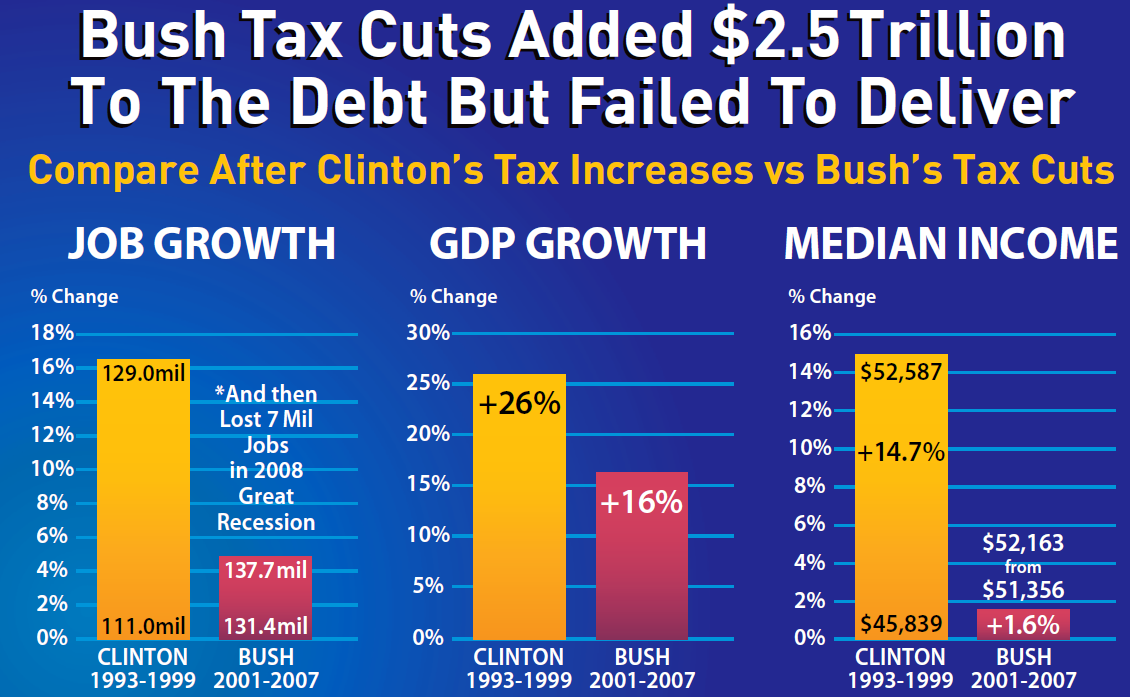
they’ll recognize tax cuts work. They have made a difference,” Bush said. However, the record of the Bush tax cuts is undeniable: their enactment coincided with the weakest economic expansion of the post-war period, blowing up the national deficit and debt, while not bringing any of the promised gains.
DIDN’T CREATE JOBS: The lofty rhetoric used by conservatives to sell the Bush tax cuts didn’t match reality.
During the decade after the Bush tax cuts were passed, “growth in investment, GDP, and employment all posted their
worst performance of any post-war expansion.” Following the Bush tax cuts, “Overall monthly job growth
was the worst of any cycle since at least February 1945, and household income growth was negative for the first cycle since tracking began in 1967.”
Ten Years Of The Bush Tax Cuts ThinkProgress