Advances in Computers thread

Large-scale quantum chip validated

14 minutes ago
A team of scientists at USC has verified that quantum effects are indeed at play in the first commercial quantum optimization processor.

The team demonstrated that the D-Wave processor housed at the USC-Lockheed Martin Quantum Computing Center behaves in a manner that indicates that quantum mechanics plays a functional role in the way it works. The demonstration involved a small subset of the chip's 128 qubits.
Read more at: Large-scale quantum chip validated
 
Google and NASA Snap Up Quantum Computer D-Wave Two

By Nicola Jones and Nature magazine
Google and NASA Snap Up Quantum Computer D-Wave Two: Scientific American
D-Wave, the small company that sells the world’s only commercial quantum computer, has just bagged an impressive new customer: a collaboration between Google, NASA and the non-profit Universities Space Research Association.

The three organizations have joined forces to install a D-Wave Two, the computer company's latest model, in a facility launched by the collaboration — the Quantum Artificial Intelligence Lab at NASA's Ames Research Center in Moffett Field, California. The lab will explore areas such as machine learning — making computers sort and analyse data on the basis of previous experience. This is useful for functions such as language translation, image searches and voice-command recognition. “We actually think quantum machine learning may provide the most creative problem-solving process under the known laws of physics,” says a blog post from Google describing the deal.

D-Wave has battled to prove that its computer really operates on a quantum level, and that it is better or faster than a conventional computer. Before striking the latest deal, the prospective customers set a series of tests for the quantum computer. D-Wave hired an outside expert in algorithm-racing, who concluded that the speed of the D-Wave Two was above average overall, and that it was 3,600 times faster than a leading conventional computer when working on the specific type of problem that the quantum computer was built to solve.

http://en.wikipedia.org/wiki/D-Wave_Two
 
Last edited:
Apple iWatch trademark application filed in Japan


Chris Davies, Jul 1st 2013 Discuss [1]
Apple has filed a trademark application for “iWatch” in Japan, fueling speculation that the company is preparing to launch a smartwatch companion device for the iPhone and iPad. The filing, made on June 3 Bloomberg reports, refers to potential uses of the name as being for a watch device or a “handheld computer”.

Apple’s plans for its wearable are still unofficial, though that hasn’t stopped ongoing speculation about the rumored iWatch project. Earlier this year, the company was tipped to have around 100 designers and engineers working on the smartwatch, while chatter back in December 2012 suggested Apple was working with Intel on the digital timepiece.

Intel later confirmed it was developing smartwatches, though declined to comment on whether Apple was involved.

Apple iWatch trademark application filed in Japan - SlashGear
 
Pebble smartwatch rumored to be sold at Best Buy soon

Pebble was one of the first smartwatches to debut and it looks like the device soon may become more mainstream.

The Pebble smartwatch is rumored to be sold at Best Buy within the next few weeks, according to claims from two employees who said they were briefed on the matter and a leaked document given to 9to5Mac.

The document shows an inventory form for a device classified as a "digital communication appcessory" that is to be in stock as of July 7. As 9to5Mac points out, the date could mean when the device goes on sale or just …

Pebble smartwatch rumored to be sold at Best Buy soon | Cutting Edge - CNET News
 
Microsoft develops 3D touchscreen with tactile feedback
By Leo Kelion

BBC News - Microsoft develops 3D touchscreen with tactile feedback
Microsoft 3D screen By adjusting resistance against a person's touch the screen can make some objects feel heavier than others

Details of a touchscreen showing 3D images that can be felt and manipulated have been published by Microsoft's research unit.

The project combines an LCD flat panel screen with force sensors and a robotic arm that moves it back and forwards.
 
New programming language makes turning GPUs into supercomputers a snap
By Ryan Whitwam on July 3, 2013 at 12:24 pm
New programming language makes turning GPUs into supercomputers a snap | ExtremeTech
Most of the bits you’ve ever crunched were run through a CPU, but your computer’s graphic processing unit (GPU) is increasingly being used for general computing tasks. The problem has always been designing applications that can take advantage of the raw computing power of a GPU. A computer science Ph.D. candidate at Indiana University by the name Eric Holk has created a new programming language called Harlan to make the process easier.

CPUs and GPUs are both important for modern computing, with each being better suited for different tasks. Most CPUs have several cores capable of running a few processing threads. It runs each thread very fast, then moves on to the next one. A GPU typically has a large number of slower processing cores (sometimes called stream processors) which can run more simultaneous threads. We would say that GPU computing is inherently more parallel than the CPU variety.
 
Samsung unveils plans to build five new research and development centersSamsung unveils plans to build five new research and development centers - SlashGear
A Samsung official who spoke to The Korea Times revealed that Samsung has plans to build five new Research and Development centers in South Korea, a project that will cost approximately $4.5 billion. The centers will each focus on their own aspects of R&D, with one being used for maximizing creativity, another for study and development of different components and materials.
 
Samsung Galaxy Note III specifications leak with 3GB RAM

Samsung Galaxy Note III specifications leak with 3GB RAM - SlashGear

It's become a race, suddenly, to deliver the first Android smartphone - or first smartphone with any mobile operating system, that is, to bring on a whopping 3GB of RAM, here between the Samsung Galaxy Note III and the LG Optimus G2. While neither device has been confirmed with full specifications delivered by its creator - or confirmed to exist, at that - both machines have been rumored just today to be carrying the next-level amount of processing capability
 
MIT researchers build an all-optical transistor

14 minutes ago by Larry Hardesty
Optical computing—using light rather than electricity to perform calculations—could pay dividends for both conventional computers and quantum computers, largely hypothetical devices that could perform some types of computations exponentially faster than classical computers.

Read more at: MIT researchers build an all-optical transistor
 
Last edited:
Wimoto wireless sensor system now offers motion detection and water sensing

Derek Markham
Technology / Gadgets
July 5, 2013

The citizen scientist in me, along with my inner geek, are really jazzed to see so many innovations in remote sensors and connected devices and smarter homes these days.

After all, it's one thing to have a subjective observation about our environment ("It seems hotter in here than normal."), and another thing entirely to look at the data and see if it truly is hotter than normal, and if so, exactly how much hotter it is.

This trend of small wireless sensor systems makes it easier than ever to get started, and for those who want to integrate some of this technology into their lives, the options just keep increasing.

Wimoto, whose remote wireless sensors we've covered before, just added a couple of new options to their system, as well as tripling the battery life of the sensors, so they are well worth taking a look at if you're considering getting started in remote monitoring for your home, office, or garden
Wimoto wireless sensor system now offers motion detection and water sensing : TreeHugger
 
CGI lighting, scanning deliver more realistic face (w/ Video)

7 hours ago by Nancy Owano weblog

(Phys.org) —Gaming and movie leaders might in the past have put up with CGI faces with that wax-museum look reminding users that the faces are anything but real, but this is a new day with advanced technologies that can make faces look very real. Computer generated imagery (CGI) expertise can perform facial imagery wonders. A team of collaborators with expertise that includes computational illumination and photography for graphics have developed a technique to produce CGI faces that look true, down to the skin cell level. Call it ultra-realistic skin simulation.


Read more at: CGI lighting, scanning deliver more realistic face (w/ Video)
 
New technique would allow a petabyte of data on a single disc

New technique would allow a petabyte of data on a single disc
Data storage and preservation are no longer restricted to the needs of individual users, or even of companies or governments large and small. Instead they are the only remaining approach to preserving the history associated with the evolution of the digital age, and possibly the post-human era to follow. A research team headed by Prof. Min Gu of Swinburne University of Technology has developed a new data storage method that may be of considerable use for such civilization-sized concerns by putting a petabyte of information on a DVD-sized polymer disk.
 
Silicon oxide memories transcend a hurdle

3 hours ago

A Rice University laboratory pioneering memory devices that use cheap, plentiful silicon oxide to store data has pushed them a step further with chips that show the technology's practicality.
The team led by Rice chemist James Tour has built a 1-kilobit rewritable silicon oxide device with diodes that eliminate data-corrupting crosstalk.

A paper on the new work appears this week in the journal Advanced Materials.

With gigabytes of flash memory becoming steadily cheaper, a 1k nonvolatile memory unit has little practical use. But as a proof of concept, the chip shows it should be possible to surpass the limitations of flash memory in packing density, energy consumption per bit and switching speed.

Read more at: Silicon oxide memories transcend a hurdle
 
Garmin launches HUD-based in-car navigation for just $130
By Bill Howard on July 9, 2013 at 8:45 am
5 Comments
Garmin launches HUD-based in-car navigation for just $130 | ExtremeTech
Garmin just sliced the cost of head-up displays from more than $1,000 to just $130 with the introduction of a stick-on-the-dash HUD that projects navigation information on your windshield (pictured above). The Garmin HUD (its name) pairs with your smartphone running Garmin StreetPilot or Navigon GPS software via Bluetooth. Just like high-end HUDs, the information bounces off a transflective patch on the windshield.

Displayed information includes turn arrows, distance to the next turn, your speed, the speed limit, excessive speed, estimated time of arrival, and lane guidance (which lane for exits vs. through traffic). If you subscribe to premium services, you can also get traffic info and photo radar alerts.


Welcome to the fifth dimension, where data is stored on crystals


Colin Druce-McFadden

Tuesday, July 9, 2013 - 5:54pm


Welcome to the fifth dimension, where data is stored on crystals | DVICE
It sounds like a bunch of sci-fi hullabaloo, but data storage has just crossed into the fifth dimension. That's right: the dimension sometimes referred to by physicists as the fabric of spacetime can now be harnessed to store you cat videos. And they've done it with frikkin' lasers and quartz.

Basically, science just created Superman's data crystals and they're gonna last forever. And we don't mean "forever" as in "ugh, my progress bar is taking forever," but the real end of time kind of forever. Bare minimum, these things will hold up for a million years. As group supervisor Peter Kazansky states: "it is thrilling to think that we have created the first document which will likely survive the human race. This technology can secure the last evidence of civilization: all we've learnt will not be forgotten."

If timeless, fifth dimensional storage written into quartz isn't cool enough for you, then check out the storage capacity on these suckers: a single crystal disc can store up to 360 terabytes of data. That's a lot of cat videos.
 
Invention transforms plain surfaces into low-cost touch screens

5 hours ago

Imagine turning a whiteboard, glass window or even a wooden table top into a responsive, touch sensitive surface. A low cost system developed by Nanyang Technological University (NTU), based on the principles of vibration and imaging that is able to track the movements of multiple fingers and of objects, can do just that.

Retrofitting the system onto existing flat-panel TVs will transform it into new, touch sensitive display screens, at only a fraction of the cost of new touch-sensitive display screens, which can cost tens of thousands of dollars.

Once hooked up to a computer, the modified TV screens can then be used as interactive billboards, mall directories and even as a digital whiteboard which can track what is drawn or written.

Read more at: Invention transforms plain surfaces into low-cost touch screens
 
15th post
LG intros world's thinnest smartphone screen
LG intros world's thinnest smartphone screen | DVICE
Adario Strange

Thursday, July 11, 2013 - 12:12pm

With all the attention currently being directed toward wearable computers like smartwatches, developments in the smartphone space seem to have slowed to an incremental pace, with few companies introducing revolutionary ideas or functions in the last year. LG is hoping to distinguish itself with a development that could inject new life into the smartphone space.

Today the company unveiled what it claims is the world's thinnest full HD LCD panel for a smartphone. The 5.2-inch panel is just 2.2 millimeters thin framed by a 2.3 millimeter bezel. The super thin panel was created using dual flexible printed circuit places between the panel and the touch film, thus reducing the panel lines by 30 percent.
 
Video: Samsung presents lighter, bendier phone concepts

Megan Wollerton

Thursday, July 11, 2013 - 3:12pm
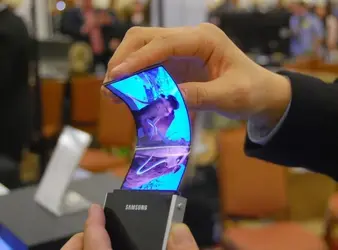
Video: Samsung presents lighter, bendier phone concepts | DVICE
.
Samsung's Device Solutions President and Chief Strategy Officer, Young Sohn, presented the video below on Tuesday at San Francisco's MobileBeat conference. It's a bit of a sneak peek into the future of cellphones at Samsung and how mobile commuication might change.

Large displays that are also sleek and super lightweight? Check. Wearable sensors that allow you to monitor your health stats on the go and send the results directly to a doctor? Double check. Not surprisingly, Sohn emphasizes the importance of medical tech at the conference: “We think the health area is a really key area of innovation.”
 

Attachments

  • $sammy_bendy_concept.webp
    $sammy_bendy_concept.webp
    23.7 KB · Views: 75
Last edited:
This little gesture-controlled cube wants to be your next mouse

Colin Druce-McFadden
This little gesture-controlled cube wants to be your next mouse | DVICE
Thursday, July 11, 2013 - 2:25pm

The computer mouse's days are numbered — that much is certain. Ever since motion-capture devices like Leap Motion and the Kinect showed up on the market, the writing has been on the wall. Now, a new option has hit Kickstarter and it just might give Leap Motion a run for its money.

Skymouse is a plug-and-play motion controller which requires minimum setup. There's also very little to learn as far as how you go about using the Skymouse. The same gestures you're used to using while giving yourself carpal tunnel via your traditional mouse all work with Skymouse.
 
Half the price of a Trim-Slice: CompuLab unveils the Utilite miniature computer

Mini-PC maker CompuLab has unveiled the next generation of its teeny, Tegra 2-powered Trim-Slice computer. Now called the Utilite, Nvidia's processing heart has been swapped for a Freescale i.MX6 system-on-chip that's available with single, dual or quad cores. The system can run either a desktop-grade Ubuntu or a fully-featured Android operating system, but probably the best news is a starting price of just US$99.

Cheap entry doesn't mean that the Israeli company has sacrificed performance for cost. Buyers of the new Utilite can look forward to up to twice the performance offered by its full-size-PC-in-a-small-package Trim-Slice ancestor for less than half the starting price.

Half the price of a Trim-Slice: CompuLab unveils the Utilite miniature computer
 
Back
Top Bottom