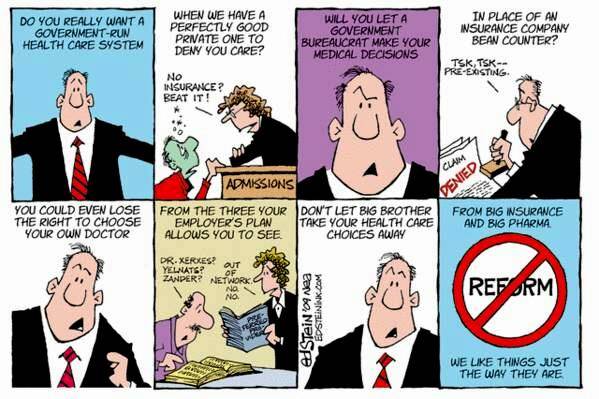
Okay, while we're on the subject of what the left doesn't tell people about US healthcare, let's discuss the REAL problems with our system that the left doesn't want you to know, because they aren't what the left would like them to be.
Rationing
Is there rationing in the US? Sure, especially in government programs like public hospitals that treat the poor, and Medicare and Medicaid.
Doctors estimate that as many as half of the 300,000 people on dialysis in the US might benefit from 6-day-a-week treatment; but Medicare only covers a maximum of 3 days a week.
Only about one in fifteen patients who could benefit from a device called HeartMate get it because Medicare won't pay for the full cost.
750,000 people suffer from sepsis each year, and 250,000 people die from it every year. Medicare balks at paying the cost ($6,800 a treatment) for Xigris, so doctors write fewer than 15,000 prescriptions for it a year.
Still, the Commonwealth Fund and Harvard School of Public Health tells us that only about 5% of Americans undergoing surgery have to wait more than four months. The figures for Australia, New Zealand, Canada, and Great Britain are 23%, 26%, 27%, and 36% respectively.
Inequality of Access
As we've all heard until our ears are ready to bleed, much of the US population does not have private health insurance and is not enrolled in public health programs. Studies show that the uninsured consume about 50% less health care than those with insurance, all other things being equal.
For decades, the European press has repeated the canard that poor people in the US get no care because they cannot afford it, and now the US press is echoing that. Not true. 95% of the elderly are enrolled in Medicare. Medicaid spends even more than Medicare does, even though it covers roughly the same number of people. The VA provides yet another safety net. And every state has a system of public hospitals and clinics for the indigent. Federal law requires emergency rooms to take all comers. State and federal laws both also require many hospitals to provide charity care, and offer matching funds for those institutions that provide a disproportionate share of care to Medicaid and the uninsured.
Low-income persons in the US without job-related health insurance spend only about fifty dollars per year more out of pocket than those with employer-provided health benefits. On average, they make 2.4 visits to doctors per year, compared to 3.4 for people with employer-provided insurance. When seriously ill, uninsured low- to moderate-income Americans receive about the same level of treatment with out of pocket costs about the same as those with employer-provided insurance.
But yeah, people with money have better health care than poor people. Being rich is always better than being poor, and that's as true in other countries as it is here.