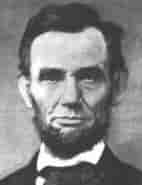
[Melvin Sickler, Lincoln Kennedy] :
Abraham Lincoln
During the Civil War (1861-1865), President Lincoln needed money to finance the War from the North. The Bankers were going to charge him 24% to 36% interest. Lincoln was horrified and went away greatly distressed, for he was a man of principle and would not think of plunging his beloved country into a debt that the country would find impossible to pay back.
Eventually President Lincoln was advised to get Congress to pass a law authorizing the printing of full legal tender Treasury notes to pay for the War effort. Lincoln recognized the great benefits of this issue. At one point he wrote:
"... (we) gave the people of this Republic the greatest blessing they have ever had -- their own paper money to pay their own debts..."
Lincoln printed 400 million dollars worth of Greenbacks (the exact amount being $449,338,902), money that he delegated to be created, a debt-free and interest-free money to finance the War. It served as legal tender for all debts, public and private. He printed it, paid it to the soldiers, to the U.S. Civil Service employees, and bought supplies for war.
Shortly after that happened, "The London Times" printed the following: "If that mischievous financial policy, which had its origin in the North American Republic, should become indurated down to a fixture, then that Government will furnish its own money without cost. That govern-ment must be destroyed, or it will destroy every monarchy on the globe." In retaliation
After this was published in "The London Times", the British Government, which was controlled by the London and other European Bankers, moved to support the Confederate South, hoping to defeat Lincoln and the Union, and destroy this government which they said had to be destroyed.
The Czar of Russia sent a portion of the Russian navy to the United States with orders that its admiral would operate under the command of Abraham Lincoln. These ships of the Russian navy then became a threat to the ships of the British navy which had intended to break the blockade and help the South.
The North won the War, and the Union was preserved. America remained as one nation.
Of course, the Bankers were not going to give in that easy, for they were determined to put an end to Lincoln's interest-free, debt-free Greenbacks. He was assassinated by an agent of the Bankers shortly after the War ended.
Thereafter, Congress revoked the Green-back Law and enacted, in its place, the National Banking Act. The national banks were to be privately owned and the national bank notes they issued were to be interest bearing. The Act also provided that the Greenbacks should be retired from circulation as soon as they came back to the Treasury in payment of taxes.
In
1972, the United States Treasury Department was asked to compute the amount of interest that would have been paid if that 400 million dollars would have been borrowed at interest instead of being issued by Abraham Lincoln. They did some computations, and a few weeks later, the United States Treasury Department said the United States Government saved 4 billion dollars in interest because Lincoln had created his own money.
The Federal Reserve Act
Abraham Lincoln and John F. Kennedy Two great presidents of the United States Assassinated for the cause of justice
www.cidpusa.org