Time for change but Arabs don't hold out much hope...
 Rouhani victory - time for Iran change?
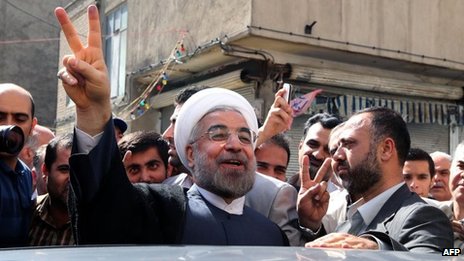
15 June 2013 > The victory of reformist-backed figure Hassan Rouhani in Iran's 14 June presidential election has a number of uncomfortable messages for the country's ruling right-wing establishment.
Rouhani victory - time for Iran change?
15 June 2013 > The victory of reformist-backed figure Hassan Rouhani in Iran's 14 June presidential election has a number of uncomfortable messages for the country's ruling right-wing establishment.
Mr Rouhani was not the reformists' first, or even the second, choice of candidate. Most had pinned their hopes on former President Mohammad Khatami, but he did not put his name forward. The reformists then looked to the pragmatic veteran politician Akbar Hashemi-Rafsanjani, who was disqualified from standing by Iran's top election body, the Guardian Council. And when Mohammad Reza Aref, the only reformist candidate in the running, withdrew earlier this week in favour of Mr Rouhani, the reformists reached a consensus and threw their weight behind him.
Hassan Rouhani is a 64-year-old cleric often described as moderate
His victory in the first round - when he unexpectedly gained 50.7% of the votes in a turnout of over 72% - has certainly emboldened the reform movement. After four years of seeing their leaders placed under house arrest, many of them imprisoned and their media outlets curtailed, they sense that voters have given them a mandate for change. This is despite the fact that Mr Rouhani is seen as more of a "moderate, centrist" figure, rather than a "true" reformer in the vein of Green movement leaders Mir Hussein Mousavi and Mehdi Karroubi, who are both under house arrest.
Hardline defeat
The downbeat mood of the "principle-ist" - or conservative ruling coalition - is evident by the tone of their media. Tabnak news agency, which is affiliated to defeated principle-ist candidate Mohsen Rezai, set the agenda. An online editorial appearing a day after the poll and before the final outcome was announced, spoke of the 2013 presidential election as a "necessary defeat for the principle-ists". "The principle-ists must understand that they must be accountable and answerable," said the editorial. "The principle-ists... must know that the era of monopolizing the media has ended."
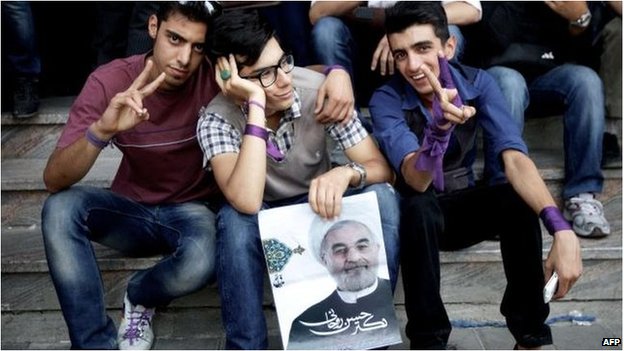
Rouhani supporters made their feelings known in Tehran even before the vote was counted
The hardline Javan newspaper chose to put a gloss on the affair, concentrating on the reported high turnout. "The Iranian nation, with its epic presence at polling stations, proved it has a strong bond with the Islamic system and again disappointed and defeated the enemy. This election, irrespective of the result, should be considered as a model for correcting the current political behaviour of groups and political activists." The conservatives had assumed an easy ride.
MORE
See also:
Arabs don't hold out much hope for a Rowhani-led Iran...
Arabs Put (Slim) Hopes in New Iranian President
June 15, 2013 The election of a moderate Iranian president could help rein in hostility between Tehran and its Arab neighbors, but many Arabs doubt he can end a sectarian confrontation that has been inflamed by war in Syria.
Hassan Rowhani, a Shi'ite cleric known for a conciliatory approach and backed by reformists, will have only limited say in policy determined by Iran's supreme leader; but with the Syrian carnage fueling rage among Sunni Arabs across the region, any gestures from Tehran may help contain it. "We hope the new Iranian president will be a believer in a political solution in Syria," said one ambassador at the Arab League in Cairo. "All that we read about Rowhani might be grounds for hope - but there is a great difference between election campaigns and what is said once in office."
For the United States and Western powers, at odds with Iran for decades and now rallying with arms behind rebels fighting Syria's Iranian-backed president, fierce religious enmities in the oil-rich Middle East add to fears of wider instability. In Saudi Arabia, whose U.S.-allied rulers lead opposition to what they see as Iran's drive to spread its power and religion, analyst Jamal Khashoggi said: "I'm sure for the Saudi leadership this is the best outcome of the elections."
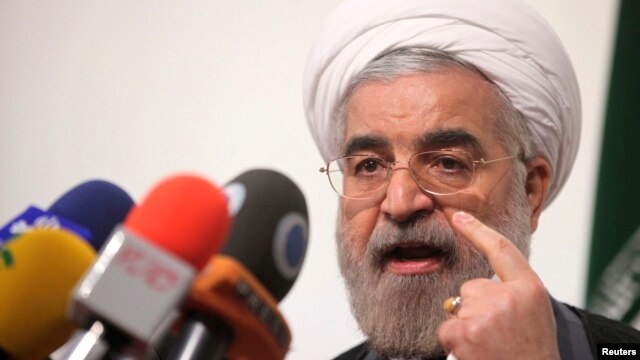
Iranian presidential candidate Hassan Rowhani, Iran's former top nuclear negotiator, speaks during a campaign rally in Tehran
He recalled that Iran's last reformist president, Mohammad Khatami, who visited Riyadh while in office from 1997-2005, had mended ties - but at a time of less ferocious disputes. Unlike now, Khashoggi said, "Iran was not meddling heavily in Syria, Bahrain and Yemen ... There were no Shi'ites killing Sunnis." In Syria, where mainly Sunni rebels are battling Iran's ally President Bashar al-Assad and his Alawite establishment, who belong to an offshoot of Shi'ism, opposition activists saw little hope for change from Rowhani. "The election is cosmetic," said Omar al-Hariri from Deraa, where the uprising began during the Arab Spring two years ago.
Muhammed al-Husseini, from the Sunni Islamist rebel group Ahrar al-Sham in Raqaa, noted power in Iran rested with Supreme Leader Ayatollah Ali Khamenei. "The powers given to the Iranian president are weak these days," he said. "They are fake powers." In Bahrain, whose Saudi-backed Sunni monarchy accuses Iran of fomenting protests among the Shi'ite majority on the island since 2011, Information Minister Samira Rajab said: "I think Rowhani is one of a team. And anybody who comes from that team will continue the same policy ... We have no more trust in the Iranian regime after what happened in Bahrain."
Egyptian Caution
IOWs - what you're saying is the democratically elected officials in the ME will refuse to respond to the will of the people who elected them? If that's what you're saying I agree but-----but if you are implying politicians are different in the "world's model democracy", consider;
A Model Democracy? Really?
by
Dave Lindorff - reduction by Star
But what kind of democracy is it really that we have here?
Forget that only half of eligible voters typically vote in quadrennial presidential elections (less than 30% in so-called off-year elections for members of the House and a third of the Senate, and less than 25% in municipal and state elections). Forget that the government is increasingly trampling on the Constitution and its Bill of Rights, with a burgeoning surveillance program and a growing militarization of the police.
The US government doesnt even do what the majority of the citizens want. In fact, these days it flat out ignores what we the people want.
Consider the polls, and what they show public sentiment to be on key issues, and then look at what the government, composed of supposedly elected representatives and an elected president, actually does:
1. Military spending
Most polls show that Americans, tired of the endless wars that have been raging almost without pause since the end of World War II, and the huge amount of taxes devoted to the military (currently over $1 trillion per year!), favor cutting the military.
2. Healthcare
Even with the passage of a sort of healthcare reform, the ludicrously and optimistically named Affordable Care Act, most Americans still tell pollsters that they would prefer a Canadian-style plan in which the government provides health insurance coverage for all, paid for by taxation. For decades this has been true. In 1988, a Harvard University/Harris poll found 61% favoring a Canadian-style so-called single-payer healthcare system.
3. Social security and Medicare programs for the elderly
Last year, President Obama, who campaigned for election in 2008 vowing never to cut Social Security benefits or Medicare programs, appointed an advisory commission heavily weighted towards people who favored such cuts, and told them to come up with recommendations for reforming both programs. He pointedly added that nothing was off the table in terms of ideas, including benefit cuts. Right wing politicians and business lobbies have long been calling for cuts in both programs, claiming that they will run out of money, in a decade in the case of Medicare and in 45-50 years in the case of Social Security. What they fail to mention is that if people were taxed on income of over $106,000 a year with the Social Security tax, and if the Medicare tax, currently less than 2% of income, were raised, there would be no shortfall at all.
Never mind the public though. Nearly all Republicans, and even many Democrats, in Congress, all recipients of large amounts of corporate campaign cash, continue to call for cuts in Social Security and Medicare benefits.
4. Higher taxes on the wealthy
With the US budget deficit soaring, with infrastructure crumbling, and with pressures mounting to cut important social programs like health care, education and welfare for the poor, there are increasing calls from the public for higher taxes on the wealthy again. President Obama has responded by calling for a slight increase in taxes on those earning more than $250,000 a year, back to a 35% rate that was in effect in 2000, but nobody in government is talking about seriously taxing the rich. As for the public? Poll after poll shows strong support for socking it to the wealthy. A Pew Research poll in July found that 44% favored higher taxes for those above $250,000 a year in income. Only 22% said they though such higher taxes were a bad idea. 44% also said higher taxes on the rich would be more fair, while 21% disagreed.
5. Action to combat climate change
Since taking office in 2008, President Obama, who had campaigned calling for action on climate change, has done almost nothing to reduce or even slow the pace of US carbon emissions. Neither has Congress done anything. The US, internationally, has actually worked openly and behind-the-scenes to prevent any global treaty on climate issues. Yet the American people want action.
A Gallup Poll last April, for example, found that 65% of Americans support having the government impose mandatory controls on CO2 emissions, even if that meant higher prices for energy and other things.
6. The war in Afghanistan
President Obama and his advisors say that even after 2014, the US will continue to have troops fighting in Afghanistan.
Yet only 27% of Americans in a recent poll by AP-GfK said they support that war. A whopping 66% said they oppose it and want it ended.
7. Invading Iran
According to a poll in March by the University of Maryland, published in the Christian Science Monitor, 70% of Americans said they wanted a diplomatic solution to dealing with Irans nuclear program. If the question was phrased to assume Iran was shown to be constructing a bomb, the result was different, with 56% supporting a US attack on Iran, but given that even US intelligence officials say there is no bomb program underway, this is not the issue.
And yet the US continues to send ever more offensive weapons to the borders of Iran, and to support covert terrorist actions inside the country, in the name of combating the countrys alleged nuclear program.
Looking at this huge disconnect between what the public wants on issue after issue and what the government actually does, one has to wonder how much different the US system is from one like Chinas or Saudi Arabias, where there is no pretense of democracy.
Certainly Americans have the right and the ability to vote for candidates, but that alone appears not to produce what President Abraham Lincoln, back in 1865, called a government of the people, by the people and for the people.
.