Yeah right--pewsh!
If that's what Boehner said, Boehner's an idiot that has been totally blinded by the asscheeks covering his
eyes-----Henry Ford must be spinning in his grave.
Poofuckinleese---think it through, who in their right mind chooses to NOT earn a living because their askeered taxes ---might--- go up, and/or they have to follow the same regulations their competition has to deal with? Very funny concept--dontcha think?
Somebody here is blind, but it isn't Boehner.
The people we are talking about hear don't need to earn a living, they already made enough money to support their families for generations. What they do now is based solely on what they want to do, not what they are afraid of, or what they need. Make it easier for them to create jobs, and they will do it. Make it harder, and they might still do it, but they will create less jobs than they would if they didn't have to jump through hoops.
Am excellent example of this is San Francisco, CA. I would be hard pressed to think of a city in this country that has more rules and regulations about jobs and businesses than San Francisco. These wonderful regulations meant that it took two years of constant work to open an ice cream parlor in San Francisco. Believe it or not, people who need to earn a living can't afford to pay rent for two years on a shop that isn't open. good thing the owner was doing this for fun, not because she needed the money. Just imagine what it would have meant to all the people that actually need to earn a living if the place had been open two years ago.
http://www.nytimes.com/2012/02/03/b...ream-shop-can-open-citys-slow-churn.html?_r=4
Joe and Jane consumer are the greatest job creators. Demand creates jobs, supply side economics is rooted in communism/totalitarianism.
Yet, for some reason, even Joe and Jane consumer couldn't get that ice cream parlor opened two years ago. did they not want it back then, or is the real truth that you are simply so deep in shit you can't hear the cries of all the people that want stuff they can't get because of the rules and regulations whose praises you are singing?
[SIZE=+1]
Including "Demand Side" Factors[/SIZE]. Socialist systems fail because consideration of demand factors is not directly linked to decisions about production, which are determined by central planning committees.
If that was true socialist systems would never work, yet they obviously do, if the system is small enough. Socialist systems have advantages that allow them to thrive in the proper environment, or in industries where demand is not tied to production decisions.
Similarly, Supply-Siders fail when they seek to separate supply from demand in the economic equation. It is demand from consumers which stimulates production by real producers. And who are these consumers? Everyone in the economy! But since the productive work force is the largest single segment, the same individuals who actually produce wealth (supply) are the largest single component in creating demand for it. Demand is stimulated when the real producers become the consumers.
Excuse me? How can a supply side economic system separate supply from demand? Where did you learn economic theory, the back of a comic book written by a disgraced communist?
The overall success attributed to free-market economies is the result of the close link between supply and demand. Demand creates supply. Industries will produce what consumers will buy. But it is not an impotent demand of wishes, rather a demand based on actual sales. If consumers (mostly from the productive work force) cannot afford to become a potent demand-side buying force, the economy becomes stagnant and everyone suffers.
How does a productive workforce become unable to afford to buy things? The only examples I can think of something like that actually happening in history did not happen in a free market, they were all the result of government control of the market. The worst ones occur when the government that is restricting the economy is outside the market itself, which is part of what contributed to the collapse in pre WWII Germany.
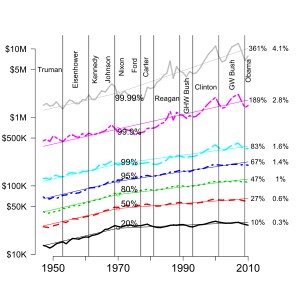
In the 1930's, when the productive work force enjoyed protections which enabled creation of the supply-side, the same consumer force also developed the economic clout to generate demand, which generated further supply, and so on. As long as those who produce the goods can afford to purchase what they create, a domestic market is created and a cycle of economic prosperity ensues. As New Deal protections were solidified over the next four decades, our economy became increasingly prosperous and the gap between rich and poor steadily narrowed. Only in the last decade, under deregulation, have these gains been reversed. Wages for workers decrease, while salaries at the top skyrocket. The rich get richer. There is less buying power (demand) from the labor force (producers/consumers). The economy slows down.
Huh? Do you live in an alternate reality where the Great Depression never happened?
The old economic truism asserts that the economy prospers during a "wartime economy." Why is that? Why should an economic boom result from diverting productive resources away from the production of consumer goods and services, towards products such as bombs and bullets that destroy real wealth? Because a massive redistribution of payments is suddenly diverted away from top-level salaries and profits, towards legions of soldiers (consumers), generally recruited from the bottom levels of the economic strata.
Because it doesn't actually happen?
The economy in the United States did not prosper until after the war ended when all that ramped up production capacity could be turned from feeding the government war machine to producing goods and creating demand.
Nice try at trying to use a falsism to support your position. too bad that reality doesn't work the way your fantasy world does.
Why shouldn't we have, instead, a "wartime economy" based on productive rather than destructive expenditures, in which good jobs are provided at good wages for building roads, hospitals, housing and manufacturing resources under regulatory controls to prevent the balance of wealth from becoming unbalanced -- concentrated in favor of those who own and control such resources as the economy sags into a top-heavy recession.
If the world actually worked that way we would be in a thriving economy right now because the government has spent more money in the last 20 years than it did in the previous century. Can you tell me why that isn't happening?
This is the essence of "Free Market Plus": to use free market incentives in private enterprise, with just enough government intervention and regulation to balance out the extremes and bring the interests of owners, investors, workers and consumers together in harmony -- a compassionate approach that benefits everyone.
Sure it does, because the government spending more money makes things better.
Tell me something, where did the concept of Free Markets Plus come from? When did social justice start making economic sense?
In the extreme example of third-world feudalism, we can see this even more dramatically. If we could take all the hard-working survivalists off the streets and put them in factories producing televisions, autos, appliances, food, and housing, there would be more than enough increased wealth to go around. It wouldn't matter whether those factories were capitalized by private investors, charities, the government, or any combination.
What a wonderful idea. It will work because we will pay them. never mind the small detail that they would rather be doing something else, paying them makes it morally not slavery.
So why don't we put them all in factories? Because, under raw capitalism, if they work in a factory, competitive pressures among the investors who own the productive resources will cause them to be paid as little as possible. This means just enough to survive on. If one owner raises salaries, it is not enough to make a dent in the system, and they reduce their competitive edge in pricing against those who continue to pay the lower salaries. No single investor has the economic clout to go first, so the productive work force does not have enough money to buy the products they could have been producing. There is no mechanism for distributing the wealth that could have been created, so there is no incentive to actually take the laborers off the street and make them productive. The people remain poor, while the investors miss out on a great opportunity. The vicious cycle can only be broken when the community as a whole, through government, establishes minimum standards to protect workers and consumers, reflecting its compassion.
Just when I think you have reached the depths of stupidity by advocating forced labor you argue that not being slaves makes people slaves.
In theory, Adam Smith's "Invisible Hand" of lassiez-faire capitalism is supposed to regulate such excesses, as workers exercise their "economic freedom" to enter into voluntary contracts with investors, exchanging labor for money. But in practice, there is no "free market" if both sides do not have equal bargaining positions. In completely unregulated feudal economies, where wealth is concentrated in the hands of a few, agreements are based on duress: workers have to take what is offered or die from starvation and exposure. The economic imbalance inherent in feudal systems is perpetuated by force, just as it was created by force.
Instead of a market where the advantage switches back and forth from one side to the other you want one where the government forces people to work for corporations and also forces the corporations to pay them an arbitrary wage.
Sounds good to me.
NOT
In the European "Middle Ages," those who had military power in an age of ongoing warfare could offer protection to those who would pledge them fealty and enter into the safety of their castles in exchange for "voluntarily" becoming their subjects. This "social contract," passed on through succeeding generations, became the basis for the "divine right" of kings, although failure to accept such "voluntary" terms of extortion would have meant certain death. Similarly, in the Southern United States prior to emancipation, great wealth was created for plantation owners by workers (slaves) who did not even enjoy a token gesture of "free choice." Although that wealth was passed on by inheritance to succeeding generations, any attempt to restore portions of such wealth to the heirs of its creators has always been labeled "reverse discrimination." In nations victimized by colonial oppression, such as in India, Africa and the Philippines, invaders conquered native populations and expropriated the land and its wealth which was, again, passed on through inheritance to succeeding generations even after the end of colonial rule. Yet those who have inherited unearned wealth in these modern feudal economies still refuse to accept economic reforms to restore any portion of such wealth to the heirs of those from whom it was taken by force, who are still forced to accept an unequal economic contract, with a result of widespread poverty.
What a wonderful reason to support your preferred form of slavery, we had different forms of it in the past.
Raw, unregulated free-market capitalism does not work. Socialism also doesn't work. We need a balance between the extremes. "Free Market Plus" is a basic free-market system, with supply and demand incentives, but with adequate regulation to protect workers and consumers in a compassionate way, ensuring the balance between supply and demand. Policies of greed, or incentives of taxation that favor a few wealthy instead of the general population of producer/consumers, are counter-productive.
How would you know that something that has never been tried won't work? If you were around before the Wright brothers flew off Kitty Hawk would you have argued that flight was impossible because it never happened before, and nothing that has never been done can be done?
Those on the extreme political right wing worship free enterprise like a dogmatic religion, in a free and purely unregulated form, while those on the extreme left would like to throw out the free market altogether. Sensible people see a balance in the middle: the free market provides the foundation for our successful economy, but is one among many factors to consider. We can compare it to sex: sex is the basis of life and free enterprise is the basis of economic life. Both are powerful motivational forces. Long-range sexual satisfaction is maximized within the boundaries of stable relationships, not by just letting the sexual impulse run wild and unrestrained. Similarly, the free market can be destructive when it runs wild and unrestrained, causing extremes of poverty and wealth, and allowing those who own and control productive resources to shut out those who do not and manipulate market forces to gain an unfair advantage over workers and consumers. Reasonable limitations on the excesses of capitalism do not diminish the legitimate operation of free markets any more than rules of the road hurt the safe use of automobiles.
No one here is arguing against reasonable rules. The problem is you are so far out in wackadoodle land you think it is reasonable to park a car in a locked garage when you want to drive to across the country.




 Liberal logic is quite worrisome, is it not?
 Right on.


