Sayaras
Platinum Member
- Nov 13, 2023
- 6,050
- 3,735
- 938
This image you posted is not in the US.It's payback time
And it was you Muslims "falastin" who began the swastikas in "palestine"...
Islamo Arab war on Jews was never a "payback," but always an initiated attack.
Did you know that Arabs in Germany, in early 1930s boycotted local Jews?
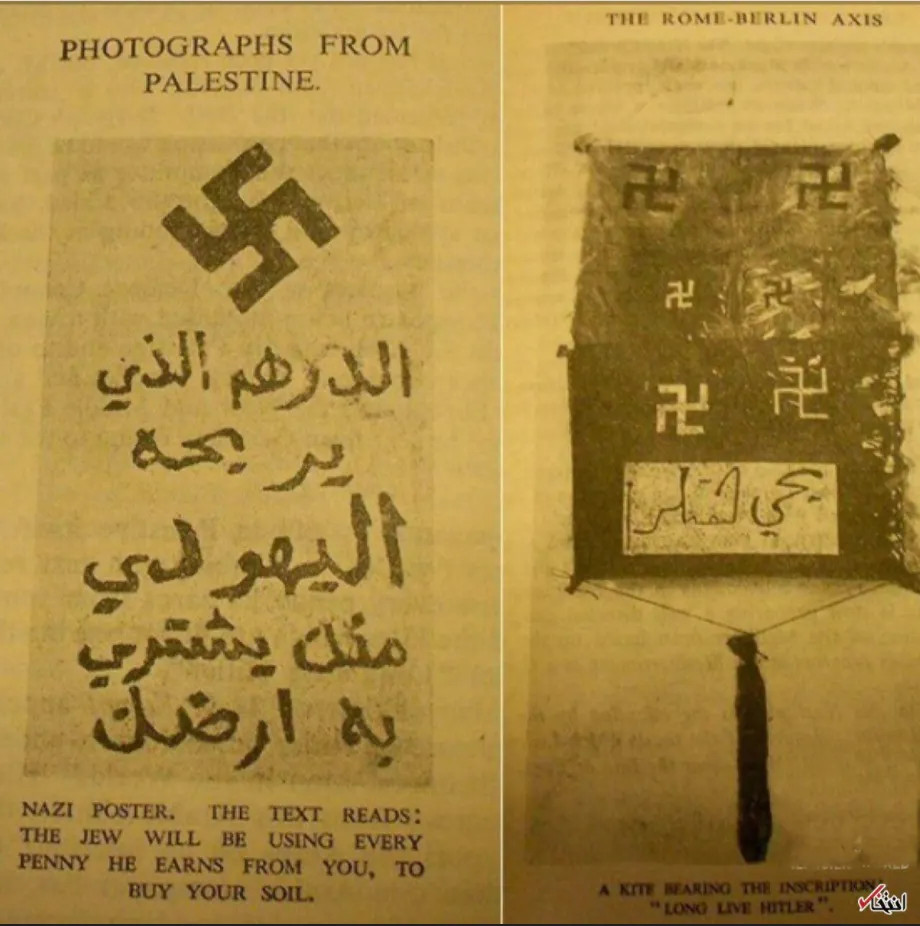
1934-1936: Arabs boycott Jews with Swastikas.
Arabs Use Swastika in Fight for Trade of Jews in Holy Land.
JTA, Aug 14, 1934 .

Arabs Use Swastika in Fight for Trade of Jews in Holy Land - Jewish Telegraphic Agency
Arabic posters with the swastika prominently displayed and advocating a boycott of all Jewish stores have suddenly appeared in Arab shop windows in Jerusalem and Haifa. At the same time walls in the two cities were placarded with the Arabic swastika posters. The anti-Jewish boycott movement...
 www.jta.org
___
1935:
When in 1935 delegates returned from an Arab youth conference in Haifa, their train to Afula bore a large swastika chalked on one of the coaches with an Arabic inscription beneath it reading "Germany over All." [ألمانيا فوق كل شيء].
It then continued for some time.
'Palestine Train Flies Swastika.'
Haifa-Damascus train flies swastika.
The New York Times, May 13, 1935 .
Palestine Train Flies Swastika. (Published 1935).

Palestine Train Flies Swastika. (Published 1935)
Haifa-Damascus train flies swastika
'Swastikas On Haifa Train.'
The Chronicler-Spokesman, 17 May 1935
'Swastika Decorates Palestine Train.'
The Sentinel, 6 June 1935
___
1936 was not a good year for democracy. The Fascist countries were seen as successful by many people. Every step taken by Hitler or Mussolini met with hesitation and trepidation on the part of the leaders of the free world. Hitler armed Germany, contraven-ing the Treaty of Versailles. The Wehrmacht marched to the Rhineland; this was a blatant violation of the Locarno Pact, according to which Germany was to keep the area demilitarized. France, which was directly affected by this move, reacted merely with protests.
During that same year, 1936, a high-ranking political refugee came to Jerusalem — Haile Selassie, Emperor of Ethiopia. The Emperor's exile symbolized a loss of deterrent power on the part of Britain, which could not prevent Ethiopia from falling to the Italians.
The Arabs of Jerusalem closely observed this ally of Britain — now an exiled refugee, a living symbol of the change in the balance of world power. Mussolini, the Italian dictator, displayed much interest in the Arabs. The dream of "II Duce" was to transform the Mediterranean into an Italian sea, as it had been during the glorious days of the Roman Empire. But fulfillment of this vision was hampered by the British Navy. Mussolini therefore sought an ally against the common enemy, Britain. Italian propaganda began to present him as the "Protector of Islam." He quickly found what he was looking for in the leader of the Palestinian Arab national movement, the Mufti, Haj Amin al-Husseini.
In Jerusalem, the Arabs knew that the time was right for demanding concessions from Britain. Swastikas and slogans expressing their feelings were inscribed upon the walls of the city. Against this international political background an Arab revolt broke out in Palestine.

Last edited:

 7 October was payback and it's not over yet