Crime rate statistics
Further information:
Crime statistics
Prison data
Further information:
Incarceration in the United States § Race
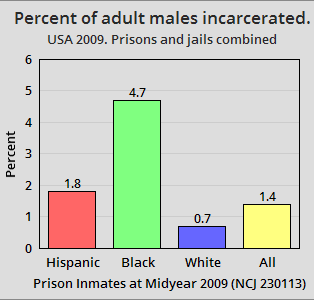
2009. Percent of adult males incarcerated by race and ethnicity.
[17]
According to the BJS non-Hispanic blacks accounted for 39.4% of the prison and jail population in 2009, while non-Hispanic whites were 34.2%, and Hispanics (of any race) 20.6%. The
incarceration rate of black males was over six times higher than that of white males, with a rate of 4,749 per 100,000 US residents.
[18][19][20]
Hispanics constituted 16.3% of the US population according to the 2010 US census.
[21][22] According to the
Bureau of Justice Statistics the black incarceration rate in state and federal prisons declined to 3,161 per 100,000 and the white incarceration rate slightly increased to 487 per 100,000.
[23] In 2009 American Indians and Alaskan Natives were jailed, paroled, or on probation at 932 per 100,000, 25% higher than for non-Indians/Natives (747), up 5.6% that year and 12% higher than 2007.
[24] However, crime in general declined during this time down to near 1970 levels, an 18% decrease from the previous decade.
[25]
A 2011 study which examined the racial disparities in violent crime and incarceration from 1980 and 2008 found little difference for black share of violent offending. Racial imbalances between arrest rates and sentencing have caused some to question the disparities. The authors argued that the prior studies had been
confounded by not separating Hispanics from Whites.
[26] Another recent study in 2012 raises a different concern, showing that Hispanics and blacks receive considerably longer sentences for the same or lesser offenses on average than white offenders with equal or greater criminal records.
[27][28] Another recent study in 2012 raises a different concern, showing that Hispanics and blacks receive considerably longer sentences for the same or lesser offenses on average than white offenders with equal or greater criminal records.
[27][28] A 2012 University of Michigan Law School study found that African Americans are given longer federal sentences even when factoring prior criminal records, and that African American jail sentences tend to be roughly 10% longer than white jail sentences for the same crimes.
[29]
According to the US
Census Bureau as of the year 2000 there were 2,224,181 blacks enrolled in college.
[30] In that same year there were 610,300 black inmates in prison according to the Bureau of Justice.
[31] 12.5 percent have a bachelor’s degree.[
citation needed] The results are highly dependent on education. 30 percent of those without college education and nearly 60 percent of high school dropouts had prison records.
[32]
Crime trends
Some studies had argued for smaller racial disparities in violent crime in recent times. However, a study of government data from 1980–2008 found that the reduction in Black violent crime relative to White violent crime was an artifact of those previous studies, which was due to Hispanic offenders being counted as White in the comparison. The Hispanic population has been increasing rapidly and Hispanics have violence rates higher than that of Whites but lower than that of Blacks.
[26]
Homicide
According to the US Department of Justice, blacks accounted for 52.5% of homicide offenders from 1980 to 2008, with whites 45.3% and "Other" 2.2%. The offending rate for blacks was almost 8 percentage points higher than whites, and the victim rate 6 times higher. Most homicides were intraracial, with 84% of white victims killed by whites, and 93% of black victims killed by blacks.
[33][34][35]
Youth crime
The "National Youth Gang Survey Analysis" (2011) state that of gang members, 46% are Hispanic/Latino, 35% are African-American/black, 11.5% are white, and 7% are other race/ethnicity.
[36]
According to the FBI Uniform Crime Reports, in the year 2008 black youths, who make up 16% of the youth population, accounted for 52% of juvenile violent crime arrests, including 58.5% of youth arrests for homicide and 67% for robbery. Black youths were overrepresented in all offense categories except DUI, liquor laws and drunkenness.
[37]
Robbery
According to the
National Crime Victimization Survey in 2002, the black arrest rate for robbery was 8.55 times higher than whites, and blacks were 16 times more likely to be incarcerated for robbery than non-Hispanic whites. Robberies with white victims and black offenders were more than 12 times more common than the reverse.
[38][39]
Hispanics
According to a 2009 report by the Pew Hispanic Center, in 2007 Latinos "accounted for 40% of all sentenced federal offenders-more than triple their share (13%) of the total U.S. adult population". This was an increase from 24% in 1991. 72% of the Latino offenders were not U.S. citizens. For Hispanic offenders sentenced in federal courts, 48% were immigration offenses and 37% drug offenses. One reason for the large increase in immigration offenses is that they exclusively fall under federal jurisdiction.
[40]
Racially motivated hate crime
The federal government publishes a list annually of
Hate Crime Statistics, 2009.
[41] Also published by the federal government is the Known Offender's Race by Bias Motivation, 2009.
[42] According to the Federal Bureau of Investigation Uniform Crime Report database, in 2010 58.6% of hate crime offenders were white (including Hispanics), 18.4% of offenders were black, 8.9% were of individuals of multiple races and 1% of offenders were Native Americans.
[43] The report also reveals that 48% of all hate crime offenders were motivated by the victim's race, while 18% were based on the victim's religion, and another 18% were based on the victim's sexual orientation.
[44] The report states that among hate crime offenses motivated by race, 70% were composed of anti-black bias, while 17.7% were of anti-white bias, and 5% were of anti-Asian or Pacific Islander bias.
[44]
Racial composition of geographic areas
Studies have examined if ethnic/racially heterogeneous areas, most often neighborhoods in large cities, have higher crime rates than more homogeneous areas. Most studies find that the more ethnically/racially heterogeneous an area is, the higher its crime rates tend to be.
[45]
Studies examining the relationship between percentages of different races in an area and crime rates have generally either found similar relationships as for nationwide crime rates or no significant relationships. Most often studied are correlations between black and Hispanic populations in a given area and crime. Such data may reveal a possible connection, but is functionally inconclusive due to a variety of other correlating factors which overlap with race and ethnicity.
[45]
Race and socioeconomic status
While there is a correlation between blacks and Hispanics and crime, the data implies a stronger tie between poverty and crime than crime and any racial group, when gender is taken into consideration.
[45] The direct correlation between crime and class, when factoring for race alone, is relatively weak. When gender, and familial history are factored, class correlates more strongly with crime than race or ethnicity.
[46][47] Studies indicate that areas with low socioeconomic status may have the greatest correlation of crime with young and adult males, regardless of racial composition, though its effect on females is negligible.
[46][47]
Theories of causation
Historically, crime statistics have played a central role in the discussion of the relationship between race and crime in the United States.
[48] As they have been designed to record information not only on the kinds of crimes committed, but also on the individuals involved in crime, criminologists and sociologists have and continue to use crime rate statistics to make general statements regarding the racial demographics of crime-related phenomena such as
victimization, arrests, prosecutions, convictions, and incarceration. Regardless of their views regarding causation, scholars acknowledge that some racial and ethnic minorities are disproportionately represented in the arrest and victimization reports which are used to compile crime rate statistics.
[49] There is, however, a great deal of debate regarding the causes of that disproportionality.
As noted above, scholars acknowledge that some racial and ethnic minorities, particularly African Americans, are disproportionately represented in the arrest and victimization reports which are used to compile crime rate statistics in the United States. The data from 2008 reveals that Black Americans are over-represented in terms of arrests made in virtually all types of crime, with the exceptions of "Driving under the influence" and "Liquor laws". Overall, Black Americans are arrested at 2.6 times the per-capita rate of all other Americans, and this ratio is even higher for murder (6.3 times) and robbery (8.1 times).
[50][51]
Schools of thought
 W. E. B. Du Bois
, one of the pioneers in the study of race and crime in the United States.
Main article:
Criminology
The relationship between race and crime has been an area of study for criminologists since the emergence of
anthropological criminology in the late 19th century.
[52] Cesare Lombroso, founder of the
Italian school of criminology, argued that criminal behavior was the product of biological factors, including race. He was among the first criminologists to claim a direct link between race and crime.
[53] This biological perspective, sometimes seen as racist and increasingly unpopular, was criticized by early 20th century scholars, including
Frances Kellor,
Johan Thorsten Sellin and
William Du Bois, who argued that other circumstances, such as social and economic conditions, were the central factors which led to criminal behavior, regardless of race. Du Bois traced the causes of the disproportional representation of Blacks in the criminal justice system back to the improperly handled
emancipation of
Black slaves in general and the
convict leasing program in particular. In 1901, he wrote:
There are no reliable statistics to which one can safely appeal to measure exactly the growth of crime among the emancipated slaves. About seventy per cent of all prisoners in the South are black; this, however, is in part explained by the fact that accused Negroes are still easily convicted and get long sentences, while whites still continue to escape the penalty of many crimes even among themselves. And yet allowing for all this, there can be no reasonable doubt but that there has arisen in the South since the [civil] war a class of black criminals, loafers, and ne'er-do-wells who are a menace to their fellows, both black and white.
[54]
The debate that ensued remained largely academic until the late 20th century, when the relationship between race and crime became a recognized field of specialized study in criminology. Helen T. Greene, professor of justice administration at
Texas Southern University, and
Shaun L. Gabbidon, professor of criminal justice at
Pennsylvania State University, note that many criminology and criminal justice programs now either require or offer elective courses on the topic of the relationship between race and crime.
[55]
Sociologist
Orlando Patterson has explained these controversies as disputes between liberal and conservative criminologists in which each camp focuses on mutually exclusive aspects of the causal net, with liberals focusing on factors external to the groups in question and conservatives focusing on internal cultural and behavioral factors.
[56]
Modern theories of causation
Conflict theory
Further information:
Conflict theory,
Conflict criminology and
Marxist criminology
Conflict theory is considered "one of the most popular theoretical frameworks among race and crime scholars".
[57] Rather than one monolithic theory, conflict theory represents a group of closely related theories which operate on a common set of fundamental assumptions.
[58] As a general theory of criminal behavior, conflict theory proposes that crime is an inevitable consequence of the conflict which arises between competing groups within society. Such groups can be defined through a number of factors, including class, economic status, religion, language, ethnicity, race or any combination thereof. Further, conflict theory proposes that crime could be largely eliminated if the structure of society were to be changed.
[59]
The form of conflict theory which emphasizes the role of economics, being heavily influenced by the work of
Karl Marx and sometimes referred to as
Marxist criminology, views crime as a natural response to the inequality arising from the competition inherent in capitalist society.
[60] Sociologists and criminologists emphasizing this aspect of social conflict argue that, in a competitive society in which there is an inequality in the distribution of goods, those groups with limited or restricted access to goods will be more likely to turn to crime. Dutch criminologist
Willem Adriaan Bonger, one of the first scholars to apply the principles of
economic determinism to the issue of crime, argued that such inequality as found in capitalism was ultimately responsible for the manifestation of crime at all levels of society, particularly among the poor. Though this line of thinking has been criticized for requiring the establishment of a utopian socialist society,
[61] the notion that the disproportionality observed in minority representation in crime rate statistics could be understood as the result of systematic economic disadvantage found its way into many of the theories developed in subsequent generations.
Culture conflict theory, derived from the pioneering work of sociologist
Thorsten Sellin, emphasizes the role of culturally accepted norms of conduct in the formation of cultural groups and the conflicts which arise through their interaction. Culture conflict theory argues that the group with the most power in any society ensures that their values, traditions and behaviors, which Sellin referred to as "conduct norms", are those to which all other members of society are forced to conform, and any actions which conflict with the interests of the dominant group are identified as deviant and/or criminal in nature. Sellin's original ideas continued to be developed throughout the 20th century, most notably by George Vold in the 1950s and Austin Turk in the 1960s, and continue to influence the contemporary debate.
[62] The recent work of Gregory J. Howard, Joshua D. Freilich and Graeme R. Newman applies culture conflict theory to the issue of immigrant and minority crime around the world. According to their research, while culturally homogeneous groups experience little to no cultural conflict, as all the members share the same set of "conduct norms", culturally heterogeneous groups, such as modern industrial nations with large immigrant populations, display heightened competition between sets of cultural norms which, in turn, leads to an increase in violence and crime. Societies which have high levels of cultural diversity in their population, it is claimed, are more likely to have higher rates of violent crime.
[62]
According to conflict theorists such as Marvin Wolfgang, Hubert Blalock and William Chambliss, the disproportionate representation of racial minorities in crime statistics and in the prison population is the result of race- and class-motivated disparities in arrests, prosecutions and sentencing rather than differences in actual participation in criminal activity, an approach which has also been taken by proponents of
critical race theory.
[63] This line of argumentation is generally seen as part of a wider approach to race-related issues referred to as the Discrimination Thesis, which assumes that differences in the treatment received by people of minority racial background in a number of public institutions, including the criminal justice, education and health care systems, is the result of overt racial discrimination. Opposed to this view is the Non-Discrimination Thesis, which seeks to defend these institutions from such accusations.
[64]
At the time it was first proposed, conflict theory was considered outside the mainstream of more established criminological theories, such as
strain theory,
social disorganization theory and
differential association theory.
[65] Barbara D. Warner, associate professor of criminal justice and police studies at Eastern Kentucky University, notes that conflict theory has been the subject of increasing criticism in recent years. Recent studies claim that, while there may have been real sentencing differences related to non-legal characteristics such as race in the 1960s, sentencing discrimination as described by the conflict theorists at that time no longer exists. Criticism has also pointed to the lack of
testability of the general theory.
[61] While much research has been done to correlate race, income level and crime
frequency, typically of less serious criminal behavior such as theft or larceny, research has shown there to be no significant correlation between race, income level and crime
seriousness. Thus, conflict theory encounters difficulties in attempting to account for the high levels of violent crime such as murder, homicide and rape, in minority populations.
[66]
Strain (anomie) theory
Further information:
Strain theory (sociology) and
Anomie
Strain theory, which is largely derived from the work of
Robert K. Merton in the 1930s and 1940s, argues that social structures within society which lead to inequality and deprivation in segments of its population indirectly encourage those segments to commit crime. According to strain theory, differences in crime rates between races are the result of real differences in behavior, but to be understood as an attempt to alleviate either absolute or relative deprivation and adapt to the existing opportunity structure.
[67]
A more recent approach to strain theory was proposed by Steven F. Messner and Richard Rosenfeld in the 1990s. In their version of the theory, which they refer to as institutional anomie theory, Messner and Rosenfeld argue that the dominance of materialistic concerns and measurements of success manifested in the
American Dream weakens the effectiveness of informal social control mechanisms and support processes, which encourages economic gain by any means, legal or illegal. In those segments of the population which experience the greatest relative deprivation, therefore, there is readiness to turn to crime to overcome inequality and eliminate relative deprivation.
[68]
Critics of strain theory point to its weaknesses when compared with actual criminal behavior patterns.
Michael R. Gottfredson and
Travis Hirschi argue that strain theory "misconstrue(s) the nature of the criminal act, supplying it with virtues it does not possess." They further point out that, while strain theory suggests that criminals should tend to target people in a more advantageous economic situation than themselves, they more often victimize individuals who live in the same economic circumstances.
[69]
Social disorganization theory
Further information:
Social disorganization theory
Social disorganization theory proposes that high rates of crime are largely the result of a heterogeneous and impoverished social ecology.
[70] Proponents of the theory point to the process of
urban decay as a major contributing factor to the breakdown of healthy urban communities which would normally curb the spread of many forms of criminal behavior. The diversity of minority cultures present in poverty-stricken neighborhoods prevents the formation of strong social bonds and leaves inhabitants uninterested in maintaining positive community relationships. This has been observed to increase the likelihood of crime in certain urban areas, which can lead to increased policing and a further breakdown of familial structures as a result of arrests, which, in turn, precipitates more crime. Social disorganization theory has been instrumental in establishing the notion that stable, culturally homogeneous communities have lower rates of delinquency and crime regardless of race.
[71]
Macrostructural opportunity theory
Phillippia Simmons reports that many of the studies which have investigated intra- and interracial crime seek to explain this through a theory of macrostructural opportunity which states that interracial violence is primarily a function of opportunity and access.
[72] According to this theory, intraracial crime rates remain relatively high due to the fact that much of the US remains residentially segregated. She notes that this theory predicts that, if residential areas were more racially integrated, intraracial crime would decrease and interracial crime would increase correspondingly. However, she also notes that not all researchers on the topic of intraracial crime agree with this result, with some pointing to other macrostructural factors, such as income and education, which may negate the effect of race on inter- and intraracial crime.
[72]
Anthony Walsh criticizes the attempt to use the macrostructural opportunity model to explain interracial rape as has been done in studies conducted in the past few decades, pointing out that such a defense is directly contradicted by the data related to homicide. Walsh argues that the macrostructural opportunity model helps explain why black murderers almost always choose black victims.
[73] There are disparities in rates of reporting rape where victims of some races are statistically less likely or more likely to report their rape, especially depending on the race of the offender. Black women in America are more likely to report sexual assault that has been perpetrated by a stranger.
[74][75] White women are more likely to report the offense if the offender is black
[76] whereas black women are still more likely to under-report rapes overall as they are more likely to blame themselves, feel they will be blamed or feel they won't be believed.
[77]
Social control theory
Further information:
Social control theory
Social control theory, which is among the most popular theories in criminology,
[78] proposes that crime is most commonly perpetrated by individuals who lack strong bonds or connections with their social environment.
[79] Based upon
Travis Hirschi's
Causes of Delinquency (1969), social bonding theory pioneered the notion that criminologists can gain useful insight into the motives behind criminal behavior by examining what normally motivates individuals to refrain from crime. From this it is argued that, in those segments of the population where such motivation is lacking, crime will be more prevalent. Hirschi was explicit in mentioning that he believed his theory held true across all racial boundaries, and subsequent research - both in the US and abroad - seems to confirm this belief.
[80] The core idea of social control theory is elaborated upon in several other theories of causation, particularly social disorganization theory.
Subculture of violence theory
Further information:
Subcultural theory
As a theory of criminal behavior, subculture of violence theory claims that certain groups or subcultures exist in society in which violence is viewed as an appropriate response to what, in the context of that subculture, are perceived as threatening situations. Building upon the work of cultural anthropologist
Walter B. Miller's
focal concerns theory, which focused on the social mechanisms behind delinquency in adolescents, sociologists Marvin E. Wolfgang and Franco Ferracuti proposed that the disproportionally high rate of crime among African Americans could be explained by their possessing a unique racial subculture in which violence is experienced and perceived in a manner different from that commonly observed in mainstream American culture.
[81]
As to the origins of this subculture of violence among African Americans, sociologists promoting the theory have pointed towards their
Southern heritage. As noted in several studies conducted throughout the 1960s and 1970s, there is a traditional North-South discrepancy in the distribution of homicide in the US, regardless of race, and this, it was argued, indicates that lower-class Southern Blacks and Whites share the same subculture of violence.
[82]
The empirical basis for the subculture of violence theory, however, has been described as "extremely limited and unpersuasive".
[82] Very little has been done to attempt an adequate assessment of supposedly criminogenic subcultural values, and several studies conducted in the late 1970s claimed to falsify the assumptions upon which the subculture of violence theory depends.
[82] More recently, scholars have criticized the theory as potentially racist in nature in its implication of one given ethnicity or culture supposedly being less fit for or less worthy of being qualified as "civilized," the built-in implication of which in turn would denote stereotypically "white" behavior as an objective norm for all societies to follow.
[83]
Prosecutorial and police discrimination theory
Further information:
Racial inequality in the American criminal justice system
Another theory proposes that racial inequality in the American criminal justice system is mostly caused by a racial imbalance in decisions to charge criminal
defendants with crimes requiring a mandatory minimum prison sentence, leading to large racial disparities in incarceration.
[3] At the Federal level of prosecution of offenders for Federal Offenses there are generally more classes of criminal offense that will result in mandatory jail sentences.[
citation needed] The majority of offenders are prosecuted by state and local prosecutors federal prosecutors and are incarcerated in state or local prisons or jails (only about 1 in 17 penal facilities is Federal).[
citation needed] On a state level, most offenders will either have committed a violent offense or have multiple prior convictions before receiving lengthy incarceration sentences.[
citation needed] State offenders are also more likely to be eligible for parole.[
citation needed] Any findings related to federal prosecution charging decisions may or may not be born out by similar studies of state or local prosecutors.[
speculation?] Similarly, a study related to the relative parole rates of white and non-white offenders could assist in determining the impact of any racial bias in the criminal justice system.[
citation needed]
One theory is that racial overrepresentation is due to police discrimination. However, various studies have shown that, in recent[
which?] decades, there has not been any noticeable disparity in black vs white crime statistics in black-controlled vs white-controlled cities (say
Atlanta vs
San Diego).[
citation needed] In a book from 1999, Tharnstrom wrote that in the largest counties, the conviction rates for accused blacks were slightly less than the conviction rates for whites, for example.
[84]
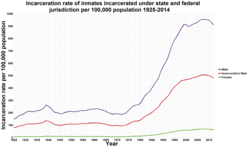
A graph showing the Incarceration rate under state and federal jurisdiction per 100,000 population 1925–2008. It does not include jail inmates. The male incarceration rate is roughly 15 times the female incarceration rate.
In a 2008 self-published paper Paul Heaton from the
RAND Corporation and Charles Loeffler wrote, that some scholars and studies have argued that police discrimination is not an important explanation for racial differences in crime, others[
who?] state that it is the main cause and some[
who?] argue that both discrimination and different real crime rates contribute. They claim that the varying results can be explained to a large degree by the methods being uncertain with many possible confounding factors. As such Heaton and Loeffler proposed a method that they argue would remove all such observable and unobservable problems. They looked at the arrest rates for assault, robbery, and rape cases where the victims reported a black and white co-offending pair and argue that differences in arrest rates should only reflect police bias. They found that the black offenders were 3% more likely to be arrested. This suggests some bias, but is insufficient to explain the large racial crime disparities.
[85][
unreliable source?]
Race and crime in the United States - Wikipedia the free encyclopedia