CREW
Reports
Corruption
[
a few snippets -- very long piece]
Trump 2.0: Bracing for criminals, corruption and constitutional crises
By Meghan Faulkner, Esther von Allmen and Sacha Heymann
February 5, 2025 - Updated February 10, 2025
During Donald Trump’s first presidency, he engaged in unprecedented corruption and abuses of power, and surrounded himself with advisors and top appointees who had their own serious conflicts of interest. CREW frequently exposed these abuses and challenged many of them in court. As the second Trump administration begins, we took a look at some of the most notable abuses and ethical issues from last time, what’s already been happening this time around, and outline what we’ll be tracking this time:
Criminal associates and officials
What happened last time?
During Trump’s first term, multiple Trump associates were charged with or convicted of crimes, with several of them serving in the White House, including Michael Flynn and Steve Bannon. Since then, more former Trump associates and administration officials, including Mark Meadows, have been charged with or convicted of crimes, with
several sentenced to prison time. Notably, Meadows and Rudy Giuliani were
charged for actions they took as part of Trump’s scheme to overturn the 2020 election, which culminated in the January 6th insurrection, though neither have been convicted.
What’s happening this time?
This time, Trump has already
named two convicted criminals to serve in his administration: Peter Navarro and Charles Kushner...Trump also nominated Charles Kushner, his daughter Ivanka’s father-in-law, to be his administration’s ambassador to France. Kushner, who was convicted and sentenced to two years in prison for campaign finance violations, tax evasion and witness tampering, was pardoned by Trump in 2020.
...
Corruption in Trump’s cabinet
What happened last time?
Trump’s first term cabinet was the most ethically challenged in American history. Interior Secretary Ryan Zinke and Health and Human Services Secretary Tom Price both
resigned after scandals, with Zinke
racking up 18 investigations into lavish spending and travel as well as whistleblower retaliation...
What’s happening this time?
Trump’s Cabinet is shaping up to be even
wealthier than his first, with at least half a dozen billionaires picked for key roles, many of whom have holdings that could pose conflicts of interest. His nominee for Secretary of Commerce, Howard Lutnick, already has
reportedly mixed his business interests with his role as Trump’s transition chair, raising concerns that he could do the same once in the Cabinet. His nominee for Energy Secretary, Chris Wright, is the chairman and CEO of Liberty Energy and likely has substantial financial interests relevant to his role that he must divest from. Doug Burgum, his pick for Secretary of the Interior,
organized the infamous meeting at Mar-a-Lago this summer where Trump reportedly promised cuts to environmental regulations in exchange for $1 billion from Big Oil execs. And that’s just scratching the surface: Trump’s nominees for Cabinet posts and other top roles including multiple former lobbyists and several billionaires with extensive business interests.
...
The Hatch Act
What happened last time?
During the last Trump administration, the Office of Special Counsel found that more than a dozen senior Trump aides, including Jared Kushner, Ivanka Trump, Stephen Miller, Mark Meadows, Kellyanne Conway and Kayleigh McEnany violated the Hatch Act by using their official position for partisan politics, with most originating from
CREW complaints.
In 2019, following
multiple complaints by
CREW, the Office of Special Counsel took the unprecedented step of
recommending that Counselor to the President Kellyanne Conway be removed from public service for egregious and repeated violation of the Hatch Act. Despite a CREW
lawsuit seeking to compel OSC to enforce the law against Conway, Conway faced no real consequences. Because the president has historically been responsible for imposing consequences for Hatch Act violations for White House staff, Conway and many of the violators from Trump’s last term faced no consequences for their violations. One notable exception is
Lynne Patton, who as a HUD official was subject to the usual disciplinary processes, and who agreed to a four-year ban on federal employment after a Hatch Act investigation spurred by a CREW complaint.
During the 2020 election, then-President Trump and his staff stepped up their mixing of official government functions with campaign-style events including during the
Republican National Convention, with numerous officials later
found to have violated the Hatch Act during the months leading up to the election.
...
Inspectors General
What happened last time?
Inspectors general are independent officials within agencies who are key to combating waste, fraud and corruption in their agencies through investigations, audits and other oversight functions. Over the course of his first term, Trump acted with increasing hostility towards IG offices across the executive branch....
What’s happening this time?
During his first week in office, Trump
fired 17 IGs across the federal government, leaving those agencies without a permanent internal watchdog. In doing so, he disregarded federal law, which
requires the president to provide Congress 30-day notice and case-specific reasons for dismissal. Some members of Congress have
objected to Trump’s failure to provide notice and justification, but others have
defended Trump’s actions. Trump’s dismissal of so many IGs aligns with the aims of Project 2025, the conservative agenda shaped by many Trump administration officials which
called for the mass replacement of IGs by Trump.
...
Emoluments Clause/Trump conflicts
What happened last time?
The degree to which Trump used the presidency for his personal financial gain during his first term was staggering. CREW
found that Trump accumulated more than 3,400 conflicts of interest between his presidential duties and private business interests during that time. He broke more than
40 years of precedent by refusing to place his assets in a blind trust. And he
violated the Constitution’s Domestic and Foreign Emoluments Clauses, including by receiving at least $13.6 million in payments from foreign governments through his businesses.
Members of Congress, state and foreign officials and interest groups frequented Trump properties as they sought to curry favor with the president; every time they visited, Trump profited. Other potential egregious conflicts, such as Trump’s proposal to host the June 2020 G-7 Summit at one of his own properties, were stopped by
public outcry and
bipartisan backlash.
................
Cronyism and nepotism
What happened last time?
During his first term, Trump defied White House ethics norms by engaging in brazen cronyism and nepotism, appointing unqualified family members and loyal donors to powerful government positions. In 2017, Trump named his son-in-law Jared Kushner as senior White House advisor, and gave his daughter Ivanka Trump a similar advisory role in his administration. Kushner’s lack of experience
proved problematic with the failure of his COVID-19 “shadow task force,” resulting in the country’s pandemic response being left primarily to the uncoordinated efforts of state and local officials. Both Jared and Ivanka ignored ethics rules during their time in the White House, including refusing to divest from significant financial investments. Together, Jared and Ivanka
made up to $640 million while working for President Trump’s administration. Trump also rewarded donors and loyalists with prestigious
appointments, including mega-donor Louis DeJoy as US postmaster general and his wife, Aldona Wos as ambassador to Canada.
...
Mar-a-Lago
What happened last time?
During the last Trump administration, Mar-a-Lago served as a place to curry favor with Trump through
membership (which doubled in early 2017 to a $200,000 initiation fee and has since
risen to $700,000-$1 million), political events and
fundraisers. Mar-a-Lago members were named as
ambassadors, potentially
gained special access to executive branch agencies and reportedly
learned classified information about American nuclear submarines.
After Trump left office in 2021, Mar-a-Lago was
infamously where Trump allegedly brought hundreds of classified documents and refused to return them to the federal government, with documents being found in a bathroom, ballroom and multiple other unsecured locations. Trump was
charged in 2023 with 37 felony counts related to the handling of the documents.
Trump has also managed to
profit off the federal government directly, by charging the Secret Service to stay at Mar-a-Lago as well as his other properties, in order to protect him. During his first term, the Secret Service likely
paid Trump’s properties close to $2 million, and potentially much more.
...
What we’ll be watching for:
- Whether Mar-a-Lago members are given special access or appointments
- Whether foreign governments, federal, state or local officials and special interest groups spend money at Mar-a-Lago
- Whether the Secret Service continues to pay Trump thousands in order to protect him at his properties
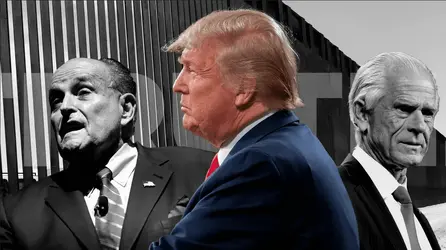 Photo of Pete Navarro by Gage Skidmore under Creative Commons license
Photo of Rudy Giuliani by Gage Skidmore under Creative Commons license
 www.dailydot.com