The biological qubit is valuable in another way too.
You've heard of Hofstadter's Butterfly?
It's a link between number theory, fractals, and the Cantor set.
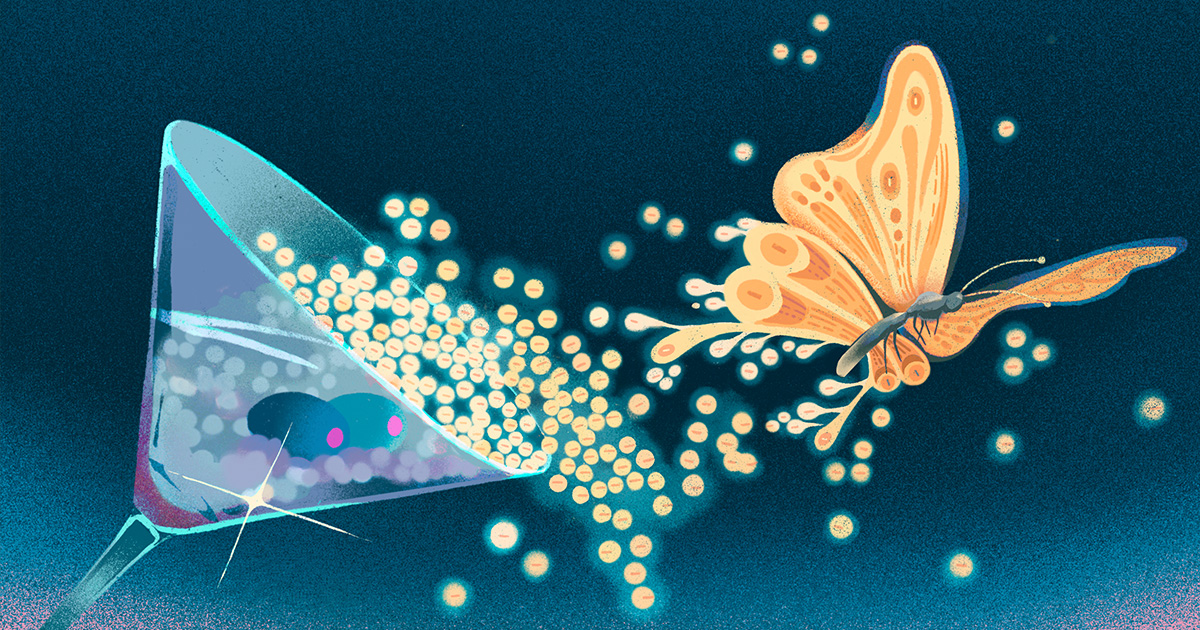
The proof, known to be so hard that a mathematician once offered 10 martinis to whoever could figure it out, connects quantum mechanics to infinitely intricate mathematical structures.

www.quantamagazine.org
And, you've heard of the critical brain theory?

en.wikipedia.org
The research question is, does number theory allow neurons to access quantum states?
According to Hofstadter's Butterfly, the answer is "yes". A fractal is a "shape" that expresses itself geometrically, and any neural network that can handle "shapes" (which is all of them) is capable of translating them into numbers.
So this gives you the feed"back" path from quantum land to classical land, and recently (in another thread) scientists have also discovered the feed"forward" path using proteins that control the spins of other proteins.
In the brain, you can take a molecule like cyclic AMP, which is a second messenger for half a dozen neurotransmitters and also regulates proteins, many of which happen to be in the cell membrane (like, at the synapse). Such a mechanism can reasonably be inferred to control spin at the synaptic level in a neural network. What that means is, a lot of the "random" behavior you see in neural networks, isn't "entirely" random, it's related to spin-spin interactions which have a geometry.
Furthermore, the Cantor set requires a recursive ("periodic") procedure to create it, and most fractals are the same way. So for instance in a Cantor set you can specify the "number of iterations", and from that you can exactly calculate the size of each interval in the Cantor dust.
If you read the first link, a finite number of iterations is always a rational number, whereas an infinite number of iterations is irrational. Therefore you're only required to handle the "approximate shape" of the butterfly, you never have to take it to an infinite recursion.
This would be an extremely clever and powerful way for the brain to become a quantum computer. The Cantor procedure (and other recursive quantum procedures like Shor's and Grover's and so on) are "algorithms", they provide solutions of specific types. Grover's will find a phase angle, which naturally dovetails with neural structures that support traveling waves, like the hippocampus - where grid cells and place cells precess according to the phase angle, which in turn encodes "where" the object is in the sensory field (i.e. geometry).
So these biological qubits we're talking about, allow us to visualize the entire process end to end, and when combined with other powerful experimental techniques like two-photon calcium imaging, they can show us how individual synapses handle spin-spin interactions.
The essential resource in quantum computing is entanglement. A Hadamard gate gets you from a pure state to a mixed state and back again, and it's nothing more than a phase shift. Hofstadter's Butterfly originates from phase shifting too, it's an interaction between electromagnetic fields.
This is the first concrete physical link between neural networks and quantum mechanics, and this molecule will us visualize it.
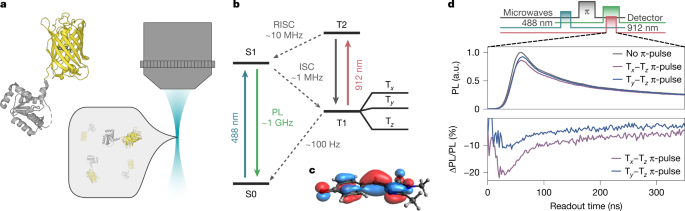
 www.nature.com

 ~S~
~S~
 ........ Dumbing it down to neanderthal levels (which you'll plz excuse me for) would be to claim a thought once exclusively biological , can now be reproduced mechanically