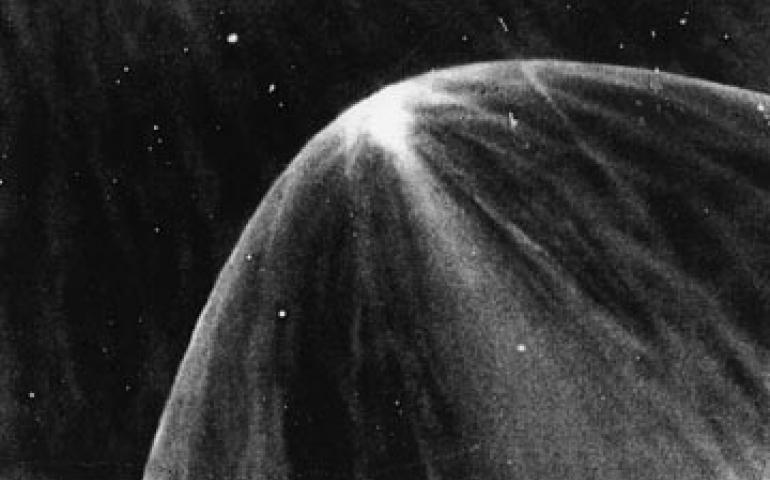
Starfish Prime Nuclear Test was detonated in outer space at an altitude of 250 miles (400 km) On July 9, 1962.
Starfish Prime Nuclear Test caused an electromagnetic pulse (EMP) that was far larger than expected, so much larger that it drove much of the instrumentation off scale, causing great difficulty in getting accurate measurements. The Starfish Prime electromagnetic pulse also made those effects known to the public by causing electrical damage in Hawaii, about 900 miles (1,450 km) away from the detonation point, knocking out about 300 streetlights, phone lines, setting off numerous burglar alarms, and damaging a telephone company microwave link. The EMP damage to the microwave link shut down telephone calls from Kauai to the other Hawaiian islands.
Because of the very large radius associated with nuclear events, it was nearly impossible to prevent indiscriminate damage to other satellites, including one's own satellites. Starfish Prime produced an artificial radiation belt in space that soon destroyed three satellites (Ariel, TRAAC, and Transit 4B all failed after traversing the radiation belt, while Cosmos V, Injun I and Telstar 1 suffered minor degradation, due to some radiation damage to solar cells, etc.). The radiation dose rate was at least 0.6 Gy/day at four months after Starfish for a well-shielded satellite or crewed capsule in a polar circular earth orbit, which caused NASA concern with regard to its crewed space exploration programs.
The effects of a Soviet high-altitude test occurred on 22 October 1962, in the Soviet Project K nuclear tests (ABM System A proof tests) when a 300 kt missile-warhead detonated near Dzhezkazgan at 290-kilometre (180 mi) altitude. The EMP fused 570 kilometres (350 mi) of overhead telephone line with a measured current of 2,500 A, started a fire that burned down the Karaganda power plant, and shut down 1,000 kilometres (620 mi) of buried armored power cables between Tselinograd and Alma-Ata.
"Power line insulators were damaged, resulting in a short circuit on the line and some lines detaching from the poles and falling to the ground."

 -
-