The study explores reasons U.S. adults give for not having children, among those ages 50 and older who haven’t had kids and those under 50 who say they’re unlikely to ever become parents.

By margins of at least 10 points, those in the younger group are more likely than those ages 50 and older to say each of the following is a major reason:
- They just don’t want to have children (57% in the younger group vs. 31% in the older group)
- They want to focus on other things, such as their career or interests (44% vs. 21%)
- Concerns about the state of the world, other than the environment (38% vs. 13%)
- They can’t afford to raise a child (36% vs. 12%)
- Concerns about the environment, including climate change (26% vs. 6%)
- They don’t really like children (20% vs. 8%)
In turn, a larger share of those in the older group say a major reason they didn’t have kids is that they didn’t find the right partner (33% vs. 24% of those in the younger group).
There are no significant differences between the two groups in the shares pointing to infertility or other medical reasons (their own or their spouse’s or partner’s) or to a spouse or partner who didn’t want to have children as major reasons.
Among those in their 40s, 22% say infertility or other medical reasons are a major factor in why they’re unlikely to ever have children. About one-in-ten of those ages 18 to 39 (9%) say the same.
The impact of not having children
Majorities of adults ages 50 and older who don’t have kids and those under 50 who say they’re unlikely to do so see some benefits to not having children.
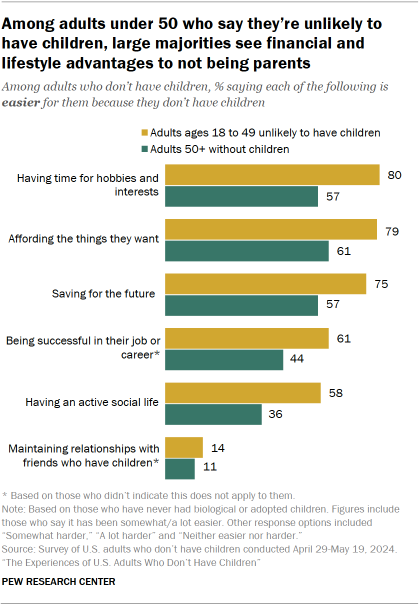
But by margins ranging from 17 to 23 points, those in the younger group are more likely than those ages 50 and older to say each of the following has been
easier for thembecause they don’t have children:
- Having time for hobbies and interests (80% in the younger group vs. 57% in the older group)
- Affording the things they want (79% vs. 61%)
- Saving for the future (75% vs. 57%)
- Being successful in their job or career (61% vs. 44%, among those who don’t indicate this doesn’t apply to them)
- Having an active social life (58 vs. 36%)
The impact at work
We also asked those who are employed about the impact not having children has had on their work lives.
Experiences are mixed. For example, 45% of those in the younger group and 35% of those in the older group say they’ve had more opportunities to network outside of work hours because they don’t have kids. At the same time, about a third in each group say they’ve been expected to take on extra work or responsibilities, and many also say they’ve been given less flexibility than those who have children.
Worries about the future
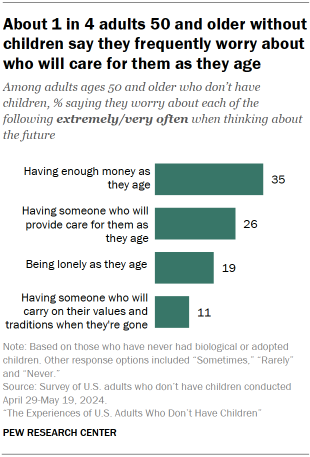
The survey also asked adults ages 50 and older without children about certain concerns they may have
as they age.
About one-in-five or more say they worry
extremely or very often about:
- Having enough money (35%)
- Having someone who will provide care for them (26%)
- Being lonely (19%)
A smaller share (11%) say they frequently worry about having someone who will carry on their values and traditions when they’re gone.
In
a separate survey, 46% of
parents ages 50 and older said they frequently worry about having enough money as they age. Smaller shares said the same about having someone who will provide care for them as they age (20%), having someone who will carry on their values and traditions (17%) and being lonely as they age (15%).
How the survey findings do – or don’t – differ by gender
For the most part, the experiences of adults without children and the reasons they give for not having them
don’t vary much by gender. This is the case across both age groups.
Still, there are some questions on which men and women without kids differ considerably.
Among those ages 50 and older, women are more likely than men to say:
- Being successful in their job or career has been easier because they don’t have children (50% among women vs. 39% among men).
- They felt pressure to have children from society in general at least sometimes when they were younger (42% vs. 27%).
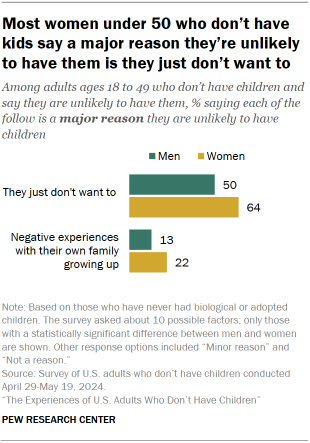
Among those ages 18 to 49, women are more likely than men to say each of the following is a major reason they’re unlikely to have children:
- They just don’t want to (64% vs. 50%)
- Negative experiences with their own families growing up (22% vs. 13%)
Women in the younger group are also more likely than their male counterparts to say the topic of whether they’ll have children comes up in conversation with their friends at least sometimes (41% vs. 26%).
Demographic and economic differences between adults 50 and older with and without children
In addition to the survey findings, this report includes an analysis of government data to show how the demographic characteristics and economic outcomes of adults ages 50 and older who don’t have children differ from those ages 50 and older who are parents.
Among adults in this age group, those who don’t have children are less likely to have ever been married. They are
more likely to have a bachelor’s degree or more education. This difference in educational attainment is especially pronounced among women.
Older women who don’t have children have higher median monthly wages than mothers. The opposite is true among older men; those without children tend to earn less than fathers.
Next: Reasons adults give for not having children
← PREV PAGE
1
234567
NEXT PAGE →
Sign up for our weekly newsletter
Fresh data delivery Saturday mornings
Sign Up
Topics
Related
REPORTJUN 6, 2024
SHORT READSMAY 13, 2024
SHORT READSAPR 3, 2024
SHORT READSMAR 21, 2024
REPORTMAR 11, 2024
Most Popular
1
Joe Biden, Public Opinion and His Withdrawal From the 2024 Race
2
How the origins of America’s immigrants have changed since 1850
3
How Americans Get Local Political News
4
U.S. adults under 30 have different foreign policy priorities than older adults
5
Third-party and independent candidates for president often fall short of early polling numbers
REPORT MATERIALS
901 E St. NW, Suite 300
Washington, DC 20004
USA
(+1) 202-419-4300 | Main
(+1) 202-857-8562 | Fax
(+1) 202-419-4372 |
Media Inquiries
RESEARCH TOPICS
Politics & Policy
International Affairs
Immigration & Migration
Race & Ethnicity
Religion
Age & Generations
Gender & LGBTQ
Family & Relationships
Economy & Work
Science
Internet & Technology
News Habits & Media
Methodological Research
FOLLOW US
ABOUT PEW RESEARCH CENTER Pew Research Center is a nonpartisan fact tank that informs the public about the issues, attitudes and trends shaping the world. It conducts public opinion polling, demographic research, media content analysis and other empirical social science research. Pew Research Center does not take policy positions. It is a subsidiary of
The Pew Charitable Trusts.
© 2024 Pew Research Center
How easy to understand is the information on this page?
What brought you to our website?
What is your highest level of education?
Is there anything else you'd like us to know?
Thank you for your feedback!
 redstate.com