In August, President Obama ordered airstrikes over northern Iraq to combat the ISIS threat, warning Americans that the bombing would be a “
long-term project.” The airstrikes have been
endorsed by Pope Francis, and after Secretary of State Kerry
announced that a “worldwide coalition” would be required to defeat the Islamic State, the US has since
declared the formation of just such a “core coalition” which includes NATO powers
such as the UK.
Alternative Accounts
The group and its leaders have been shrouded in myth and mystery since its inception, as documented above. Even the US government has declared that the Islamic State’s second leader, Abu Omar al-Baghdadi,
never existed. The current leader, Abu-Bakr al-Baghdadi, is so elusive that there are only two known photographs and one video recording of him in existence, leading security “experts”
to declare: “They know physically who this guy is, but his backstory is just myth.” This has led many to speculate on the group’s possible founding and backing by Western intelligence as a front for foreign policy goals such as the sectarian division of Iraq or as an excuse to keep the west militarily involved in the region. As far back as 2006 the UK Telegraph
reported that prominent Sunni insurgent leaders in Iraq were claiming that the group’s founder, Abu Musab al-Zarqawi, was “”an American, Israeli and Iranian agent who is trying to keep our country unstable so that the Sunnis will keep facing occupation.” This sentiment is echoed to the present day, with Saudi scholar Consultative Assembly member Dr. Aissa Al-Ghaith
claiming that the Islamic State is backed by America, Israel and Iran. This sentiment is bolstered by the revelation earlier this year that
ISIS fighters were trained by the US military at a camp in Jordan in 2012.
There are many questions surrounding the group’s online PR activities and its unlikely facility with various forms of media, a phenomenon that
even the New York Times has noted. Although much has been made of the rounds of photos claiming to show the group’s brutal execution and treatment of its prisoners, at least some of these photos appear to have been recycled from other countries at other times. There is still no answer as to who staged the beheading video of James Foley or why it was
faked, but many point to the fact that British authorities warned that merely
looking at the video might qualify as terrorism as a sign of the video’s true nature and origins.
This continues a tradition of suspicious ISIS media releases dating back to the
recordings of Abu Omar al-Baghdadi that were released during the 2009-2010 period after the US government had
declared him a fictitious character and Iraqi authorities
reported that he was under arrest.
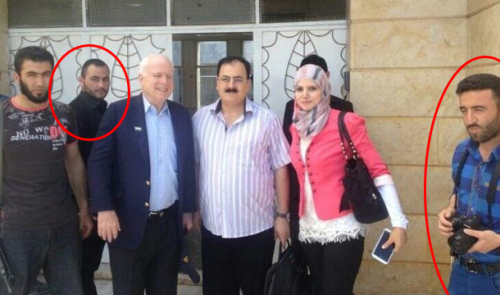
An image of US Senator John McCain in Syria in April 2013 has generated controversy for
claims that it pictures him with ISIS member Mohammad Nour and even ISIS leader Baghdadi himself. Some have cast doubt on whether the man in the photograph is Baghdadi, but the man does bear an uncanny resemblance to the official picture of Baghdadi on the
State Department “Rewards for Justice” website.


