Now that you changed into a sock to quote wiki, ha ha ha:
Nazi-occupied Europe
Al-Husseini arrived in
Rome on 10 October 1941. He outlined his proposals before Alberto Ponce de Leon. On condition that the
Axis powers 'recognize in principle the unity, independence, and sovereignty, of an Arab state, including Iraq, Syria, Palestine, and Transjordan', he offered support in the war against Britain and stated his willingness to discuss the issues of 'the Holy Places, Lebanon, the
Suez Canal, and
Aqaba'. The Italian foreign ministry approved al-Husseini's proposal, recommended giving him a grant of one million
lire, and referred him to
Benito Mussolini, who met al-Husseini on 27 October. According to al-Husseini's account, it was an amicable meeting in which Mussolini expressed his hostility to the Jews and Zionism.
[159]
Back in the summer of 1940 and again in February 1941, al-Husseini submitted to the
Nazi German Government a draft declaration of German-Arab cooperation, containing a clause:
Germany and Italy recognize the right of the Arab countries to solve the question of the Jewish elements, which exist in Palestine and in the other Arab countries, as required by the national and ethnic (
völkisch) interests of the Arabs, and as the Jewish question was solved in Germany and Italy.
[160]
Encouraged by his meeting with the Italian leader, al-Husseini prepared a draft declaration, affirming the Axis support for the Arabs on 3 November. In three days, the declaration, slightly amended by the Italian foreign ministry, received the formal approval of Mussolini and was forwarded to the German embassy in Rome. On 6 November, al-Husseini arrived in
Berlin, where he discussed the text of his declaration with
Ernst von Weizsäcker and other German officials. In the final draft, which differed only marginally from al-Husseini's original proposal, the Axis powers declared their readiness to approve the elimination (
Beseitigung) of the Jewish National Home in Palestine.
[161]

Haj Amin al-Husseini meeting with Adolf Hitler (December 1941).
On 20 November, al-Husseini met the German Foreign Minister
Joachim von Ribbentrop[162] and was officially received by
Adolf Hitler on 28 November.
[163] He asked Adolf Hitler for a public declaration that 'recognized and sympathized with the Arab struggles for independence and liberation, and that would support the elimination of a national Jewish homeland'.
[164] Hitler refused to make such a public announcement, saying that it would strengthen the
Gaullists against the
Vichy France,
[165] but asked al-Husseini 'to lock ...deep in his heart' the following points, which
Christopher Browning summarizes as follows, that
‘Germany has resolved, step by step, to ask one European nation after the other to solve its Jewish problem, and at the proper time, direct a similar appeal to non-European nations as well'. When Germany had defeated Russia and broken through the Caucasus into the Middle East, it would have no further imperial goals of its own and would support Arab liberation... But
Hitler did have one goal. "Germany’s objective would then be solely the destruction of the Jewish element residing in the Arab sphere under the protection of British power". (
Das deutsche Ziel würde dann lediglich die Vernichtung des im arabischen Raum unter der Protektion der britischen Macht lebenden Judentums sein). In short, Jews were not simply to be driven out of the German sphere but would be hunted down and destroyed even beyond it.’
[166]
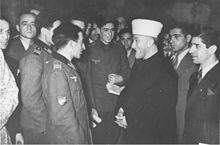
Al-Husseini meeting with Muslim volunteers, including the
Azerbaijani Legion, at the opening of the Islamic Central Institute in
Berlin on 18 December 1942, during the Muslim festival
Eid al-Adha.
A separate record of the meeting was made by
Fritz Grobba, who until recently had been the German ambassor to Iraq. His version of the crucial words reads "when the hour of Arab liberation comes, Germany has no interest there other than the destruction of the power protecting the Jews".
[167] Al-Husseini's own account of this point, as recorded in his diary, is very similar to Grobba's.
[168] According to Amin's account, however, when Hitler expounded his view that the Jews were responsible for World War I, Marxism and its revolutions, and this was why the task of Germans was to persevere in a battle without mercy against the Jews, he replied: "We Arabs think that Zionism, not the Jews, is the cause of all of these acts of sabotage."
[169]
In December 1942, al-Husseini held a speech at the celebration of the opening of the Islamic Central Institute (
Islamisches Zentralinstitut) in
Berlin, of which he served as honorary chair. In the speech, he harshly criticised those he considered as aggressors against Muslims, namely "Jews, Bolsheviks and Anglo-Saxons." At the time of the opening of the Islamic Central Institute, there were an estimated 3,000 Muslims in Germany, including 400 German converts. The Islamic Central Institute gave the Muslims in Germany institutional ties to the 'Third Reich'.
[170]
The Holocaust
Al-Husseini and the Holocaust
Much of the case against Husseini's role in
The Holocaust emerged in the immediate aftermath of WW2, with those collecting evidence working for the
Jewish Agency in the context of an intensive public relations exercise to establish a Jewish state in Mandatory Palestine.
[171] Husseini has been described by the
American Jewish Congress as "Hitler's henchman"
[172] and some scholars, such as Schwanitz and Rubin, have argued that Husseini made the
Final Solutioninevitable by shutting out the possibility of Jews escaping to Palestine.
[173]
Although some historians have questioned al-Husseini's knowledge of the Holocaust while it was in progress,
Wolfgang G. Schwanitz notes that in his memoirs Husseini recalled that
Heinrich Himmler, in the summer of 1943, while confiding some German war secrets, inveighed against Jewish "war guilt", and revealed the ongoing extermination (in Arabic,
abadna) of the Jews.
[174]
Gilbert Achcar, referring to this meeting with Himmler, observes:
The Mufti was well aware that the European Jews were being wiped out; he never claimed the contrary. Nor, unlike some of his present-day admirers, did he play the ignoble, perverse, and stupid game of Holocaust denial... . His amour-propre would not allow him to justify himself to the Jews... .gloating that the Jews had paid a much higher price than the Germans... he cites... : 'Their losses in the Second World War represent more than thirty percent of the total number of their people ...'. Statements like this, from a man who was well placed to know what the Nazis had done ... constitute a powerful argument against Holocaust deniers. Husseini reports that
Reichsführer-SSHeinrich Himmler ... told him in summer 1943 that the Germans had ‘already exterminated more than three million’ Jews: "I was astonished by this figure, as I had known nothing about the matter until then." ... Thus. in 1943, Husseini knew about the genocide... .
[175]
The memoir then continues:-
Himmler asked me on the occasion: 'How do you propose to settle the Jewish question in your country?' I replied: 'All we want from them is that they return to their countries of origin.' He (Himmler) replied: 'We shall never authorize their return to Germany.'
[176]
Wolfgang G. Schwanitz doubts the sincerity of his surprise since, he argues, Husseini had publicly declared that Muslims should follow the example Germans set for a "definitive solution to the Jewish problem".
[177]
Subsequently, the Mufti declared in November 1943:
It is the duty of
Muhammadans [Muslims] in general and Arabs in particular to ... drive all Jews from Arab and Muhammadan countries... . Germany is also struggling against the common foe who oppressed Arabs and Muhammadans in their different countries. It has very clearly recognized the Jews for what they are and resolved to find a definitive solution [
endgültige Lösung] for the Jewish danger that will eliminate the scourge that Jews represent in the world.
[178]
At the
Nuremberg trials, one of
Adolf Eichmann's deputies,
Dieter Wisliceny, stated that al-Husseini had actively encouraged the extermination of European Jews, and that al-Husseini had a meeting with Eichmann at his office, during which Eichmann gave him a view of the current state of the "
Solution of the Jewish Question in Europe" by the
Third Reich. The allegation is dismissed by most serious historians.
[179] A single affidavit by
Rudolf Kastner reported that Wisliceny told him that he had overheard Husseini say he had visited Auschwitz incognito in Eichmann's company.
[180] Eichmann denied this at his trial in Jerusalem in 1961. He had been invited to Palestine in 1937 with his superior Hagen by a representative of the
Haganah, Feival Polkes,
[181] Polkes supported German foreign policy in the Near East and offered to work for them in intelligence. Eichmann and Hagen spent one night in Haifa but were refused a visa to stay any longer.
[182] They met Polkes in Cairo instead.
[182][183] Eichmann stated that he had only been introduced to al-Husseini during an official reception, along with all other department heads, and there is no evidence, despite intensive investigations, that show the mufti to have been a close collaborator of Eichmann, exercising influence over him or accompanying on visits to death camps.
[184] The Jerusalem court accepted Wisliceny's testimony about a key conversation between Eichmann and the mufti,
[185] and found as proven that al-Husseini had aimed to implement the Final Solution.
[186] Hannah Arendt, who was present at the trial, concluded in her book,
Eichmann in Jerusalem: A Report on the Banality of Evil, that the evidence for an Eichmann- al-Husseini connection was based on rumour and unfounded.
[187][188]
Rafael Medoff concludes that 'actually there is no evidence that the Mufti's presence was a factor at all; the Wisliceny hearsay is not merely uncorroborated, but conflicts with everything else that is known about the origins of the Final Solution.'
[189] Bernard Lewis also called Wisliceny's testimony into doubt: 'There is no independent documentary confirmation of Wisliceny's statements, and it seems unlikely that the Nazis needed any such additional encouragement from the outside.'
[190] Bettina Stangneth called Wisliceny's claims "colourful stories" that "carry little weight".
[191]
Al-Husseini's attempts to block Jewish refugees
The Mufti opposed all immigration of Jews into Palestine. No evidence has been forthcoming to show he was opposed to programmes to take Jews to safety outside the Middle East, be it Sweden, or Switzerland or Far eastern countries.
[192] The Mufti’s numerous letters appealing to various governmental authorities to prevent Jewish emigration to Palestine have been widely republished and cited as documentary evidence of his collaboration with Nazis and his participative support for their genocidal actions. For instance, Husseini intervened on 13 May 1943, before the meeting with Himmler when he was informed of the Holocaust,
[193] with the German Foreign Office to block possible transfers of Jews from Bulgaria, Hungary and Romania to Palestine, after reports reached him that 4,000 Jewish children accompanied by 500 adults had managed to reach Palestine. He asked that the Foreign Minister "to do his utmost" to block all such proposals and this request was complied with.
[194] According to Idith Zertal, none of the documents presented at Eichmann's trial prove that it was the Mufti's interference, in these 'acts of total evil,' that prevented the children's rescue.
[195] In June 1943 the Mufti recommended to the Hungarian minister that it would be better to send Jews in Hungary to
Concentration Camps in Poland rather than let them find asylum in Palestine. A year later, on 25 July 1944 he wrote to the Hungarian foreign minister to register his objection to the release of certificates for 900 Jewish children and 100 adults for transfer from Hungary, fearing they might end up in Palestine. He suggested that if such transfers of population were deemed necessary, then:
I ask your Excellency to permit me to draw your attention to the necessity of preventing the Jews from leaving your country for Palestine, and if there are reasons which make their removal necessary, it would be indispensable and infinitely preferable to send them to other countries where they would find themselves under active control, for example, in Poland, thus avoiding danger and preventing damage."
[196][197]

Haj Amin al-Husseini meeting with
Heinrich Himmler (1943).
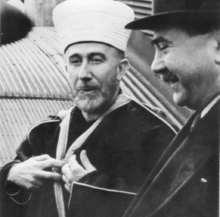
Haj Amin al-Husseini and Nazi collaborator
Mile Budak in occupied Sarajevo (1943).
Achcar quotes the Mufti’s memoirs about these efforts to influence the Axis powers to prevent emigration of Eastern European Jews to Palestine:
We combatted this enterprise by writing to Ribbentrop, Himmler, and Hitler, and, thereafter, the governments of Italy, Hungary, Rumania, Bulgaria, Turkey, and other countries. We succeeded in foiling this initiative, a circumstance that led the Jews to make terrible accusations against me, in which they held me accountable for the liquidation of four hundred thousand Jews who were unable to emigrate to Palestine in this period. They added that I should be tried as a war criminal in Nurenberg.
[198]
In November, 1943 the Mufti said:
It is the duty of Muhammadans in general and Arabs in particular to … drive all Jews from Arab and Muhammadan countries….Germany is also struggling against the common foe who oppressed Arabs and Muhammadans in their different countries. It has very clearly recognized the Jews for what they are and resolved to find a definitive solution [endgültige Lösung] for the Jewish danger that will eliminate the scourge that Jews represent in the world. ….
[178]
In September 1943, intense negotiations to rescue 500 Jewish children from the
Arbe concentration camp collapsed due to the objection of al-Husseini who blocked the children's departure to Turkey because they would end up in Palestine.
[199]
Propaganda

Bosniak soldiers of the SS 13 Division, reading Husseini's pamphlet Islam and Judaism
Throughout World War II, al-Husseini worked for the Axis Powers as a broadcaster in propaganda targeting Arab public opinion. He was thereby joined by other Arabs such as Fawzi al-Qawuqji[208] and Hasan Salama. The Mufti was paid "an absolute fortune" of 50,000 marks a month (when a German field marshal was making 25,000 marks a year),[209] the equivalent today of $12,000,000 a year.[129] Walter Winchell called him "the Arabian Lord Haw-Haw".[210]
The Mufti also wrote a pamphlet for the 13th SS Handschar division, translated as Islam i Zidovstvo (Islam and Judaism) which closed with a quotation from Bukhari-Muslim by Abu Khurreira that states:"The Day of Judgement will come, when the Muslims will crush the Jews completely: And when every tree behind which a Jew hides will say: 'There is a Jew behind me, Kill him!".[211] Some accounts, ignoring the historical record, have claimed that the Handschar was responsible for killing 90% of Bosnian Jews. In fact, Handschar units were deployed only after most of the Jews in Croatia had been deported or exterminated. One report, however, of a Handschar patrol murdering some Jewish civilians in Zvornik in April 1944 after their real identity was revealed, is plausible.[212]
On 1 March 1944, while speaking on Radio Berlin, al-Husseini said: 'Arabs, rise as one man and fight for your sacred rights. Kill the Jews wherever you find them. This pleases God, history, and religion. This saves your honor. God is with you.'[213][214][215]
Recruitment
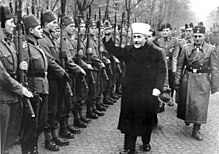
November 1943 al-Husseini greeting Bosnian Waffen-SS volunteers with a Nazi salute.[216] At right is SS General Karl-Gustav Sauberzweig.

Haj Amin el-Husseini reviewing SS 13th Division soldiers from a car
Among the Nazi leadership, the greatest interest in the idea of creating Muslim units under German command was shown by Heinrich Himmler, who viewed the Islamic world as a potential ally against the British Empire and regarded the Nazi-puppet Independent State of Croatia as a 'ridiculous state'.[217] Himmler had a romantic vision of Islam as a faith ‘fostering fearless soldiers’, and this probably played a significant role[218][219] in his decision to raise three Muslim divisions under German leadership in the Balkans from Bosnian Muslims and Albanians:[220][221] the 13th Handschar,[222] the 21st Skanderbeg, and the 23rd Kama (Shepherd's dagger). Riven by interethnic conflict, the region's Jewish, Croat, Roma, Serb and Muslim communities suffered huge losses of life,[223][224] Bosnian Muslims losing around 85,000 from a genocidal Chetnik ethnic cleansing operations alone.[225] The Muslims had three options: to join the Croatian Ustaše, or the Yugoslav partisans, or to create local defense units. Following a tradition of service in the old Bosnian regiments of the former Austro-Hungarian army, they chose an alliance with Germany, which promised them autonomy. Husseini, having been petitioned by the Bosnian Muslim leaders, was well informed of their plight.[226] Dissatisfied with low enlistenment, Himmler asked the mufti to intervene.[227] Husseini negotiated, made several requests, mostly ignored by the SS, and conducted several visits to the area.[228] His speeches and charismatic authority proved instrumental in improving enlistment notably.[229] In one speech he declared that:
Those lands suffering under the British and Bolshevist yoke impatiently await the moment when the Axis (powers) will emerge victorious. We must dedicate ourselves to unceasing struggle against Britain -that dungeon of peoples - and to the complete destruction of the British Empire.We must dedicate ourselves to unceasing struggle against Bolshevist Russia because communism is incompatible with Islam.'
One SS officer reporting on impressions from the mufti's Sarajevo speech said Husseini was reserved about fighting Bolshevism, his main enemies being Jewish settlers in Palestine and the English.[230] During a visit in July 1943 the Mufti said: "The active cooperation of the world's 400 million Muslims with their loyal friends, the German, can be of decisive influence upon the outcome of the war. You, my Bosnian Muslims, are the first Islamic division [and] serve as an example of the active collaboration....My enemy's enemy is my friend." [231] Himmler in addressing the unit on another occasion declared "Germany [and] the Reich have been friends of Islam for the past two centuries, owing not to expediency but to friendly conviction. We have the same goals."[232]
In an agreement signed by Husseini and Himmler on 19 May 1943, it was specified that no synthesis of Islam and Nationalism was to take place.[233][234] Husseini asked that Muslim divisional operations to be restricted to the defense of the Moslem heartland of Bosnia and Herzegovina; that partisans be amnestied if they laid down their arms; that the civilian population not be subject to vexations by troops;that assistance be offered to innocents injured by operations; and that harsh measures like deportations, confiscations of goods, or executions be governed in accordance with the rule of law.[235]The Handschar earned a repute for brutality in ridding north-eastern Bosnia of Serbs and partisans: many local Muslims, observing the violence, were driven to go over to the communist partisans.[236][237] Once redeployed outside Bosnia, and as the fortunes of war turned, mass defections and desertions took place, and Volksdeutsche were drafted to replace the losses.[238] The mufti blamed the mass desertions on German support for the Četniks.[239] Many Bosnians in these divisions who survived the war sought asylum in Western and Arab countries, and of those settling in the Middle East, many fought in Palestine against the new state of Israel.[240] Reacting to the formation by Great Britain of a special Jewish legion in the Allied cause, Husseini urged Germany to raise a similar Arab legion.[15] Husseini helped organize Arab students and North African emigres in Germany into the "Arabisches Freiheitkorps", an Arab Legion in the German Army that hunted down Allied parachutists in the Balkans and fought on the Russian front.[189]


