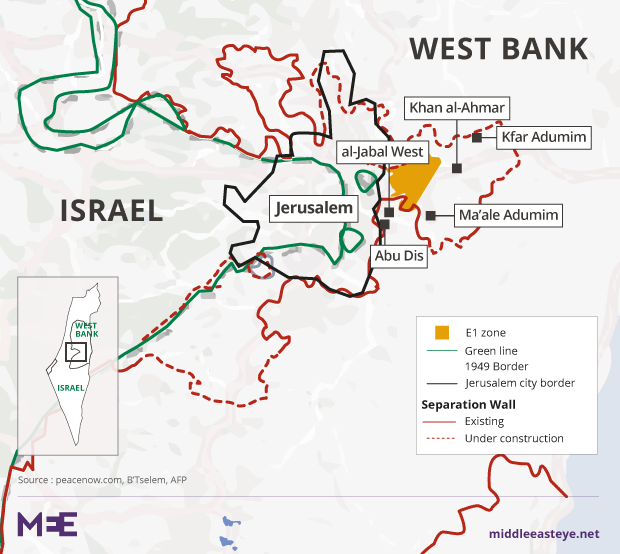
The encampment that began to take shape in the 1970s overlooks Route 1, the main artery connecting Jerusalem, Ma’aleh Adumim and the Dead Sea beyond. From their very first day on the site, the Jahalin were well-aware that the land they had squatted on was within the municipal boundaries of Kfar Adumim. The also knew that this location was not a long-term solution for their housing needs.
The Israeli government initiated a dialogue with the Jahalin more than a decade ago, offering them alternatives. All around Khan al-Ahmar, Route 1 was expanding, and some of the Bedouin living there simply moved elsewhere to avoid the noise and traffic. It was clear to the Jahalin that they could not remain where they were, and they signed a relocation agreement with the State of Israel.
The government promptly set aside state land for a new neighborhood on the outskirts of Abu Dis, named “Jahalin West,” and offered a package worth over half a million shekels for each wife in each of the Jahalin households—a package that includes a large plot of land, completely developed and zoned for residential construction, with infrastructure for water and electricity. The new neighborhood will offer services that the Jahalin can only dream of today—services the P.A. and E.U. have never offered them, including health clinics, public transportation, proper schools, access to employment and more.
In off-the-record conversations, the Jahalin will tell you how eager they are to relocate and to begin to build their lives in a modern, legal neighborhood. But they will also tell you about how they are threatened by the Palestinian Authority, which will not allow them to relinquish their hold on the strategic piece of land on which Khan al-Ahmar sits.
Source