Now the evidence is released. ObamaCare passed due to illegal voters voting in 2008.

National Review. LOL!

You have data to refute this:

Of the 21 Democratic senators who opposed the 1964 act, only one would ever change parties. Nor did the segregationist constituencies that elected these Democrats throw them out in favor of Republicans: The remaining 20 continued to be elected as Democrats or were replaced by Democrats. It was, on average, nearly a quarter of a century before those seats went Republican. If southern rednecks ditched the Democrats because of a civil-rights law passed in 1964, it is strange that they waited until the late 1980s and early 1990s to do so.
Still waiting for your explanation why LA, MS, AL, GA, and SC all switched to Republican in 1964...? For the first time since the 1872 election, those 5 states voted GOP in 1964. What to you think caused that switch?
Because the voters there opposed the human rights violation at the heart of the Democratic platform.

You understand that what happened in 1964 predated "the Southern Strategy" don't you?
You have that backwards as the south clung to its racist roots. It's laughable to think the voters in those racist southern states opposed human rights violations against blacks, whom they at one time, fought to secede from the nation just to keep their slaves.

As far as the "Southern Strategy," that was just one piece of the puzzle which flipped the south from Democrat to Republican. The shift of that paradigm began in the 1940's when the Democrat party splintered over civil rights, forming the Dixiecrat party. That failed as the civil rights movement marched forward through the 50' and early 60's, culminating with a Democrat president who proposed a civil rights bill and then another Democrat president signing it into law. Those 5 southern states, which fought hard against civil rights, then abandoned the party they supported for nearly a century prior to the 1964 election, as they all voted GOP for the first time since 1872 (which had no Democrat front runner anyway).
 
National Review. LOL!

You have data to refute this:

Of the 21 Democratic senators who opposed the 1964 act, only one would ever change parties. Nor did the segregationist constituencies that elected these Democrats throw them out in favor of Republicans: The remaining 20 continued to be elected as Democrats or were replaced by Democrats. It was, on average, nearly a quarter of a century before those seats went Republican. If southern rednecks ditched the Democrats because of a civil-rights law passed in 1964, it is strange that they waited until the late 1980s and early 1990s to do so.
Still waiting for your explanation why LA, MS, AL, GA, and SC all switched to Republican in 1964...? For the first time since the 1872 election, those 5 states voted GOP in 1964. What to you think caused that switch?
Because the voters there opposed the human rights violation at the heart of the Democratic platform.

You understand that what happened in 1964 predated "the Southern Strategy" don't you?
You have that backwards as the south clung to its racist roots. It's laughable to think the voters in those racist southern states opposed human rights violations against blacks, whom they at one time, fought to secede from the nation just to keep their slaves.

And yet it is the Northeast which has the nation's most segregated schools, New York at the top of the list, it was Boston which had violent protests against a means of school integration. Seems odd to say that the South is racist when it has the nation's most integrated schools and has the highest level of racial diversity, you know that quality which liberals in the Northeast talk about craving but run away from.

Those 5 southern states, which fought hard against civil rights, then abandoned the party they supported for nearly a century prior to the 1964 election, as they all voted GOP for the first time since 1872 (which had no Democrat front runner anyway).

What of Arkansas, Tennessee, Florida, North Carolina and Virginia? Didn't they have black folks living there?
 
National Review. LOL!

You have data to refute this:

Of the 21 Democratic senators who opposed the 1964 act, only one would ever change parties. Nor did the segregationist constituencies that elected these Democrats throw them out in favor of Republicans: The remaining 20 continued to be elected as Democrats or were replaced by Democrats. It was, on average, nearly a quarter of a century before those seats went Republican. If southern rednecks ditched the Democrats because of a civil-rights law passed in 1964, it is strange that they waited until the late 1980s and early 1990s to do so.
Still waiting for your explanation why LA, MS, AL, GA, and SC all switched to Republican in 1964...? For the first time since the 1872 election, those 5 states voted GOP in 1964. What to you think caused that switch?
Because the voters there opposed the human rights violation at the heart of the Democratic platform.

You understand that what happened in 1964 predated "the Southern Strategy" don't you?
You have that backwards as the south clung to its racist roots. It's laughable to think the voters in those racist southern states opposed human rights violations against blacks, whom they at one time, fought to secede from the nation just to keep their slaves.

And yet it is the Northeast which has the nation's most segregated schools, New York at the top of the list, it was Boston which had violent protests against a means of school integration. Seems odd to say that the South is racist when it has the nation's most integrated schools and has the highest level of racial diversity, you know that quality which liberals in the Northeast talk about craving but run away from.

Those 5 southern states, which fought hard against civil rights, then abandoned the party they supported for nearly a century prior to the 1964 election, as they all voted GOP for the first time since 1872 (which had no Democrat front runner anyway).

What of Arkansas, Tennessee, Florida, North Carolina and Virginia? Didn't they have black folks living there?
You have got to be a "special" kind of stupid if you think the [confederate] south isn't more racist than the north.
 
You have got to be a "special" kind of stupid if you think the [confederate] south isn't more racist than the north.

The North has less diversity and only racists want to live in areas with low diversity. The North has the most segregated schools in the nation. Only racists don't want their kids to go to school with black children.
 
Oh those conservatives from the South, today's GOP base. Weird you don't know the GOP/Dems switched sides a few times the past 150+ years?

I find it odd that so many liberals attack the racists of the South, whites who live in communities where blacks constitute 30% or more of the population, while they live in whiteopias like, say Monterey, CA, where blacks constitute only 2.8% of the population.

You'd think that the racists would move to Monterey and the diversity loving liberals would move to the South where they could drink deep of the fabulous diversity that they so value with their uttered words, but remarkably not with the way they actually choose to live their lives.

Yep, Cali isn't diverse *shaking head*

But thanks for agreeing the Southern states are generally regarded as the least tolerant!
 
Oh those conservatives from the South, today's GOP base. Weird you don't know the GOP/Dems switched sides a few times the past 150+ years?

I find it odd that so many liberals attack the racists of the South, whites who live in communities where blacks constitute 30% or more of the population, while they live in whiteopias like, say Monterey, CA, where blacks constitute only 2.8% of the population.

You'd think that the racists would move to Monterey and the diversity loving liberals would move to the South where they could drink deep of the fabulous diversity that they so value with their uttered words, but remarkably not with the way they actually choose to live their lives.

Yep, Cali isn't diverse *shaking head*

But thanks for agreeing the Southern states are generally regarded as the least tolerant!

I'm saying that you're intolerant for choosing to live in a city where blacks constitute only 2.8% of the population. Shame on you. Big Talk, No Action.
 
Do you have anything more recent, like in this century, or at least since the late 1960's when the GOP embraced the well documented "Southern Strategy" in which the Gop effectively embraced the racist ideals of the much earlier Democratic party? Actually the swap started back in 1948 when the Dems added an equal rights plank to their platform. Why does the GOP have such great memories from a century ago, but you have trouble remembering the vile things your party has done recently?

The BIG LIE of the Southern Strategy has really infected you liberals. Educate yourself.

Southern Strategy

If the parties had in some meaningful way flipped on civil rights, one would expect that to show up in the electoral results in the years following the Democrats’ 1964 about-face on the issue. Nothing of the sort happened: Of the 21 Democratic senators who opposed the 1964 act, only one would ever change parties. Nor did the segregationist constituencies that elected these Democrats throw them out in favor of Republicans: The remaining 20 continued to be elected as Democrats or were replaced by Democrats. It was, on average, nearly a quarter of a century before those seats went Republican. If southern rednecks ditched the Democrats because of a civil-rights law passed in 1964, it is strange that they waited until the late 1980s and early 1990s to do so.

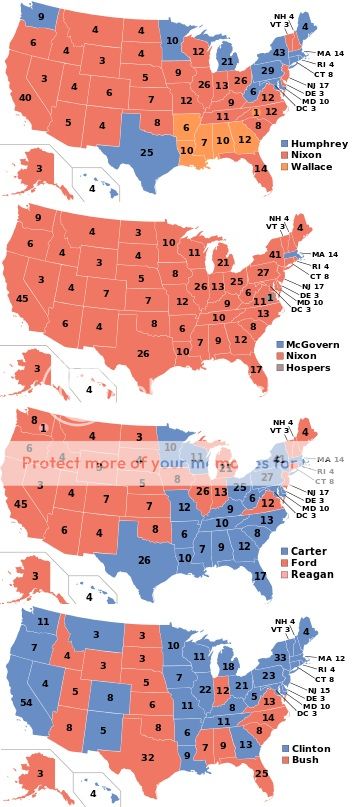
Here's how propagandists construct the Big Lie. They take some facts, overlook others, and the actually outright lie about the conclusions. What is the Big Lie about the Southern Strategy? Nixon did it. He flipped the South by appealing to their racism. Most of the South went for Wallace in 1968. The traditionally liberal parts of the country went for Humphrey and the rest of the nation went for Nixon. When the rest of the nation supports Nixon there are no nefarious motives assigned, but when a few Southern states follow the lead of the rest of the nation then they're doing it for the wrong reasons. What was their alternative, vote for Wallace or Humphrey and neither of those was palatable. Nixon didn't do anything.

Come 1972, the Big Lie has us believe that Nixon clamped a lock-down on the South. Well, he did the same everywhere except in Massachusetts. Now what happened in 1976, did that lock-down hold? Nope, look at all of those Democratic electoral votes in the South - a solid Democratic victory through every state which should be impossible if the Republicans had a lock on the Southern vote.

Jump forward to the Clinton years and let's see how much of a lock the Republicans have on the South. After the Reagan years, it should have been impossible for Clinton to win many of those states, remember the Southern Democrats were all Republicans now, except for the fact that evidence shows this not to be the case.

SouthernStrategy_zps7b8d58b4.jpg


So what did happen in the South? This:

The Republican ascendancy in Dixie is associated with the rise of the southern middle class, the increasingly trenchant conservative critique of Communism and the welfare state, the Vietnam controversy and the rise of the counterculture, law-and-order concerns rooted in the urban chaos that ran rampant from the late 1960s to the late 1980s, and the incorporation of the radical Left into the Democratic party. Individual events, especially the freak show that was the 1968 Democratic convention, helped solidify conservatives’ affiliation with the Republican party. Democrats might argue that some of these concerns — especially welfare and crime — are “dog whistles” or “code” for race and racism, but this criticism is shallow in light of the evidence and the real saliency of those issues among U.S. voters of all backgrounds and both parties for decades. Indeed, Democrats who argue that the best policies for black Americans are those that are soft on crime and generous with welfare are engaged in much the same sort of cynical racial calculation President Johnson was practicing when he informed skeptical southern governors that his plan for the Great Society was “to have them ******* voting Democratic for the next two hundred years.” Johnson’s crude racism is, happily, largely a relic of the past, but his strategy endures.​

Here's a piece from RealClearPolitics which highlights how deeply ingrained the Big Lie has become:

But in the course of this argument, Bouie makes the following statement: “White Southerners jumped ship from Democratic presidential candidates in the 1960s, and this was followed by a similar shift on the congressional level, and eventually, the state legislative level. That the [last] two took time doesn’t discount the first.”

If you polled pundits, you’d probably get 90 percent agreement with this statement. And if you polled political scientists, you’d likely get a majority to sign off on it. That’s maddening, because it’s incorrect.

I’ve written at length on this, both in my book and here, but it is worth revisiting. In truth, the white South began breaking away from the Democrats in the 1920s, as population centers began to develop in what was being called the “New South” (remember, at the beginning of the 20th century, New Orleans was the only thing approximating what we currently think of as a city in the South).

In the 1930s and 1940s, FDR performed worse in the South in every election following his 1932 election. By the mid-1940s, the GOP was winning about a quarter of the Southern vote in presidential elections. . . .

Perhaps the biggest piece of evidence that something significant was afoot is Richard Nixon’s showing in 1960. He won 46.1 percent of the vote to John F. Kennedy’s 50.5 percent. One can write this off to JFK’s Catholicism, but writing off three elections in a row becomes problematic, especially given the other developments bubbling up at the local level. It’s even more problematic when you consider that JFK had the nation’s most prominent Southerner on the ticket with him.

But the biggest problem with the thesis comes when you consider what had been going on in the interim: Two civil rights bills pushed by the Eisenhower administration had cleared Congress, and the administration was pushing forward with the Brown decision, most famously by sending the 101st Airborne Division to Arkansas to assist with the integration of Little Rock Central High School.

It’s impossible to separate race and economics completely anywhere in the country, perhaps least of all in the South. But the inescapable truth is that the GOP was making its greatest gains in the South while it was also pushing a pro-civil rights agenda nationally. What was really driving the GOP at this time was economic development. As Southern cities continued to develop and sprout suburbs, Southern exceptionalism was eroded; Southern whites simply became wealthy enough to start voting Republican.


Weird, you mean the LIBERAL/PROGRESSIVE parts of the GOP, MAINLY in the North East, supported the civil rights acct but the SOUTHERNERS OF BOTH PARTIES OPPOSED IT? Which party is the South the base of today? lol

By party and region
Note: "Southern", as used in this section, refers to members of Congress from the eleven states that made up the Confederate States of America in the American Civil War. "Northern" refers to members from the other 39 states, regardless of the geographic location of those states.

The original House version:

  • Southern Democrats: 7–87 (7–93%)
  • Southern Republicans: 0–10 (0–100%)
  • Northern Democrats: 145–9 (94–6%)
  • Northern Republicans: 138–24 (85–15%)
The Senate version:

Civil Rights Act of 1964 - Wikipedia the free encyclopedia


KEEP TRYING THAT REVISION BUBBA, WITHOUT IT YOU KLOWNS HAVE NOTHING TO FALL BACK ON :banana:
 
Do you have anything more recent, like in this century, or at least since the late 1960's when the GOP embraced the well documented "Southern Strategy" in which the Gop effectively embraced the racist ideals of the much earlier Democratic party? Actually the swap started back in 1948 when the Dems added an equal rights plank to their platform. Why does the GOP have such great memories from a century ago, but you have trouble remembering the vile things your party has done recently?

The BIG LIE of the Southern Strategy has really infected you liberals. Educate yourself.

Southern Strategy

If the parties had in some meaningful way flipped on civil rights, one would expect that to show up in the electoral results in the years following the Democrats’ 1964 about-face on the issue. Nothing of the sort happened: Of the 21 Democratic senators who opposed the 1964 act, only one would ever change parties. Nor did the segregationist constituencies that elected these Democrats throw them out in favor of Republicans: The remaining 20 continued to be elected as Democrats or were replaced by Democrats. It was, on average, nearly a quarter of a century before those seats went Republican. If southern rednecks ditched the Democrats because of a civil-rights law passed in 1964, it is strange that they waited until the late 1980s and early 1990s to do so.

Here's how propagandists construct the Big Lie. They take some facts, overlook others, and the actually outright lie about the conclusions. What is the Big Lie about the Southern Strategy? Nixon did it. He flipped the South by appealing to their racism. Most of the South went for Wallace in 1968. The traditionally liberal parts of the country went for Humphrey and the rest of the nation went for Nixon. When the rest of the nation supports Nixon there are no nefarious motives assigned, but when a few Southern states follow the lead of the rest of the nation then they're doing it for the wrong reasons. What was their alternative, vote for Wallace or Humphrey and neither of those was palatable. Nixon didn't do anything.

Come 1972, the Big Lie has us believe that Nixon clamped a lock-down on the South. Well, he did the same everywhere except in Massachusetts. Now what happened in 1976, did that lock-down hold? Nope, look at all of those Democratic electoral votes in the South - a solid Democratic victory through every state which should be impossible if the Republicans had a lock on the Southern vote.

Jump forward to the Clinton years and let's see how much of a lock the Republicans have on the South. After the Reagan years, it should have been impossible for Clinton to win many of those states, remember the Southern Democrats were all Republicans now, except for the fact that evidence shows this not to be the case.

SouthernStrategy_zps7b8d58b4.jpg


So what did happen in the South? This:

The Republican ascendancy in Dixie is associated with the rise of the southern middle class, the increasingly trenchant conservative critique of Communism and the welfare state, the Vietnam controversy and the rise of the counterculture, law-and-order concerns rooted in the urban chaos that ran rampant from the late 1960s to the late 1980s, and the incorporation of the radical Left into the Democratic party. Individual events, especially the freak show that was the 1968 Democratic convention, helped solidify conservatives’ affiliation with the Republican party. Democrats might argue that some of these concerns — especially welfare and crime — are “dog whistles” or “code” for race and racism, but this criticism is shallow in light of the evidence and the real saliency of those issues among U.S. voters of all backgrounds and both parties for decades. Indeed, Democrats who argue that the best policies for black Americans are those that are soft on crime and generous with welfare are engaged in much the same sort of cynical racial calculation President Johnson was practicing when he informed skeptical southern governors that his plan for the Great Society was “to have them ******* voting Democratic for the next two hundred years.” Johnson’s crude racism is, happily, largely a relic of the past, but his strategy endures.​

Here's a piece from RealClearPolitics which highlights how deeply ingrained the Big Lie has become:

But in the course of this argument, Bouie makes the following statement: “White Southerners jumped ship from Democratic presidential candidates in the 1960s, and this was followed by a similar shift on the congressional level, and eventually, the state legislative level. That the [last] two took time doesn’t discount the first.”

If you polled pundits, you’d probably get 90 percent agreement with this statement. And if you polled political scientists, you’d likely get a majority to sign off on it. That’s maddening, because it’s incorrect.

I’ve written at length on this, both in my book and here, but it is worth revisiting. In truth, the white South began breaking away from the Democrats in the 1920s, as population centers began to develop in what was being called the “New South” (remember, at the beginning of the 20th century, New Orleans was the only thing approximating what we currently think of as a city in the South).

In the 1930s and 1940s, FDR performed worse in the South in every election following his 1932 election. By the mid-1940s, the GOP was winning about a quarter of the Southern vote in presidential elections. . . .

Perhaps the biggest piece of evidence that something significant was afoot is Richard Nixon’s showing in 1960. He won 46.1 percent of the vote to John F. Kennedy’s 50.5 percent. One can write this off to JFK’s Catholicism, but writing off three elections in a row becomes problematic, especially given the other developments bubbling up at the local level. It’s even more problematic when you consider that JFK had the nation’s most prominent Southerner on the ticket with him.

But the biggest problem with the thesis comes when you consider what had been going on in the interim: Two civil rights bills pushed by the Eisenhower administration had cleared Congress, and the administration was pushing forward with the Brown decision, most famously by sending the 101st Airborne Division to Arkansas to assist with the integration of Little Rock Central High School.

It’s impossible to separate race and economics completely anywhere in the country, perhaps least of all in the South. But the inescapable truth is that the GOP was making its greatest gains in the South while it was also pushing a pro-civil rights agenda nationally. What was really driving the GOP at this time was economic development. As Southern cities continued to develop and sprout suburbs, Southern exceptionalism was eroded; Southern whites simply became wealthy enough to start voting Republican.


Weird, you mean the LIBERAL/PROGRESSIVE parts of the GOP, MAINLY in the North East, supported the civil rights acct but the SOUTHERNERS OF BOTH PARTIES OPPOSED IT? Which party is the South the base of today? lol

By party and region
Note: "Southern", as used in this section, refers to members of Congress from the eleven states that made up the Confederate States of America in the American Civil War. "Northern" refers to members from the other 39 states, regardless of the geographic location of those states.

The original House version:

  • Southern Democrats: 7–87 (7–93%)
  • Southern Republicans: 0–10 (0–100%)
  • Northern Democrats: 145–9 (94–6%)
  • Northern Republicans: 138–24 (85–15%)
The Senate version:

Civil Rights Act of 1964 - Wikipedia the free encyclopedia


KEEP TRYING THAT REVISION BUBBA, WITHOUT IT YOU KLOWNS HAVE NOTHING TO FALL BACK ON :banana:


Thanks for verifying my point.

If the parties had in some meaningful way flipped on civil rights, one would expect that to show up in the electoral results in the years following the Democrats’ 1964 about-face on the issue. Nothing of the sort happened: Of the 21 Democratic senators who opposed the 1964 act, only one would ever change parties. Nor did the segregationist constituencies that elected these Democrats throw them out in favor of Republicans: The remaining 20 continued to be elected as Democrats or were replaced by Democrats. It was, on average, nearly a quarter of a century before those seats went Republican. If southern rednecks ditched the Democrats because of a civil-rights law passed in 1964, it is strange that they waited until the late 1980s and early 1990s to do so.
 
Do you have anything more recent, like in this century, or at least since the late 1960's when the GOP embraced the well documented "Southern Strategy" in which the Gop effectively embraced the racist ideals of the much earlier Democratic party? Actually the swap started back in 1948 when the Dems added an equal rights plank to their platform. Why does the GOP have such great memories from a century ago, but you have trouble remembering the vile things your party has done recently?

The BIG LIE of the Southern Strategy has really infected you liberals. Educate yourself.

Southern Strategy

If the parties had in some meaningful way flipped on civil rights, one would expect that to show up in the electoral results in the years following the Democrats’ 1964 about-face on the issue. Nothing of the sort happened: Of the 21 Democratic senators who opposed the 1964 act, only one would ever change parties. Nor did the segregationist constituencies that elected these Democrats throw them out in favor of Republicans: The remaining 20 continued to be elected as Democrats or were replaced by Democrats. It was, on average, nearly a quarter of a century before those seats went Republican. If southern rednecks ditched the Democrats because of a civil-rights law passed in 1964, it is strange that they waited until the late 1980s and early 1990s to do so.

Here's how propagandists construct the Big Lie. They take some facts, overlook others, and the actually outright lie about the conclusions. What is the Big Lie about the Southern Strategy? Nixon did it. He flipped the South by appealing to their racism. Most of the South went for Wallace in 1968. The traditionally liberal parts of the country went for Humphrey and the rest of the nation went for Nixon. When the rest of the nation supports Nixon there are no nefarious motives assigned, but when a few Southern states follow the lead of the rest of the nation then they're doing it for the wrong reasons. What was their alternative, vote for Wallace or Humphrey and neither of those was palatable. Nixon didn't do anything.

Come 1972, the Big Lie has us believe that Nixon clamped a lock-down on the South. Well, he did the same everywhere except in Massachusetts. Now what happened in 1976, did that lock-down hold? Nope, look at all of those Democratic electoral votes in the South - a solid Democratic victory through every state which should be impossible if the Republicans had a lock on the Southern vote.

Jump forward to the Clinton years and let's see how much of a lock the Republicans have on the South. After the Reagan years, it should have been impossible for Clinton to win many of those states, remember the Southern Democrats were all Republicans now, except for the fact that evidence shows this not to be the case.

SouthernStrategy_zps7b8d58b4.jpg


So what did happen in the South? This:

The Republican ascendancy in Dixie is associated with the rise of the southern middle class, the increasingly trenchant conservative critique of Communism and the welfare state, the Vietnam controversy and the rise of the counterculture, law-and-order concerns rooted in the urban chaos that ran rampant from the late 1960s to the late 1980s, and the incorporation of the radical Left into the Democratic party. Individual events, especially the freak show that was the 1968 Democratic convention, helped solidify conservatives’ affiliation with the Republican party. Democrats might argue that some of these concerns — especially welfare and crime — are “dog whistles” or “code” for race and racism, but this criticism is shallow in light of the evidence and the real saliency of those issues among U.S. voters of all backgrounds and both parties for decades. Indeed, Democrats who argue that the best policies for black Americans are those that are soft on crime and generous with welfare are engaged in much the same sort of cynical racial calculation President Johnson was practicing when he informed skeptical southern governors that his plan for the Great Society was “to have them ******* voting Democratic for the next two hundred years.” Johnson’s crude racism is, happily, largely a relic of the past, but his strategy endures.​

Here's a piece from RealClearPolitics which highlights how deeply ingrained the Big Lie has become:

But in the course of this argument, Bouie makes the following statement: “White Southerners jumped ship from Democratic presidential candidates in the 1960s, and this was followed by a similar shift on the congressional level, and eventually, the state legislative level. That the [last] two took time doesn’t discount the first.”

If you polled pundits, you’d probably get 90 percent agreement with this statement. And if you polled political scientists, you’d likely get a majority to sign off on it. That’s maddening, because it’s incorrect.

I’ve written at length on this, both in my book and here, but it is worth revisiting. In truth, the white South began breaking away from the Democrats in the 1920s, as population centers began to develop in what was being called the “New South” (remember, at the beginning of the 20th century, New Orleans was the only thing approximating what we currently think of as a city in the South).

In the 1930s and 1940s, FDR performed worse in the South in every election following his 1932 election. By the mid-1940s, the GOP was winning about a quarter of the Southern vote in presidential elections. . . .

Perhaps the biggest piece of evidence that something significant was afoot is Richard Nixon’s showing in 1960. He won 46.1 percent of the vote to John F. Kennedy’s 50.5 percent. One can write this off to JFK’s Catholicism, but writing off three elections in a row becomes problematic, especially given the other developments bubbling up at the local level. It’s even more problematic when you consider that JFK had the nation’s most prominent Southerner on the ticket with him.

But the biggest problem with the thesis comes when you consider what had been going on in the interim: Two civil rights bills pushed by the Eisenhower administration had cleared Congress, and the administration was pushing forward with the Brown decision, most famously by sending the 101st Airborne Division to Arkansas to assist with the integration of Little Rock Central High School.

It’s impossible to separate race and economics completely anywhere in the country, perhaps least of all in the South. But the inescapable truth is that the GOP was making its greatest gains in the South while it was also pushing a pro-civil rights agenda nationally. What was really driving the GOP at this time was economic development. As Southern cities continued to develop and sprout suburbs, Southern exceptionalism was eroded; Southern whites simply became wealthy enough to start voting Republican.


Lee Atwater’s Infamous 1981 Interview on the Southern Strategy


The late, legendarily brutal campaign consultant Lee Atwater explains how Republicans can win the vote of racists without sounding racist themselves:


You start out in 1954 by saying, “******, ******, ******.” By 1968 you can’t say “******”—that hurts you, backfires. So you say stuff like, uh, forced busing, states’ rights, and all that stuff, and you’re getting so abstract. Now, you’re talking about cutting taxes, and all these things you’re talking about are totally economic things and a byproduct of them is, blacks get hurt worse than whites.… “We want to cut this,” is much more abstract than even the busing thing, uh, and a hell of a lot more abstract than “******, ******.”

Now, the same indefatigable researcher who brought us Mitt Romney’s “47 percent” remarks, James Carter IV, has dug up the entire forty-two-minute interview from which that quote derives. Here, The Nation publishes it in its entirety for the very first time.


The forty-two-minute recording, acquired by James Carter IV, confirms Atwater’s incendiary remarks and places them in context.


Exclusive Lee Atwater s Infamous 1981 Interview on the Southern Strategy The Nation
 
Lee Atwater’s Infamous 1981 Interview on the Southern Strategy

Why are you valuing the ego-centric words of a publicity hound, a standard feature of campaign managers who live for the chance of "being talked about" over the actual on-the-ground results?

If the parties had in some meaningful way flipped on civil rights, one would expect that to show up in the electoral results in the years following the Democrats’ 1964 about-face on the issue. Nothing of the sort happened: Of the 21 Democratic senators who opposed the 1964 act, only one would ever change parties. Nor did the segregationist constituencies that elected these Democrats throw them out in favor of Republicans: The remaining 20 continued to be elected as Democrats or were replaced by Democrats. It was, on average, nearly a quarter of a century before those seats went Republican. If southern rednecks ditched the Democrats because of a civil-rights law passed in 1964, it is strange that they waited until the late 1980s and early 1990s to do so.
 
Do you have anything more recent, like in this century, or at least since the late 1960's when the GOP embraced the well documented "Southern Strategy" in which the Gop effectively embraced the racist ideals of the much earlier Democratic party? Actually the swap started back in 1948 when the Dems added an equal rights plank to their platform. Why does the GOP have such great memories from a century ago, but you have trouble remembering the vile things your party has done recently?

The BIG LIE of the Southern Strategy has really infected you liberals. Educate yourself.

Southern Strategy

If the parties had in some meaningful way flipped on civil rights, one would expect that to show up in the electoral results in the years following the Democrats’ 1964 about-face on the issue. Nothing of the sort happened: Of the 21 Democratic senators who opposed the 1964 act, only one would ever change parties. Nor did the segregationist constituencies that elected these Democrats throw them out in favor of Republicans: The remaining 20 continued to be elected as Democrats or were replaced by Democrats. It was, on average, nearly a quarter of a century before those seats went Republican. If southern rednecks ditched the Democrats because of a civil-rights law passed in 1964, it is strange that they waited until the late 1980s and early 1990s to do so.

Here's how propagandists construct the Big Lie. They take some facts, overlook others, and the actually outright lie about the conclusions. What is the Big Lie about the Southern Strategy? Nixon did it. He flipped the South by appealing to their racism. Most of the South went for Wallace in 1968. The traditionally liberal parts of the country went for Humphrey and the rest of the nation went for Nixon. When the rest of the nation supports Nixon there are no nefarious motives assigned, but when a few Southern states follow the lead of the rest of the nation then they're doing it for the wrong reasons. What was their alternative, vote for Wallace or Humphrey and neither of those was palatable. Nixon didn't do anything.

Come 1972, the Big Lie has us believe that Nixon clamped a lock-down on the South. Well, he did the same everywhere except in Massachusetts. Now what happened in 1976, did that lock-down hold? Nope, look at all of those Democratic electoral votes in the South - a solid Democratic victory through every state which should be impossible if the Republicans had a lock on the Southern vote.

Jump forward to the Clinton years and let's see how much of a lock the Republicans have on the South. After the Reagan years, it should have been impossible for Clinton to win many of those states, remember the Southern Democrats were all Republicans now, except for the fact that evidence shows this not to be the case.

SouthernStrategy_zps7b8d58b4.jpg


So what did happen in the South? This:

The Republican ascendancy in Dixie is associated with the rise of the southern middle class, the increasingly trenchant conservative critique of Communism and the welfare state, the Vietnam controversy and the rise of the counterculture, law-and-order concerns rooted in the urban chaos that ran rampant from the late 1960s to the late 1980s, and the incorporation of the radical Left into the Democratic party. Individual events, especially the freak show that was the 1968 Democratic convention, helped solidify conservatives’ affiliation with the Republican party. Democrats might argue that some of these concerns — especially welfare and crime — are “dog whistles” or “code” for race and racism, but this criticism is shallow in light of the evidence and the real saliency of those issues among U.S. voters of all backgrounds and both parties for decades. Indeed, Democrats who argue that the best policies for black Americans are those that are soft on crime and generous with welfare are engaged in much the same sort of cynical racial calculation President Johnson was practicing when he informed skeptical southern governors that his plan for the Great Society was “to have them ******* voting Democratic for the next two hundred years.” Johnson’s crude racism is, happily, largely a relic of the past, but his strategy endures.​

Here's a piece from RealClearPolitics which highlights how deeply ingrained the Big Lie has become:

But in the course of this argument, Bouie makes the following statement: “White Southerners jumped ship from Democratic presidential candidates in the 1960s, and this was followed by a similar shift on the congressional level, and eventually, the state legislative level. That the [last] two took time doesn’t discount the first.”

If you polled pundits, you’d probably get 90 percent agreement with this statement. And if you polled political scientists, you’d likely get a majority to sign off on it. That’s maddening, because it’s incorrect.

I’ve written at length on this, both in my book and here, but it is worth revisiting. In truth, the white South began breaking away from the Democrats in the 1920s, as population centers began to develop in what was being called the “New South” (remember, at the beginning of the 20th century, New Orleans was the only thing approximating what we currently think of as a city in the South).

In the 1930s and 1940s, FDR performed worse in the South in every election following his 1932 election. By the mid-1940s, the GOP was winning about a quarter of the Southern vote in presidential elections. . . .

Perhaps the biggest piece of evidence that something significant was afoot is Richard Nixon’s showing in 1960. He won 46.1 percent of the vote to John F. Kennedy’s 50.5 percent. One can write this off to JFK’s Catholicism, but writing off three elections in a row becomes problematic, especially given the other developments bubbling up at the local level. It’s even more problematic when you consider that JFK had the nation’s most prominent Southerner on the ticket with him.

But the biggest problem with the thesis comes when you consider what had been going on in the interim: Two civil rights bills pushed by the Eisenhower administration had cleared Congress, and the administration was pushing forward with the Brown decision, most famously by sending the 101st Airborne Division to Arkansas to assist with the integration of Little Rock Central High School.

It’s impossible to separate race and economics completely anywhere in the country, perhaps least of all in the South. But the inescapable truth is that the GOP was making its greatest gains in the South while it was also pushing a pro-civil rights agenda nationally. What was really driving the GOP at this time was economic development. As Southern cities continued to develop and sprout suburbs, Southern exceptionalism was eroded; Southern whites simply became wealthy enough to start voting Republican.


Weird, you mean the LIBERAL/PROGRESSIVE parts of the GOP, MAINLY in the North East, supported the civil rights acct but the SOUTHERNERS OF BOTH PARTIES OPPOSED IT? Which party is the South the base of today? lol

By party and region
Note: "Southern", as used in this section, refers to members of Congress from the eleven states that made up the Confederate States of America in the American Civil War. "Northern" refers to members from the other 39 states, regardless of the geographic location of those states.

The original House version:

  • Southern Democrats: 7–87 (7–93%)
  • Southern Republicans: 0–10 (0–100%)
  • Northern Democrats: 145–9 (94–6%)
  • Northern Republicans: 138–24 (85–15%)
The Senate version:

Civil Rights Act of 1964 - Wikipedia the free encyclopedia


KEEP TRYING THAT REVISION BUBBA, WITHOUT IT YOU KLOWNS HAVE NOTHING TO FALL BACK ON :banana:


Thanks for verifying my point.

If the parties had in some meaningful way flipped on civil rights, one would expect that to show up in the electoral results in the years following the Democrats’ 1964 about-face on the issue. Nothing of the sort happened: Of the 21 Democratic senators who opposed the 1964 act, only one would ever change parties. Nor did the segregationist constituencies that elected these Democrats throw them out in favor of Republicans: The remaining 20 continued to be elected as Democrats or were replaced by Democrats. It was, on average, nearly a quarter of a century before those seats went Republican. If southern rednecks ditched the Democrats because of a civil-rights law passed in 1964, it is strange that they waited until the late 1980s and early 1990s to do so.


Weird, so it wasn't the Congress who changed parties, but the Southern states? lol

Get honest, ONE TIME


Why Did Black Voters Flee The Republican Party In The 1960s?

Black voters began supporting the Democratic party in greater numbers almost a century ago. But the events of 1964 marked a dramatic shift in voting patterns that's still with us today.

"The data suggests that even as late as 1960, only about two-thirds of African-Americans were identified with the Democratic Party," he says. "Now, two-thirds is a pretty big number. But when you compare it to today, that number hovers at about 90 percent."

Ninety percent. So what happened?

Well, according to Hutchings and to Tufts University historian Peniel Joseph, Barry Goldwater happened.


"African-Americans heard the message that was intended to be heard. Which was that Goldwater and the Goldwater wing of the Republican party were opposed not only to the Civil Rights Act, but to the civil rights movement, in large part, as well."

An Abrupt Exit From The GOP

When Goldwater, in his acceptance speech, famously told the ecstatic convention "extremism in the defense of liberty is no vice," he was speaking of "a very specific notion of liberty," says Peniel Joseph: "Small government, a government that doesn't give out handouts to black people. A government that doesn't have laws that interfere with states' rights. A government that is not conducting a war on poverty."


It was a signal both sides heard loud and clear. Goldwater attracted the white Southern votes his advisers thought were essential, paving the way for the "Southern Strategy" that Richard Nixon and Ronald Reagan would use successfully in later years. And the third of black Republican voters remaining speedily exited the party.


"It was an abrupt shift," says Hutchings. "For [the] relatively few — but still not trivial — fraction of blacks, they moved aggressively, and almost unanimously, into the Democratic Party."


Why Did Black Voters Flee The Republican Party In The 1960s Code Switch NPR


You don't need to know too much history to understand that the South from the civil war to the Civil Rights Act of 1964 tended to be opposed to minority rights. This factor was separate from party identification or ideology. We can easily control for this variable by breaking up the voting by those states that were part of the confederacy and those that were not.

Were Republicans really the party of civil rights in the 1960s Harry J Enten Comment is free theguardian.com
 
Lee Atwater’s Infamous 1981 Interview on the Southern Strategy

Why are you valuing the ego-centric words of a publicity hound, a standard feature of campaign managers who live for the chance of "being talked about" over the actual on-the-ground results?

If the parties had in some meaningful way flipped on civil rights, one would expect that to show up in the electoral results in the years following the Democrats’ 1964 about-face on the issue. Nothing of the sort happened: Of the 21 Democratic senators who opposed the 1964 act, only one would ever change parties. Nor did the segregationist constituencies that elected these Democrats throw them out in favor of Republicans: The remaining 20 continued to be elected as Democrats or were replaced by Democrats. It was, on average, nearly a quarter of a century before those seats went Republican. If southern rednecks ditched the Democrats because of a civil-rights law passed in 1964, it is strange that they waited until the late 1980s and early 1990s to do so.

Cool, so the Congress didn't change parties. How about the black votesm did they stay with the GOP? lol
 
Oh those conservatives from the South, today's GOP base. Weird you don't know the GOP/Dems switched sides a few times the past 150+ years?

I find it odd that so many liberals attack the racists of the South, whites who live in communities where blacks constitute 30% or more of the population, while they live in whiteopias like, say Monterey, CA, where blacks constitute only 2.8% of the population.

You'd think that the racists would move to Monterey and the diversity loving liberals would move to the South where they could drink deep of the fabulous diversity that they so value with their uttered words, but remarkably not with the way they actually choose to live their lives.

Yep, Cali isn't diverse *shaking head*

But thanks for agreeing the Southern states are generally regarded as the least tolerant!

I'm saying that you're intolerant for choosing to live in a city where blacks constitute only 2.8% of the population. Shame on you. Big Talk, No Action.

Should look at the COUNTY versus just city Bubba
 
You have got to be a "special" kind of stupid if you think the [confederate] south isn't more racist than the north.

The North has less diversity and only racists want to live in areas with low diversity. The North has the most segregated schools in the nation. Only racists don't want their kids to go to school with black children.


Right, it was the North that opposed busing,. lol
 
Amazing!

Not ONE Obamacare pro/con evidently contradicted or agreed with the below FACTS.

Is the simple gross 1,000% exaggerated number too hard to swallow?

Folks especially those against Obamacare, do you realize if MORE Americans totally comprehended the enormity of this exaggeration i.e. Obama said before ACA passed: “I don’t have to explain to you that nearly 46 million Americans don’t have health insurance coverage today. In the wealthiest nation on Earth, 46 million of our fellow citizens have no coverage.”

He said it dozens more times, including in June 2013: “We are not a nation that accepts nearly 46 million uninsured men,women and children.”

This totally fabricated, grossly overstated number 46 million is what EVERYONE including critics use BUT IT IS SO WRONG!!!!

1) 10 million were NOT legal citizens.... - The Census admits 10 million of the "46 million uninsured" ARE NOT CITIZENS!
Proof:10 million are not citizens Income Poverty and Health Insurance Coverage in the United States 2009 - Income Wealth - Newsroom - U.S. Census Bureau
Please I ask you go check this out ... The 46 million used by the Census includes 10 million people NOT eligible for insurance i.e. not citizens!

2) 14 million per the CENSUS were eligible for Medicaid but didn't know it! Again the Census tells us they UNDERCOUNTED those that should have been enrolled in Medicaid. But where was Obama's administration on getting them enrolled?
Proof:14 million due to Medicaid ineptness eligible before ACA: http://coverageforall.org/pdf/BC-BS_Uninsured-America.pdf

3) 18 million Americans that are under 34 didn't need health insurance but could afford (they make over $50,000) but don't want employers health plan were counted as "uninsured"! They don't want it and more importantly need it!
Proof:18 million never wanted or need health insurance: CRISIS OF THE UNINSURED 2009

Add these numbers up and it is 42 million people of the supposedly 46 million that are either illegal, don't know, or don't want!

Do you think ACA would have passed if the "YES" voters knew there with just 4 million people really needing health insurance?

Where were the Congressional investigations on the 14 million that were eligible BEFORE ACA for Medicaid but Obama didn't get them registered?

Where were the news stories explaining these 3 simple facts .. 10 million not citizens..14 million Medicaid eligible..18 million don't want!

WHY don't more people recognize this PHONY number exaggerated the uninsured by over a 1,000%!

10 million are not legal citizens!
14 million simply don't know they are covered by Medicaid!
18 million don't want, don't need, can afford employers' health plans!
42 million supposedly "uninsured" that are legal, are already eligible for Medicaid and DON"T want insurance !!!

Obamacares is law. Except it

Millions of People Have Health Insurance Thanks to Obamacare

Dred Scott was law, and no we didn't have to accept it just because the democrats said so.

You meant conservatives right? It was liberals/progressives who fought it, along with conservatives slavery....

It was old-time Christians who fought it, moron.

Oh the conservatives base!
 
Right, it was the North that opposed busing,. lol


The Boston Bus Riots.

The Boston busing crisis (1974 -1988) was a series of protests and riots that occurred in Boston, Massachusetts in response to the passing of the 1965 Racial Imbalance Act, which ordered public schools in the state to desegregate. W. Arthur Garrity Jr. of the United States District Court for the District of Massachusetts laid out a plan for compulsory busing of students from predominantly white areas of the city to schools with predominantly black student populations. The legislation provoked outrage from white Bostonians and led to widespread protests and violent public disturbances. The conflict lasted for over a decade and contributed to a demographic shift in Boston public schools, with dramatically fewer students enrolling in public schools and more white families sending their children to private schools instead. . . .

In the Boston metropolitan area, Judge W. Arthur Garrity Jr. of the United States District Court for the District of Massachusetts found a recurring pattern of racial discrimination in the operation of the Boston public schools in a 1974 ruling. His ruling found the schools were unconstitutionally segregated.

As a remedy, he used a busing plan developed by the Massachusetts State Board of Education to implement the state's Racial Imbalance Law that had been passed by the Massachusetts state legislature a few years earlier, requiring any school with a student enrollment that was more than 50% nonwhite to be balanced according to race. The Boston School Committee consistently disobeyed orders from the state Board of Education. Judge Garrity's ruling, upheld on appeal by the United States Court of Appeals for the First Circuit and by the Supreme Court led by Warren Burger, required school children to be brought to different schools to end segregation. The final Judge Garrity-issued decision in the case came in 1988. . . .

For three years after the plan commenced, Massachusetts state troopers were stationed at South Boston High.[2] The first day of the plan, only 100 of 1,300 students came to school at South Boston.[2] Only 13 of the 550 South Boston juniors ordered to attend Roxbury showed up.[2] Parents showed up every day to protest, and football season was cancelled.[2] Whites and blacks began entering through different doors. . . .

Of the 100,000 enrolled in Boston school districts, attendance fell to 40,000 from 60,000 during these years.[2] Opponents personally attacked Judge Garrity, claiming that because he lived in a white suburb, his own children were not affected by his ruling. The author of the busing plan, Robert Dentler, lived in the suburb of Lexington, which was unaffected by the ruling. . . .

There were a number of protest incidents that turned severely violent, even resulting in deaths. In one case, Theodore Landsmark, a Yale-educated attorney, was attacked and bloodied by a group of white teenagers as he exited Boston City Hall.[4]. . . In a retaliatory incident the next day, black teenagers in Roxbury threw rocks at a white man's car and caused him to crash.[2] The youths dragged him out and crushed his skull with nearby paving stones. When police arrived, the man was surrounded by a crowd of 100 chanting "Let him die" while lying in a coma from which he never recovered.

In another instance, a white teenager was stabbed nearly to death by a black teenager at South Boston High School. The community's white residents mobbed the school, trapping the black students inside.[9] There were dozens of other racial incidents at South Boston High that year.[2] The school was forced to close for a month after the stabbing.[2] When it opened again, it was one of the first high schools to install metal detectors; with 400 students attending, it was guarded by 500 police officers every day. . .

By the time the experiment with busing ended in 1988, the Boston school district had shrunk from 100,000 students to 57,000, only 15% of whom were white.[10] In 2008 Boston Public Schools were 76% black and Hispanic, and 14% White.
 
15th post
Do you have anything more recent, like in this century, or at least since the late 1960's when the GOP embraced the well documented "Southern Strategy" in which the Gop effectively embraced the racist ideals of the much earlier Democratic party? Actually the swap started back in 1948 when the Dems added an equal rights plank to their platform. Why does the GOP have such great memories from a century ago, but you have trouble remembering the vile things your party has done recently?

The BIG LIE of the Southern Strategy has really infected you liberals. Educate yourself.

Southern Strategy

If the parties had in some meaningful way flipped on civil rights, one would expect that to show up in the electoral results in the years following the Democrats’ 1964 about-face on the issue. Nothing of the sort happened: Of the 21 Democratic senators who opposed the 1964 act, only one would ever change parties. Nor did the segregationist constituencies that elected these Democrats throw them out in favor of Republicans: The remaining 20 continued to be elected as Democrats or were replaced by Democrats. It was, on average, nearly a quarter of a century before those seats went Republican. If southern rednecks ditched the Democrats because of a civil-rights law passed in 1964, it is strange that they waited until the late 1980s and early 1990s to do so.

Here's how propagandists construct the Big Lie. They take some facts, overlook others, and the actually outright lie about the conclusions. What is the Big Lie about the Southern Strategy? Nixon did it. He flipped the South by appealing to their racism. Most of the South went for Wallace in 1968. The traditionally liberal parts of the country went for Humphrey and the rest of the nation went for Nixon. When the rest of the nation supports Nixon there are no nefarious motives assigned, but when a few Southern states follow the lead of the rest of the nation then they're doing it for the wrong reasons. What was their alternative, vote for Wallace or Humphrey and neither of those was palatable. Nixon didn't do anything.

Come 1972, the Big Lie has us believe that Nixon clamped a lock-down on the South. Well, he did the same everywhere except in Massachusetts. Now what happened in 1976, did that lock-down hold? Nope, look at all of those Democratic electoral votes in the South - a solid Democratic victory through every state which should be impossible if the Republicans had a lock on the Southern vote.

Jump forward to the Clinton years and let's see how much of a lock the Republicans have on the South. After the Reagan years, it should have been impossible for Clinton to win many of those states, remember the Southern Democrats were all Republicans now, except for the fact that evidence shows this not to be the case.

SouthernStrategy_zps7b8d58b4.jpg


So what did happen in the South? This:

The Republican ascendancy in Dixie is associated with the rise of the southern middle class, the increasingly trenchant conservative critique of Communism and the welfare state, the Vietnam controversy and the rise of the counterculture, law-and-order concerns rooted in the urban chaos that ran rampant from the late 1960s to the late 1980s, and the incorporation of the radical Left into the Democratic party. Individual events, especially the freak show that was the 1968 Democratic convention, helped solidify conservatives’ affiliation with the Republican party. Democrats might argue that some of these concerns — especially welfare and crime — are “dog whistles” or “code” for race and racism, but this criticism is shallow in light of the evidence and the real saliency of those issues among U.S. voters of all backgrounds and both parties for decades. Indeed, Democrats who argue that the best policies for black Americans are those that are soft on crime and generous with welfare are engaged in much the same sort of cynical racial calculation President Johnson was practicing when he informed skeptical southern governors that his plan for the Great Society was “to have them ******* voting Democratic for the next two hundred years.” Johnson’s crude racism is, happily, largely a relic of the past, but his strategy endures.​

Here's a piece from RealClearPolitics which highlights how deeply ingrained the Big Lie has become:

But in the course of this argument, Bouie makes the following statement: “White Southerners jumped ship from Democratic presidential candidates in the 1960s, and this was followed by a similar shift on the congressional level, and eventually, the state legislative level. That the [last] two took time doesn’t discount the first.”

If you polled pundits, you’d probably get 90 percent agreement with this statement. And if you polled political scientists, you’d likely get a majority to sign off on it. That’s maddening, because it’s incorrect.

I’ve written at length on this, both in my book and here, but it is worth revisiting. In truth, the white South began breaking away from the Democrats in the 1920s, as population centers began to develop in what was being called the “New South” (remember, at the beginning of the 20th century, New Orleans was the only thing approximating what we currently think of as a city in the South).

In the 1930s and 1940s, FDR performed worse in the South in every election following his 1932 election. By the mid-1940s, the GOP was winning about a quarter of the Southern vote in presidential elections. . . .

Perhaps the biggest piece of evidence that something significant was afoot is Richard Nixon’s showing in 1960. He won 46.1 percent of the vote to John F. Kennedy’s 50.5 percent. One can write this off to JFK’s Catholicism, but writing off three elections in a row becomes problematic, especially given the other developments bubbling up at the local level. It’s even more problematic when you consider that JFK had the nation’s most prominent Southerner on the ticket with him.

But the biggest problem with the thesis comes when you consider what had been going on in the interim: Two civil rights bills pushed by the Eisenhower administration had cleared Congress, and the administration was pushing forward with the Brown decision, most famously by sending the 101st Airborne Division to Arkansas to assist with the integration of Little Rock Central High School.

It’s impossible to separate race and economics completely anywhere in the country, perhaps least of all in the South. But the inescapable truth is that the GOP was making its greatest gains in the South while it was also pushing a pro-civil rights agenda nationally. What was really driving the GOP at this time was economic development. As Southern cities continued to develop and sprout suburbs, Southern exceptionalism was eroded; Southern whites simply became wealthy enough to start voting Republican.


YOUR AUTHOR FROM REALCLEARPOLITICS

But what happens when we control for both party affiliation and region? As Sean Trende noted earlier this year, "sometimes relationships become apparent only after you control for other factors".

In this case, it becomes clear that Democrats in the north and the south were more likely to vote for the bill than Republicans in the north and south respectively. This difference in both houses is statistically significant with over 95% confidence. It just so happened southerners made up a larger percentage of the Democratic than Republican caucus, which created the initial impression than Republicans were more in favor of the act.

Nearly 100% of Union state Democrats supported the 1964 Civil Rights Act compared to 85% of Republicans. None of the southern Republicans voted for the bill, while a small percentage of southern Democrats did.

The same pattern holds true when looking at ideology instead of party affiliation. The folks over at Voteview.com, who created DW-nominate scores to measure the ideology of congressmen and senators, found that the more liberal a congressman or senator was the more likely he would vote for the Civil Rights Act of 1964, once one controlled for a factor closely linked to geography.

That's why Strom Thurmond left the Democratic party soon after the Civil Right Act passed. He recognized that of the two parties, it was the Republican party that was more hospitable to his message. The Republican candidate for president in 1964, Barry Goldwater, was one of the few non-Confederate state senators to vote against the bill. He carried his home state of Arizona and swept the deep southern states – a first for a Republican ever.


Now, it wasn't that the Civil Rights Act was what turned the South against the Democrats or minorities against Republicans. Those patterns, as Trende showed, had been developing for a while. It was, however, a manifestation of these growing coalitions. The South gradually became home to the conservative party, while the north became home to the liberal party.

Today, the transformation is nearly complete. President Obama carried only 18% of former Confederate states, while taking 62% of non-Confederate states in 2012

Were Republicans really the party of civil rights in the 1960s Harry J Enten Comment is free theguardian.com
 
Right, it was the North that opposed busing,. lol


The Boston Bus Riots.

The Boston busing crisis (1974 -1988) was a series of protests and riots that occurred in Boston, Massachusetts in response to the passing of the 1965 Racial Imbalance Act, which ordered public schools in the state to desegregate. W. Arthur Garrity Jr. of the United States District Court for the District of Massachusetts laid out a plan for compulsory busing of students from predominantly white areas of the city to schools with predominantly black student populations. The legislation provoked outrage from white Bostonians and led to widespread protests and violent public disturbances. The conflict lasted for over a decade and contributed to a demographic shift in Boston public schools, with dramatically fewer students enrolling in public schools and more white families sending their children to private schools instead. . . .

In the Boston metropolitan area, Judge W. Arthur Garrity Jr. of the United States District Court for the District of Massachusetts found a recurring pattern of racial discrimination in the operation of the Boston public schools in a 1974 ruling. His ruling found the schools were unconstitutionally segregated.

As a remedy, he used a busing plan developed by the Massachusetts State Board of Education to implement the state's Racial Imbalance Law that had been passed by the Massachusetts state legislature a few years earlier, requiring any school with a student enrollment that was more than 50% nonwhite to be balanced according to race. The Boston School Committee consistently disobeyed orders from the state Board of Education. Judge Garrity's ruling, upheld on appeal by the United States Court of Appeals for the First Circuit and by the Supreme Court led by Warren Burger, required school children to be brought to different schools to end segregation. The final Judge Garrity-issued decision in the case came in 1988. . . .

For three years after the plan commenced, Massachusetts state troopers were stationed at South Boston High.[2] The first day of the plan, only 100 of 1,300 students came to school at South Boston.[2] Only 13 of the 550 South Boston juniors ordered to attend Roxbury showed up.[2] Parents showed up every day to protest, and football season was cancelled.[2] Whites and blacks began entering through different doors. . . .

Of the 100,000 enrolled in Boston school districts, attendance fell to 40,000 from 60,000 during these years.[2] Opponents personally attacked Judge Garrity, claiming that because he lived in a white suburb, his own children were not affected by his ruling. The author of the busing plan, Robert Dentler, lived in the suburb of Lexington, which was unaffected by the ruling. . . .

There were a number of protest incidents that turned severely violent, even resulting in deaths. In one case, Theodore Landsmark, a Yale-educated attorney, was attacked and bloodied by a group of white teenagers as he exited Boston City Hall.[4]. . . In a retaliatory incident the next day, black teenagers in Roxbury threw rocks at a white man's car and caused him to crash.[2] The youths dragged him out and crushed his skull with nearby paving stones. When police arrived, the man was surrounded by a crowd of 100 chanting "Let him die" while lying in a coma from which he never recovered.

In another instance, a white teenager was stabbed nearly to death by a black teenager at South Boston High School. The community's white residents mobbed the school, trapping the black students inside.[9] There were dozens of other racial incidents at South Boston High that year.[2] The school was forced to close for a month after the stabbing.[2] When it opened again, it was one of the first high schools to install metal detectors; with 400 students attending, it was guarded by 500 police officers every day. . .

By the time the experiment with busing ended in 1988, the Boston school district had shrunk from 100,000 students to 57,000, only 15% of whom were white.[10] In 2008 Boston Public Schools were 76% black and Hispanic, and 14% White.

And? How many blacks stayed with the GOP again?
 
Back
Top Bottom