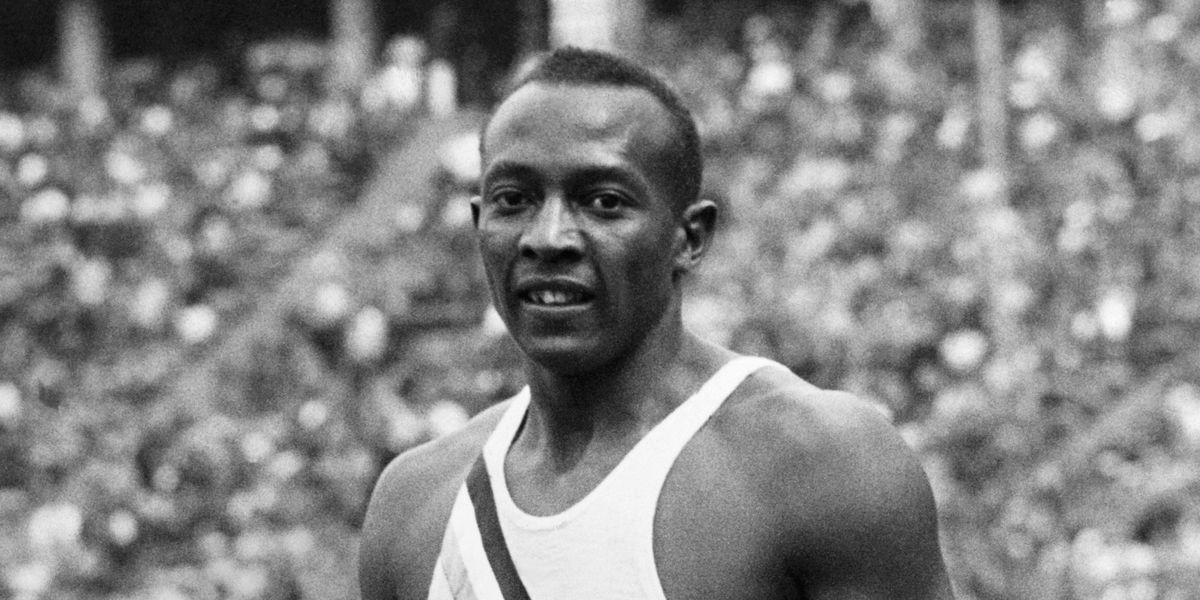
I'd bet there was less racial division in America in Jesse Owens' time than today.
He was really awesome! Helluva man.
I don't think you want to put money on that bet.
Jesse Owens: Olympic Triumphs and Olympic-Sized Struggles
The African American Olympic sprinter spent much of his life struggling with issues of race.
Jesse Owens, a record-breaking Olympic sprinter and the best athlete of his time, spent much of his life struggling with issues of race. Unlike other athletes of his era, Owens' day-to-day life was defined — and restricted — by his skin color. He suffered humiliating treatment even as he was revered as the most successful athlete of the day, winning four gold medals in the 1936 Olympics in Adolf Hitler's Germany. But the racism he experienced in a country on the brink of ethnic cleansing was hardly worse than what he faced back home in the United States.
For years after his athletic career winded down, Owens endured a personal struggle, leading him to prize wealth over principles as he criticized civil rights leaders of the late 1960s. In the decade before his death, his philosophy on race relations progressed, and he finally advocated the civil rights movement.
The African American Olympic sprinter spent much of his life struggling with issues of race.

www.biography.com
Athlete Jesse Owens: battling poverty and racial bigotry with sporting success
Reaching international heights, track and field athlete Jesse Owens would set the world record for long jump that would stand for 25 years. His four gold medals win at the Olympic Games in Berlin, during the Nazi regime, would bring him many adoring German fans. His victory - along with those of other African American athletes - questioned the Nazi propaganda on Aryan superiority.
After the Olympics
After the games had ended, the Olympic team was invited to compete in Sweden, but Owens decided he wanted to pursue financial gain by returning to the US to take up endorsement offers. He had continued to face discrimination throughout his athletic career, having to work to pay his way with no access scholarships. So when faced with endorsement opportunities, naturally he took it. This angered the US athletic officials who withdrew his amateur status, ending his career instantly.
Owens had returned to the US an international star yet had difficulty in finding work. He was banned from appearing at amateur sporting events to uphold his image and commercial offers disappeared. A few of his African-American teammates entered academia or held elected office, but many struggled to secure stable careers upon returning. Mack Robinson the silver medalist once used his Olympic jacket while working as a street sweeper to keep warm.
How Jesse Owens faced both Jim Crow and Hitler in a sporting environment

www.europeana.eu


 www.sportanddev.org